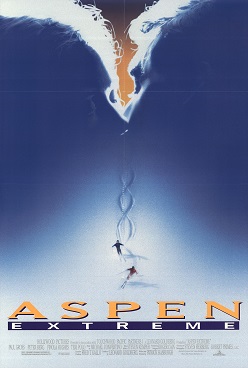
Aspen Extreme
1993
Directed by Patrick Hasburgh
Same disclaimer as always before we get started: this list is based entirely on my personal Flickchart rankings, which have been built over years of head-to-head matchups between movies I’ve actually seen. This is not an objective declaration that Aspen Extreme is the fourth-worst movie ever made, nor am I trying to offend anyone who loves it. If this is one of those movies you discovered at exactly the right age and you’ve been carrying a torch for T.J. Burke and the Powder 8 ever since, I genuinely don’t want to take that away from you.
Movies are subjective. This one just happens to be a movie I would rather not watch again.
I first saw Aspen Extreme sometime in the mid-1990s when it turned up on cable. I don’t remember exactly what prompted me to watch it. That’s probably appropriate because I don’t remember much about the experience beyond the skiing, the scenery, and a general feeling that I had spent a surprisingly long time watching people I didn’t care about do things I wasn’t invested in.
I watched it again several years ago. My opinion didn’t change. Sometimes a second viewing reveals something you missed the first time. Sometimes it confirms that you were paying attention just fine.
Welcome to Aspen. Try to Stay Awake.
Aspen Extreme was released in January 1993 and was written and directed by Patrick Hasburgh, making his feature directing debut. Paul Gross stars as T.J. Burke alongside Peter Berg as Dexter Rutecki, two friends who leave their automobile-plant jobs in Michigan and head west to become ski instructors in Aspen, Colorado. The story grew out of Hasburgh’s own experiences as a ski instructor, and much of the movie was filmed in and around Aspen.
That sounds like the beginning of a perfectly serviceable early-’90s movie. Two blue-collar guys decide they’re tired of the life they’re living. They head to Aspen. They meet attractive people. They ski. They have adventures. Presumably somebody learns something about friendship before the credits roll. I should be able to get on board with that.
I grew up during the era when movies routinely built entire plots around a couple of idiots going somewhere they probably shouldn’t. Heck, if I want to watch two friends go to Aspen, Dumb & Dumber exists. Harry and Lloyd may be profoundly stupid, but I care more about whether those two idiots stay friends than I ever cared about T.J. and Dexter. That’s the fundamental problem here. Aspen Extreme wants me emotionally invested in a friendship that never became emotionally interesting to me.
T.J. Burke Is Certainly a Person in This Movie
Paul Gross plays T.J., the more charismatic of the two friends. He adapts to Aspen fairly quickly, becomes a successful ski instructor and attracts the attention of both local radio personality Robin Hand, played by Teri Polo, and wealthy older socialite Bryce Kellogg, played by Finola Hughes.
T.J. also wants to be a writer. You would think that part might help. As someone who has spent a pretty significant portion of his adult life writing things and hoping people might eventually pay money to read some of them, I should be primed to connect with the struggling-writer subplot. Instead, every time the movie returned to T.J.’s writing ambitions, I mostly thought: Oh, right. He’s doing that too.
That’s not really Gross’s fault. I don’t think anybody in Aspen Extreme gives an embarrassingly bad performance. Nobody is chewing scenery like it’s the last edible thing on the mountain. Gross is perfectly capable. Peter Berg is perfectly capable. Teri Polo has some genuine warmth. The characters simply never become interesting enough for me to invest in them.
T.J. is presented as the guy we’re supposed to follow through this experience, but I never felt particularly curious about where he was going. If he succeeded, fine. If he failed, okay. If he became a ski instructor, writer, or regional manager at the Aspen Radio Shack, I probably would have reacted about the same way. That is not an ideal relationship to have with your protagonist.
Dexter Deserved a Better Movie
Dexter has the rougher journey. While T.J. thrives in Aspen, Dexter struggles. His social awkwardness becomes more pronounced, and he increasingly resents how easily his friend seems to adapt to their new environment. Eventually Dexter falls into drug and alcohol abuse before working his way toward recovery.
There’s real dramatic material there. A friendship changes when two people move into a completely different environment and discover that one of them belongs there more naturally than the other. One friend succeeds while the other feels himself slipping further behind. That could work.
But Aspen Extreme never got me invested enough in Dexter for the downward spiral to affect me. I knew what the movie wanted me to feel. That’s different from feeling it. And that distinction becomes considerably more important later.
Is This a Ski Movie, a Romance, or a Tragedy?
The movie also has a strange tonal identity problem. At first, Aspen Extreme feels like it wants to be escapist fantasy. Leave Detroit. Move to Aspen. Become a ski instructor. Meet beautiful women. Spend your life surrounded by spectacular mountains.
Then the movie starts layering heavier material onto that foundation. Dexter develops a drug problem. T.J.’s friendship with Dexter deteriorates. T.J. becomes involved with Bryce, whose interest in attractive ski instructors apparently rotates seasonally. Robin becomes the healthier romantic possibility waiting nearby. And eventually somebody dies in an avalanche. That’s quite a journey.
I don’t object to tonal shifts in principle. A comedy can become dramatic. A lightweight adventure can reveal something darker underneath. Movies don’t have to maintain the same emotional temperature from beginning to end. But the transition has to feel organic.
Here, I often feel as though I’m watching several different ideas compete for control of the same movie. There’s the aspirational ski movie. There’s the relationship melodrama. There’s the tragic friendship story. None of them became compelling enough to make me wish the movie would settle on one.
Robin Is Probably the Best Thing T.J. Has Going
Teri Polo’s Robin is at least likable. She and T.J. have decent chemistry, and under different circumstances I might have cared about whether they eventually found their way toward each other. Unfortunately, the Bryce storyline sits directly in the middle of it. Bryce is wealthy, older, and attracted to T.J. She is also more function than character. She’s there to represent temptation. She pulls T.J. away from Robin and contributes to his growing distance from Dexter. Eventually T.J. is supposed to understand that what he had with Bryce wasn’t meaningful and recognize that Robin offered something more genuine.
Okay. I understand the machinery. I can see the gears turning. I simply don’t care very much about what they’re operating. That’s the recurring problem with Aspen Extreme. I rarely find myself confused about what the movie wants me to feel. The movie is actually fairly clear about it. My emotions just refuse to cooperate.
At Least the Mountains Show Up for Work
There is one part of Aspen Extreme I will happily praise. It looks great. The scenery is gorgeous, and the skiing footage is legitimately impressive. Hasburgh knew this world personally, and the production made extensive use of real ski locations. Disney’s own historical entry for the film notes location shooting in Aspen, while the movie’s ski sequences used accomplished skiers and substantial mountain photography.
There are moments when I can absolutely understand why someone who loves skiing might have affection for this movie. Snow-covered mountains look spectacular on film. Good skiers are incredible to watch. There is an elegance to watching someone carve down a mountain at speeds that would cause me personally to make peace with my maker. I can appreciate all of that.
But if I specifically wanted to watch spectacular skiing, I could find Olympic highlights. A movie still needs the movie part. Beautiful scenery can enhance a story. It can’t substitute for my investment in that story.
That’s why the old description of Aspen Extreme as “Top Gun on the ski slopes” doesn’t work for me. A contemporary review also characterized the film as essentially Top Gun in the snow, while Vincent Canby of The New York Times criticized it as slow-moving and dramatically underdeveloped. I understand what the comparison is trying to communicate. Young guys. Competitive environment. Danger. Romance. Cool people doing something physically impressive.
But calling Aspen Extreme “Top Gun on skis” feels less like marketing and more like an insult to Top Gun. Maverick has presence. Goose has personality. That friendship matters. I care when things go wrong. Which brings us to Dexter.
And Then Dexter Dies
Eventually T.J. and Dexter repair their friendship enough to return to their shared goal of competing in the Powder 8. Before they get there, they ski outside the permitted boundaries and trigger an avalanche. Dexter dies. This is clearly intended to be the movie’s emotional gut punch. It wasn’t mine.
That sounds cold, and I don’t mean it that way. I am very capable of getting emotional when movies kill characters. Thomas J. in My Girl? Devastating. Shelby in Steel Magnolias? Absolutely heartbreaking. There are deaths in movies I’ve seen dozens of times where I know exactly what’s coming and still feel that familiar lump forming in my throat.
Dexter’s death left me almost completely unmoved. Not because the circumstances aren’t tragic. A young man dying in an avalanche is obviously tragic. But movies don’t get emotional credit merely for placing a tragic event into the screenplay. The audience has to care about the person before the tragedy occurs. By the time the avalanche arrives, Aspen Extreme is trying to withdraw emotional funds from an account I never deposited anything into.
Insufficient balance. Transaction declined.
T.J. Writes Something, So That’s Taken Care Of
After Dexter’s death, T.J. channels his grief into writing about their friendship, and the piece is ultimately published in a ski magazine after his earlier attempts at publication had gone nowhere. Again, on paper, that sounds like exactly the kind of thing that should work for me. Writing gives T.J. a way to process the loss. The relationship with Dexter inspires him to find his voice. His tragedy produces something meaningful.
And I’m sitting there thinking: Yep. That’s probably supposed to be poignant.
The problem isn’t that the idea is bad. It’s that the movie hasn’t earned enough emotional investment for the payoff to mean much. The writing subplot feels less like a culmination and more like the screenplay checking a box it introduced earlier. Writer subplot? Resolved. Next.
Please Welcome Dexter’s Replacement
Then we get the Powder 8. This has been the shared dream. T.J. and Dexter wanted to compete together. Dexter is dead. So the movie gives T.J. another partner. They win. Again, I understand what I’m supposed to take from this. T.J. is carrying Dexter’s memory with him. The victory is bittersweet because his friend isn’t there to share it.
But I had such little investment in the competition that the victory itself didn’t land. A new partner arrives, T.J. skis, they win, and the movie seems to be waiting for me to feel satisfied. I’m still waiting.
Maybe if the friendship between T.J. and Dexter had hit me harder, the replacement partner would have emphasized the absence. Maybe if I had cared more about the Powder 8 itself, winning would have meant something. Instead, I mostly watched it happen. That phrase could summarize most of my relationship with this movie. I watched it happen.
Hey, Isn’t That the Friday Night Lights Guy?
There is one thing about Aspen Extreme that has remained lodged in my brain. Peter Berg. Years after seeing this movie, I watched Friday Night Lights when it came out in 2004 and learned that Berg had directed it. My first thought was: Wait. Isn’t that the Aspen Extreme guy?
Yes. Yes, he was.
Berg went on to establish a substantial career behind the camera, and Friday Night Lights became one of his defining directing credits. He later helped develop the television version as well. I don’t say that as some kind of backhanded compliment. People’s careers evolve. An actor in a movie I barely remembered eventually became a filmmaker whose work I recognized immediately. That’s actually pretty cool. It is also somehow one of my strongest memories connected to Aspen Extreme. Not an ideal sign for Aspen Extreme.
Even 1993 Had Better Options
I also can’t really defend this movie through nostalgia. I am extraordinarily vulnerable to nostalgia. You show me the right early-’90s movie, and I will forgive enormous amounts of nonsense simply because the clothing looks familiar and somebody is listening to music I remember hearing on the radio.
But if I wanted to spend an evening revisiting the movies of the early 1990s, Aspen Extreme would be nowhere near the front of the line. There are too many other movies from that era that make me feel something. Something funny. Something exciting. Something warm and familiar. Aspen Extreme mostly makes me wonder how much longer is left.
The movie runs 113 minutes according to Box Office Mojo. It feels considerably longer. There are two-hour movies I wish would keep going. This isn’t one of them.
Critics Weren’t Exactly Doing Backflips Either
It’s always interesting when I reach one of these movies and discover that contemporary critics more or less understood what bothered me. Vincent Canby’s 1993 review for The New York Times criticized the film as dramatically underdeveloped despite its near-two-hour running time. Other reviews praised the ski footage more readily than the story, which is pretty much where I land decades later.
Commercially, Aspen Extreme wasn’t a major hit either. Box Office Mojo lists a little over $8 million in domestic grosses, while The Numbers places its 1993 theatrical total just under that figure depending on its reporting methodology. I don’t bring that up to say box office validates my opinion. Plenty of great movies fail financially. Plenty of terrible movies make fortunes. Money tells us how many tickets were sold, not whether a movie was good.
Still, Aspen Extreme does seem to have become one of those movies remembered most strongly by a relatively small group of viewers who caught it at the right moment. If you’re one of them, I salute you. You can have my copy.
Why It Lands at Number Four
Like I said at the beginning, Aspen Extreme didn’t end up at number four because I constructed some complicated rubric and carefully measured how many points it lost for dull characters. Flickchart did this. Over years of head-to-head matchups, Aspen Extreme simply kept losing. Would I rather watch this or that? That. How about this one? The other one. Surely Aspen Extreme can beat something. Apparently not very often. That’s how a movie winds up this close to the bottom.
I don’t passionately hate Aspen Extreme. That’s almost the problem. There are movies I dislike that at least inspire a reaction. They make me angry. They make me laugh at their mistakes. They leave me with something to argue about afterward. Aspen Extreme mostly leaves me indifferent. The skiing is impressive. The scenery is beautiful. The people making it clearly knew and loved the world they were depicting. I just don’t care about the characters inhabiting that world.
Dexter dies, and I don’t feel much. T.J. gets published, and I don’t feel much. T.J. wins the Powder 8, and I still don’t feel much. A movie can survive an implausible plot. It can survive a ridiculous premise. It can survive characters making questionable decisions. Indifference is much harder to overcome.
That’s why Aspen Extreme keeps losing. And unless Flickchart suddenly pairs it against something truly catastrophic, I suspect it will continue to do so.
Next Time on Movie Monday
Next week, we leave the mountains behind and continue toward the very bottom of the list. Number three takes us on a road trip with an old friend from my childhood. Or at least someone who looks and sounds a lot like that old friend. I grew up loving Pee-Wee Herman, which means nostalgia should have given his return every possible advantage. Unfortunately, nostalgia can only carry a bicycle so far. Next week: Pee-Wee’s Big Holiday. Let’s see what happens when a movie spends an awful lot of time reminding me how much I liked a better one.
What did you think of Aspen Extreme? Do you have fond memories of catching it on cable or VHS in the ’90s? Are the skiing sequences enough to make the movie work for you, or did you also find yourself struggling to care about T.J. and Dexter? Drop a comment below and let me know.

