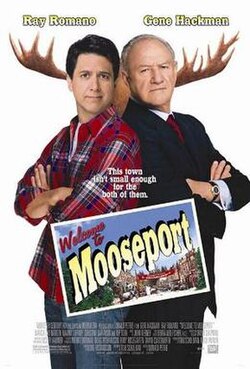
Welcome to Mooseport
2004
Directed by Donald Petrie
Before we go any further, the standard disclaimer applies: everything you are about to read represents my own opinion, shaped by my own particular experience with this film, and none of it is intended as a criticism of anyone who genuinely loves Welcome to Mooseport. Maybe it holds a warm spot in your early 2000s memories. Maybe you find it charming in exactly the way I could not. That is entirely valid, and I am not here to take it from you.
What I am here to do is talk about a film that assembled a genuinely impressive collection of talented people, handed them a premise with real comedic potential, and then proceeded to do almost nothing interesting with any of it. That is a specific kind of disappointment, and it earns a specific kind of place on this list.
There is also something that needs to be said at the outset, and I want to say it with appropriate weight: Welcome to Mooseport was Gene Hackman’s final film. He retired from acting after this role, citing health reasons, and he passed away in February 2025 at the age of 95. By any measure, Hackman was one of the finest actors of his generation — a two-time Oscar winner whose career spanned six decades and produced some of the most memorable performances in American cinema. He deserved a better film to close out that career, and the fact that this is the last one makes watching it a stranger, more melancholy experience than it might otherwise have been. I will get to all of that. But first, let me back up.
How I Got Here
I did not see Welcome to Mooseport in theaters. I caught it on cable at some point after the fact, the way you ended up seeing a lot of films from that era — channel surfing, landing somewhere in the middle of something, deciding to stay just long enough to find out what was going on. By the time I had assembled the full picture, I had formed an opinion. That opinion has not shifted.
Welcome to Mooseport was released on February 20, 2004, by 20th Century Fox. It was directed by Donald Petrie, written by Tom Schulman, and produced on a budget of $30 million. It grossed approximately $14.6 million worldwide. That is not a misprint. The film made back less than half of what it cost to produce, making it a genuine box office disappointment by any reasonable measure.
The premise, to give it its fair due, is not without charm on paper. Monroe “Eagle” Cole, a former U.S. president played by Hackman, retires to his vacation home in the small Maine town of Mooseport following a bruising divorce. When the town’s mayor unexpectedly dies, the local council approaches Cole about running for the office — partly out of flattery, partly because it would solve a practical problem he has with his ex-wife regarding the property. Cole agrees. The complication arrives in the form of Harold “Handy” Harrison, a mild-mannered local plumber and hardware store owner played by Ray Romano, whose name has also been entered into the race and who has his own personal reasons for not backing down.
There is a version of this story that works. A politically savvy Washington veteran crashing into small-town democracy, completely unprepared for the intimacy and stubbornness of local politics, going up against a genuinely decent everyman who simply refuses to be outmaneuvered — that is a real movie. It is a movie worth making. This is not that movie.
The Hackman Problem (Which Is Really a Script Problem)
Let’s talk about Gene Hackman, because any honest discussion of Welcome to Mooseport has to start there.
Hackman won his first Academy Award for The French Connection in 1972, playing hard-nosed New York detective Jimmy “Popeye” Doyle in one of the most electrifying lead performances of that decade. He won his second Oscar for Unforgiven in 1993, this time as the brutal and terrifying Sheriff Little Bill Daggett. Between and beyond those two poles, he gave memorable performances in The Conversation, Hoosiers, The Royal Tenenbaums, and dozens of other films. He was the kind of actor who made every scene he appeared in feel more substantial, more lived-in. You believed him in ways you did not always believe other actors, because he did not seem to be performing. He seemed to simply be.
In Welcome to Mooseport, he is clearly trying. He is giving the role real work. And it does not matter, because the screenplay cannot meet him at the level he is operating on. The film positions Monroe Cole as a larger-than-life figure who is also, somehow, the kind of person who gets flustered by a small-town election and slowly develops feelings for his long-suffering executive secretary Grace Sutherland, played by Marcia Gay Harden. The character asks Hackman to be both commanding and bumbling, both worldly and naive, and never makes a convincing case for why he is any of those things at any particular moment. Cole is a collection of plot functions wearing a presidential suit.
There are moments where you can see what a better film might have done with this casting. Roger Ebert, in his three-star review — yes, three stars; we will get there in a moment — wrote that Hackman “could charm the chrome off a trailer hitch,” and that is not wrong. The charm is there. The presence is there. The tools are all on the table. The carpenter just didn’t show up.
The Romano Mismatch
Ray Romano is a genuinely funny person. Everybody Loves Raymond, which ran on CBS from 1996 to 2005, built nine seasons of durable domestic comedy around his specific gifts: the slightly overwhelmed delivery, the long-suffering quality, the sense of a man perpetually outnumbered by his own life. He is good at playing someone ordinary in recognizable, relatable ways.
The problem is that Welcome to Mooseport does not really ask him to do that. It asks him to be a romantic lead, a political underdog, and a lovable everyman hero in a David-and-Goliath narrative, all at the same time. Those are not quite the same job. Romano does his best, and his best is genuinely decent in places. But the character of Handy Harrison is more outline than person, and when he shares the screen with Hackman, the gap in gravity between them is hard to ignore. Not because Romano is untalented, but because Hackman simply operates at a different atmospheric pressure, and the film pits them against each other without finding a way to make that imbalance dramatically interesting.
The Seattle Post-Intelligencer’s William Arnold put it plainly enough in his review at the time, writing that the film is “glaringly lopsided” and that Hackman “chews him up and spits him out so effectively” that Romano’s central role suffers for it. That is a bit harsh on Romano personally, but the structural observation is correct. When your everyman protagonist gets consistently overshadowed by the person he is supposed to be the underdog against, the underdog story stops working.
The Film’s Identity Crisis
Welcome to Mooseport does not know what kind of movie it wants to be, and it never makes up its mind.
There are stretches that play as political satire — the absurdity of a former president’s vast campaign apparatus descending on a tiny Maine town to fight over the mayorship, the gap between Washington-style strategy and local expectations. Rip Torn, playing Cole’s campaign strategist Bert Langdon, has some fun with this material. Those moments work.
And then the film pivots entirely into romantic comedy territory, and the satire evaporates. Cole and his secretary. Handy and his girlfriend, local veterinarian Sally Mannis, played by Maura Tierney. Proposals. Misunderstandings. Tender reconciliations. The movie wants you to be invested in both storylines simultaneously, but the tonal gears grind every time it shifts. When you are watching a political comedy about the absurdities of small-town democracy, having it interrupt itself for romantic subplot mechanics is not a relief. It is a distraction.
The film is also not sharp enough in its political satire to justify the label. A genuinely incisive political comedy would have something to say about the way power and celebrity warp even the most minor democratic processes. Welcome to Mooseport gestures in that direction occasionally, particularly in the sequence where Cole’s full campaign infrastructure arrives in town and turns a local election into a media event, but it backs away from the implication every time it gets close. The movie is too interested in being likable to commit to being pointed.
What Actually Works
In the spirit of fairness this series has always tried to maintain:
The supporting cast is genuinely solid. Marcia Gay Harden does everything she can with Grace Sutherland, bringing a warmth and dry wit to a character who mostly exists to be devoted and eventually rewarded for it. Maura Tierney is credible as Sally, though the film frequently forgets to give her anything to do beyond react. Christine Baranski, playing Cole’s monstrous ex-wife Charlotte, is having a transparently wonderful time and is all the better for it. Baranski has a gift for playing a certain kind of elegantly terrible person, and she deploys it here to consistent effect. Fred Savage, in an early post-Wonder Years career move, shows up as a presidential aide and acquits himself respectably.
And Hackman, even in a film that does not deserve him, is still Hackman. There are individual scenes — a golf sequence, a televised debate — where he finds the right register and the movie briefly becomes what it could have been throughout. Those moments are worth noting, even if they also make the rest of the film more frustrating by comparison.
On the Ebert Problem
Roger Ebert gave Welcome to Mooseport three out of four stars, and I want to address that directly, because it is the kind of critical disconnect that tends to follow this film around.
Ebert’s argument was essentially that the film’s success depends entirely on the charm of its actors, and that Hackman’s charm is formidable enough to carry it. He is not wrong about the charm, and he is not wrong that Hackman elevates the material. But three stars implies a film that largely succeeds at what it is attempting, and Welcome to Mooseport does not succeed. It coasts. There is a difference between a film that works and a film that is pleasant enough to sit through because its lead actor is compelling. Hackman being Hackman does not redeem a screenplay that squanders him.
The Rotten Tomatoes consensus, which sits at 13% and describes the film as “a bland comedy that squanders a talented cast,” is closer to the mark. That is essentially the case against this movie in a single sentence.
The Real Disappointment
When Gene Hackman passed away last year, a lot of retrospectives made note of the fact that Welcome to Mooseport was his final film. Several of those pieces asked, with genuine regret, whether this was really the note a career like his deserved to end on. The answer is obviously no. The French Connection, Unforgiven, The Royal Tenenbaums — a career that included those films deserved to close on something that gave its star room to do what he did best.
What makes Welcome to Mooseport frustrating rather than merely bad is that it was not inevitable. The casting of Hackman alongside Romano was not inherently a mistake. The small-town political fish-out-of-water premise was not inherently played out. The film had real ingredients. It just never found a reason to be anything beyond agreeable, and in the search for agreeableness, it let everything interesting slip away.
Somewhere in Mooseport, Maine, Monroe Cole is probably doing fine as mayor. The movie that sent him there was not.
Next Time on Movie Monday
We are continuing down the list next week, and things are about to get considerably more grotesque. Number 15 takes us into sequel territory — specifically the kind of sequel that strips away everything that made its predecessor great and replaces it with pure body-horror spectacle. The Fly II from 1989, directed by Chris Walas, is what happens when a deeply human story about love, loss, and transformation gets handed off to the creature effects department and asked to just… do that again, but louder. Eric Stoltz, Daphne Zuniga, and one truly memorable ending await you. Come prepared.
 The Confusing Middle