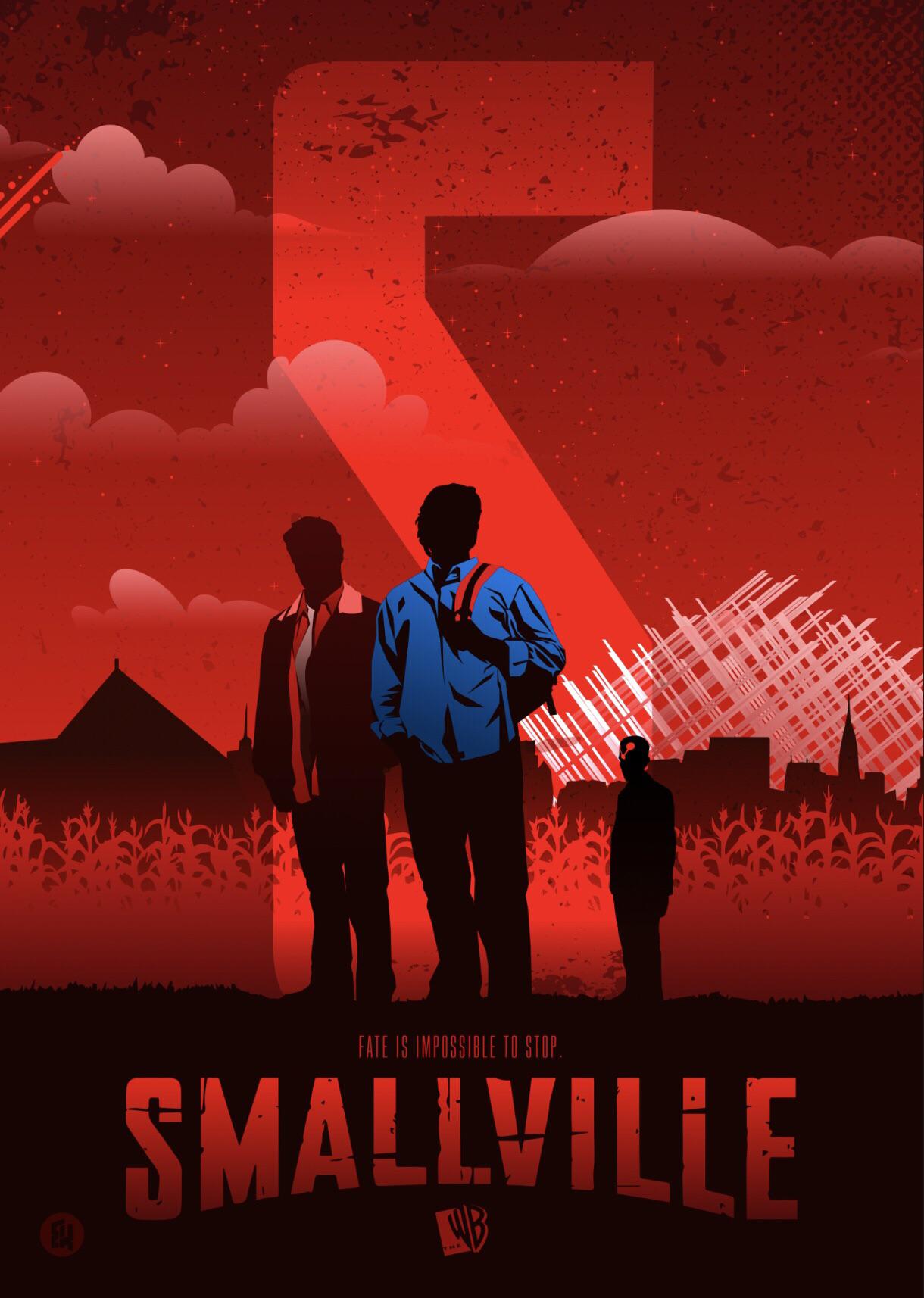
Welcome back to Rewatching Smallville, my weekly dive into the iconic series that explores Clark Kent’s journey before becoming Superman. Whether you’re a long-time fan or new to the show, you’re invited to join in each Tuesday as I revisit episodes and share my thoughts and observations. Be sure to share your own memories and theories in the comments below!
Last week, “Fade” gave us Clark walking in on Lex and Lana and quietly falling apart about it, while a hitman with a warm heart and an invisibility power tried to solve Clark’s romantic problems in the most catastrophically wrongheaded way possible. The episode also gave Chloe Sullivan her first front-page Daily Planet byline, which the show took the time to actually celebrate. It was a contained, emotionally confident hour that used a villain-of-the-week framework to put Clark’s most personal wound directly in front of him.
This week, the season’s final chapter begins.
“Oracle,” the 21st episode of Season Five and the 109th episode overall, aired on May 4, 2006. Written by Caroline Dries from a story by Neil Sadhu and Daniel Sulzberg, and directed by Whitney Ransick, it is functionally the penultimate episode of the season — and it knows it. The mythology pieces have been in motion all year, and “Oracle” is where the board gets arranged for the endgame. What makes it more than just a table-setting exercise is that it arranges those pieces around two things that matter equally: Clark’s nineteenth birthday, and a ghost that isn’t his father.
Happy Birthday, Clark. Sort Of.
The episode opens on a birthday party. Martha, Chloe, and Lois have thrown Clark a small surprise gathering at the Kent farmhouse, complete with a lopsided rum cake that Lois baked from scratch and clearly needed a few more trial runs. The birthday banner is made in Superman colors — blue, red, and yellow — which is a nice touch whether the production designer did it consciously or not. The episode notes that Clark celebrates May 3rd as his birthday, which is consistent with the show’s established timeline for the character.
It’s a warm scene, and the show is smart enough to let it breathe for a moment before quietly acknowledging what’s missing. Jonathan Kent is not there. There is a card from Martha that Jonathan had already bought before his death, tucked inside of which are two baseball tickets. Clark receives this with more grace than you’d expect from someone whose father died a few months earlier and is watching his nineteenth birthday being marked without his dad. The show doesn’t underline the ache too heavily, but it’s present in every frame of the sequence.
Clark takes the tickets to the cemetery later that night. He’s there to thank Jonathan. And that’s when Jonathan appears.
The problem, of course, is that it isn’t Jonathan.
The Ghost and the Con
The central device of “Oracle” is an old one: the specter who appears to deliver a message and slowly reveals, through what the message actually asks, that something is wrong. Clark is visited by what appears to be his father’s ghost, and Jonathan tells him that he must kill Lionel Luthor. Jonathan appears again to Martha with the same message. Martha tells Clark. Clark begins to act on it.
The unmasking — that “Jonathan” is actually Brainiac, James Marsters’ artificial intelligence villain who has been operating throughout Season Five under the human alias Milton Fine — lands with weight because the show has done the necessary work. Brainiac has spent the whole season constructing a plan to use Clark as a vessel for General Zod. He has been working with Lex, gathering deadly viruses, and operating with the particular patience of a machine that doesn’t have to worry about running out of time. Using Jonathan Kent’s face against Clark is arguably the cruelest play in his entire Season Five toolkit, and the episode treats it that way.
John Schneider, who played Jonathan Kent as a series regular before Jonathan’s death in “Reckoning,” gets to do something genuinely interesting here. He is playing Brainiac playing Jonathan. The warmth that made Jonathan feel real across four-plus seasons is present, slightly wrong — too insistent, too specifically focused on a single violent outcome. Schneider has always been a reliable presence on this show, and the fact that his return is as the villain in disguise gives the episode a layer of discomfort that a straightforward ghost story wouldn’t have.
The unmasking scene is one of the episode’s best pieces of staging. Clark is in the barn, increasingly convinced that Lionel did something to contribute to Jonathan’s death — Chloe finds phone records indicating Lionel and Jonathan were in contact in the weeks before he died, with a final call coming an hour before Jonathan’s fatal heart attack. Clark is emotional, not thinking clearly, letting grief do what grief does. He confronts Lionel. “Jonathan” is there, urging him on. And then Lionel, possessed by Jor-El, touches the apparition and Brainiac’s disguise dissolves.
It’s Lionel who ultimately dispatches the construct. Which is its own kind of reversal for a character who has spent most of his time on this show functioning as an ambient threat.
What Lionel Actually Knows
The Lionel material in “Oracle” is among the most interesting the show has given John Glover this season. Up to this point, Lionel’s shift from antagonist to something more complicated has been gradual and not always convincing. Here, the episode does something that snaps it into focus.
After the confrontation in the barn, Lionel takes Clark to his office and opens a closet. Inside are stacks and stacks of paper, all covered in Kryptonian symbols that Lionel has been compulsively writing without knowing why — his role as Jor-El’s vessel, which began back in Season Four’s “Commencement,” manifesting on the page. He doesn’t fully understand what he’s been channeling. He gives it all to Chloe, who has been quietly becoming the show’s most reliable decoder of Kryptonian material, and asks her to make sense of it.
Lionel also tells Clark something he didn’t have to tell him: that he did speak to Jonathan the night Jonathan died. He was there to tell Jonathan he knew Clark’s secret. Jonathan was furious and didn’t let him explain. Lionel says this to Martha by the episode’s end, standing in the Kent farmhouse with his hat in hand, and he doesn’t try to spin it. He says it and leaves.
Whether that amounts to anything close to redemption is a question the show has been circling for a while now. What it does is make Lionel’s position in the Season Five finale — standing between Clark and the worst possible outcome — feel earned rather than convenient. John Glover has been playing this transition with more patience than the plot sometimes deserves, and “Oracle” is one of the episodes that rewards him for it.
Lex and Fine: The Endgame Begins
While Clark is navigating grief and manipulation, the other half of the season’s conspiracy reaches its critical turn.
Lex has spent the season convinced that he and Fine are collaborators with a shared goal: developing a vaccine that could protect humanity against alien invaders. He has been gathering viruses, funding research, and rationalizing increasing amounts of ethical compromise as necessary costs of saving the world. When Fine arrives at the lab in “Oracle,” Lex is prepared to confront him. He opens a lead-lined box to test whether Fine has a meteor-rock vulnerability, which is a smart move and a fair indicator of how far Lex’s suspicion has developed.
Fine is unimpressed. He tells Lex, simply and without apparent malice, that he is not Kryptonian — he was made by Kryptonians. A blade forms from his arm. He takes the vaccine.
And then Fine injects Lex.
The twist is not that the vaccine is actually a weapon. The twist is that it works. By the end of the episode, when Lex cuts his finger on a corkscrew, the wound heals immediately before his eyes. Whatever Fine put in that syringe, Lex Luthor now has a superhuman healing factor. The season finale has its vessel.
Michael Rosenbaum has been doing remarkable work across Season Five playing a Lex who wants to be a hero and keeps making choices that make heroism less available to him. The final beat in this episode — Lex staring at his healed finger with an expression that holds both wonder and the first faint awareness that something has gone irreversibly wrong — is one of the better pieces of acting the show has given him this year.
Clark’s Birthday, Continued
There’s a scene late in the episode that earns its place because of what it doesn’t do.
Lois finds Clark in the loft — the show’s default location for Clark when he’s sitting alone with his feelings — and she asks him what’s wrong. Clark tells her he’s upset about Lex and Lana. Lois listens, and then says something that the show frames as comfort but is also just quietly true: maybe Lana isn’t the one who was meant for Clark. Maybe he’s been waiting for something better.
The scene is careful. It’s not setting up a romantic subplot. It’s not winking at the audience. Erica Durance plays it as someone genuinely trying to help a friend she’s developed a real affection for, and the show allows the moment to be exactly that — two people sitting in a loft, one of them having a rough birthday, the other offering the best version of what she has to give.
Then Chloe arrives, and Lois exits, and Chloe does her own version of the same thing. She reminds Clark that Jonathan’s most important gifts to him weren’t the baseball tickets. They were everything he built into Clark across nineteen years. She is right, and the show knows she is right, and Allison Mack doesn’t oversell it.
It’s a quiet birthday, all things considered. Not the worst kind.
The Hamlet Question
The episode gets one of its most enjoyable moments from a single line of Chloe’s dialogue.
When Clark tells her about seeing Jonathan’s ghost and asks if she thinks Jonathan is trying to warn him about Lionel, Chloe asks if he’s sure his dad is “Hamlet-ing” him — and then says, “Hand me a cloak and call me Horatio.” It’s a quick, smart allusion. In Shakespeare’s Hamlet, the murdered King Hamlet appears to his son as a ghost to demand revenge, and Horatio is Hamlet’s closest friend, the one who stays rational when everyone else is spinning out. The parallel is obvious and earns the joke. Chloe is always the Horatio in the room.
The title of the episode works on two levels that the show acknowledges explicitly. Lionel tells Clark that the Kryptonian voice channeling through him must be meant for Clark — that Lionel is functioning as an oracle in the classical sense, a vessel for a message not his own. The episode also drops in a brief note that in DC Comics, “Oracle” is the code name for Barbara Gordon after she stopped operating as Batgirl. That’s a footnote rather than a thematic point in this episode, but it’s the kind of continuity nod that the show enjoys dropping in for the comics-fluent viewer.
What the Birthday Actually Cost
Stepping back from the individual pieces, “Oracle” is doing something structurally generous for a penultimate episode: it insists on treating Clark’s emotional life with the same weight as its mythology plotting, even when the mythology is accelerating toward a finale.
Clark’s nineteenth birthday is marked by a party with no father present, by receiving a gift Jonathan bought before he died, by visiting a grave, and by being manipulated by something wearing his father’s face. None of that is accidental. The episode keeps returning to what it means to be Clark Kent at nineteen — not yet Superman, not still a kid, standing in a world that keeps asking more of him than any reasonable person could be asked to give.
The show has always been at its best when it treats that position with genuine seriousness rather than just using it as backdrop for whichever villain arrived that week. “Oracle” keeps both things running simultaneously and mostly succeeds.
Where This Leaves Us
“Oracle” ends with Chloe identifying a repeating pattern in Lionel’s Kryptonian notes, and Clark translating it.
Two words. That’s all it says, and that’s all the episode needs to say. The season finale — “Vessel” — is next, and whatever is coming has been announced.
This is a strong penultimate episode in the way that good penultimate episodes tend to be: it doesn’t try to deliver the payoff, but it makes sure every element is precisely where it needs to be when the payoff arrives. Brainiac’s deception is exposed but the damage is done. Lex has been transformed. Clark has survived another birthday. Lionel has told the truth about something he could have kept quiet.
And two words are now hanging over everything.
Next week, “Vessel.”
What did you think about Brainiac using Jonathan’s face to manipulate Clark — cruel master stroke or one step too far? And how did it feel watching Clark spend his birthday finding out his dad’s ghost was never his dad? Share your thoughts in the comments below!

