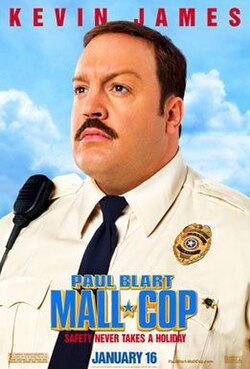
Paul Blart: Mall Cop
2009
Directed by Steve Carr
Same disclaimer as always, because I know there are bound to be people who love this movie: this list comes straight from my Flickchart rankings, built from thousands of head to head matchups between films I’ve actually watched. It isn’t a verdict on quality, and it definitely isn’t a judgment on anyone who has this one in their comfort watch rotation. If Paul Blart got you through a sick day home from school or a long car ride as a kid, I’m not here to take that away from you. I’m only explaining why, on my own personal scoreboard, this one landed at number seven.
A Joke Stretched Past Its Breaking Point
Here’s my honest problem with Paul Blart: Mall Cop. The premise is a single joke, and the joke is that this guy takes his job way too seriously. That’s it. That’s the whole engine. A security guard with hypoglycemia and a Segway believes, with total sincerity, that his mall is worth defending like it’s a border crossing. There’s a version of this movie that mines real comedy out of that gap between how seriously Paul takes himself and how little anyone else does, and every so often the film stumbles into that version by accident. But mostly it just repeats the joke, louder, for ninety minutes, and expects the repetition itself to be funny.
I don’t think Kevin James is the problem here. He’s clearly having fun, and there’s a sincerity to his performance that a handful of critics picked up on even while panning everything around it. The Chicago Sun-Times gave the film three stars specifically because it found the comedy wholesome rather than mean-spirited, and I understand that read. But wholesome and funny aren’t the same thing, and a movie can be perfectly pleasant company without earning much of my attention once the credits roll.
What’s Actually Going On Here
The plot, for anyone who needs the refresher: Paul Blart lives with his daughter Maya and his mother in West Orange, New Jersey, and dreams of joining the state police. His hypoglycemia derails him during the academy’s physical fitness test, so he settles into mall security work instead, patrolling the West Orange Pavilion Mall on his Segway and half-heartedly training a new recruit named Veck Simms who clearly isn’t interested in the job.
Paul also has his eye on Amy Anderson, who runs a kiosk in the mall, and the movie spends its first act on the two of them circling each other, including a genuinely uncomfortable dinner scene where Paul mistakes margaritas for lemonade during a nacho eating contest and ends up crashing through a window. It’s the kind of scene that tells you exactly what kind of movie you’re watching before the plot even shows up.
The plot, when it finally arrives, kicks in on Black Friday. A crew disguised as Santa’s Village workers takes over the mall, holds a group of employees hostage in the bank, and seals off the exits with motion sensors. Veck turns out to be running the whole operation. Paul, oblivious as always, wanders back into the mall after a round of Rock Band and realizes something is very wrong. What follows is Die Hard scaled down to food court size, with Paul improvising his way through the mall to take out Veck’s crew one at a time while a corrupt SWAT commander who bullied him in childhood tries to stop him from actually helping. It escalates to a chase, a betrayal, a rescue, and a proposal on matching Segways, which is either the most romantic or the strangest image in the entire film depending on your mood.
None of that is a bad skeleton for a movie. Die Hard in a mall is a perfectly good pitch. The trouble is that the execution never trusts the premise enough to let it breathe. Nathan Rabin’s review for The A.V. Club nailed this when he called the back half a stale riff on Die Hard, and I think that’s exactly right. The film knows what movie it’s imitating. It just never figures out what it wants to add to the formula beyond a Segway and a guy with low blood sugar.
The corrupt cop subplot is a good example of the movie having a genuinely interesting idea and then doing almost nothing with it. Bobby Cannavale plays Commander James Kent, a former childhood bully of Paul’s who now leads the SWAT response and turns out to be working with Veck the whole time. That’s a solid twist on paper. It gives Paul an adult version of the exact kind of authority figure who dismissed him his whole life, and it raises the stakes of his rescue attempt in a way the film could have leaned into much harder. Instead, Kent mostly just stands around barking orders and rolling his eyes at Paul until the reveal happens, and once it does, the confrontation resolves in about the length of a commercial break. There’s a sharper, meaner version of this movie buried somewhere in that relationship, and I kept waiting for it to surface.
Veck himself suffers from the same underdevelopment. Keir O’Donnell plays him as a smirking, disaffected young employee who Paul is training and clearly doesn’t respect, which should set up some real tension once he’s revealed as the mastermind behind the whole heist. But the movie never bothers connecting those dots emotionally. Veck’s betrayal doesn’t sting because the film never gave us a reason to trust him beyond basic workplace politeness in the first place. He’s a plot device wearing a Santa’s Village name tag, and once his job is done, so is his character.
The Story Behind the Camera
A few production details are worth knowing, because they explain some of the choices on screen better than the finished film does on its own.
Kevin James co-wrote the script with Nick Bakay and produced the film alongside Adam Sandler’s Happy Madison Productions, which tells you a lot about the comedic DNA running through it even without Sandler appearing on screen. Steve Carr directed, working from a production that started shooting in late February 2008 in the Boston area. The filmmakers had originally hoped to shoot at Willowbrook Mall in Wayne, New Jersey, but were denied a permit there, so production shifted to the Burlington Mall in Burlington, Massachusetts instead.
That location swap meant transforming a working Massachusetts mall into a fictional New Jersey one, complete with holiday decorations installed from late February through mid April, a prop ball pit near the Sears entrance, and a full Santa’s Village built at the opposite end of the mall. Most of the interior filming happened overnight so the crew could work without shutting the mall down during business hours, and some of the more elaborate stunt work, including Paul’s scuffle in the scenic elevator, was shot separately at the South Shore Plaza in Braintree because the Burlington Mall’s layout couldn’t accommodate it.
There’s something almost funny about how much effort went into faking a mundane New Jersey mall on a soundstage-adjacent scale, all in service of a movie whose entire comedic conceit is that nothing about this mall is actually worth defending. The production clearly believed in the bit more than I do.
It’s also worth pointing out how squarely this film sits inside the Happy Madison house style of the late 2000s, even without Adam Sandler in the movie. The formula is recognizable if you’ve seen almost anything else the studio was putting out around that era: a broad, lovable everyman lead, a workplace or small town setting treated like its own little universe, a love interest who exists mostly to validate the protagonist’s decency, and a plot that escalates into something far more dangerous than the tone of the first act would suggest. Paul Blart follows that shape closely enough that you could almost predict certain beats before they happen, and I don’t think that’s a coincidence. This was a movie built on a formula that had already proven itself reliable, and the studio wasn’t interested in reinventing anything.
Where It Landed With Everyone Else
Critics were not kind to this one, and the numbers back that up plainly. Rotten Tomatoes puts the film at 34 percent positive across critic reviews, with a consensus that credits it with some laughs while dinging the flimsy plot and lack of comic momentum. Metacritic landed at 39 out of 100 for what it classifies as generally unfavorable reviews. Peter Travers at Rolling Stone gave it one star out of four and had little patience for the juvenile humor. Variety‘s Brian Lowry was blunter still, calling it an almost shockingly amateurish one note joke of a comedy.
Not everyone piled on. James Berardinelli found something to like in Paul Blart as a character even while acknowledging the tone skewed young, and called it a reasonable pick for an undemanding night at home. Roger Ebert gave it three stars and singled out the film’s wholesome quality as a point in its favor, which feels like a real outlier among the reviews I dug up but also tracks with Ebert’s long standing soft spot for earnest, unpretentious comedy.
Audiences liked it a great deal more than critics did. CinemaScore polling gave the film a B grade, and the box office numbers tell an even clearer story. Paul Blart: Mall Cop opened at number one over Martin Luther King weekend in January 2009, pulling in just under $32 million over the traditional three day frame and nearly $39 million across the full four day holiday weekend, which made it the second best MLK weekend opening of all time behind Cloverfield. It held onto the top spot for a second weekend before eventually settling into a long, steady theatrical run that carried it past $146 million domestically and roughly $186 million worldwide, all against a modest $26 million budget. It also topped the DVD sales charts in its first two weeks of home release, which is the kind of detail that tells you this was never a movie built for critics in the first place. It was built for exactly the audience it found, and that audience showed up in a big way.
That gap between critical and audience reception is worth sitting with for a second, because it’s not really a mystery. This is a movie engineered from the ground up to be inoffensive, family friendly, and easy to half watch on a Saturday afternoon. It succeeded enormously at being exactly that. It just never had much interest in being more than that, and that’s the part that keeps it from climbing any higher on my list.
The commercial success also explains why this franchise didn’t stay a one and done. Sony was reportedly interested in a follow up almost immediately after the first film’s release, though it took years for that interest to turn into an actual production. A sequel eventually went into development, with Kevin James returning to co-write and star and Andy Fickman stepping in to direct, and Paul Blart: Mall Cop 2 arrived in theaters in the spring of 2015, six years after the original. I haven’t ranked the sequel on my Flickchart list because I have never seen it, but the fact that the studio waited six years to greenlight a follow up to a movie that made $186 million worldwide tells you something about how little urgency there was behind expanding this particular world. The first film made its money and said what it had to say. Everything after that felt more obligatory than inspired.
Why It Lands at Number Seven
When I think about why Paul Blart sits where it does for me, it isn’t really about mean spiritedness or incompetence, because the movie is neither of those things. It’s a perfectly pleasant, harmless comedy that clearly wanted to make people smile and largely succeeded at that specific, modest goal. My issue is that a ninety minute movie built around a single character trait needs that trait to evolve somehow, and Paul never really changes across the runtime. He’s earnest and overzealous in the first scene and he’s earnest and overzealous in the last one, just with better lighting and a proposal attached.
I don’t need every comedy to have a character arc worthy of prestige drama. I do need enough forward motion that the ending feels like it was earned rather than just arrived at once the plot ran out of hostages to rescue. Paul Blart: Mall Cop never quite finds that motion, and no amount of Segway chases or margarita fueled window crashes can fully make up the difference. It’s a movie I can respect for knowing exactly what it is. I just don’t need to watch it again to remember that.
Next Time on Movie Monday
Next Monday we’re stepping away from the least favorites list entirely for a palate cleanser, and this one’s a personal favorite. We’re heading down under, quite literally, for Disney’s twenty ninth animated feature and a movie that deserves a lot more credit than it usually gets. Pack your binoculars and watch out for the eagles, because we’re talking about The Rescuers Down Under.
What’s your take on Paul Blart: Mall Cop? Did the Segway chases and the earnest heart win you over, or did the one joke premise wear thin for you the same way it did for me? Drop a comment and let me know.


Paul Blart wasn’t great cinema. That’s true. It did make me chuckle a few times, and I had low expectations before I started watching it, which probably helped.
LikeLiked by 1 person