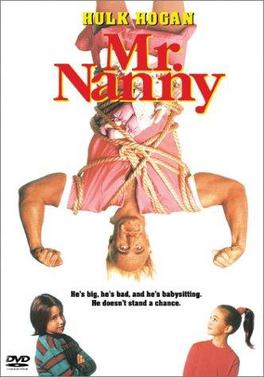
Mr. Nanny
1993
Directed by Michael Gottlieb
Welcome back to Movie Monday. And before we get into anything else, the standard disclaimer applies: everything that follows is my own opinion, shaped entirely by my own experience with this film, and none of it is meant as a criticism of anyone who watched Mr. Nanny and genuinely enjoyed it. You are allowed to enjoy things. Cinema is subjective. If this movie brought you joy, that’s real, and you should hold onto it. We good? Good.
Because I have some things to say.
Hulkamania Was Real
Let me be honest with you about something up front: I grew up on Hulk Hogan.
I don’t mean that in a casual, peripheral sort of way. I mean that in the way a certain generation of kids mean it — Hulkamania was a genuine cultural force in my childhood, and Hulk Hogan was, for a stretch of years in the 1980s, one of the most recognizable human beings on planet Earth. The yellow and red. The bandana. The mustache that was doing a lot of heavy lifting aesthetically. The way he’d cup his hand to his ear and invite the crowd to get louder, as if the noise in that arena wasn’t already threatening structural damage. I watched Saturday morning wrestling. I knew who the Undertaker was. I said my prayers and took my vitamins, brother, at least in spirit.
So when I tell you that Mr. Nanny is one of the worst films I have ever seen, I want you to understand that this assessment doesn’t come from a place of indifference toward its star. There was a version of me — a younger, more optimistic, significantly less cinematically experienced version — who probably thought Hulk Hogan making movies was a reasonable and even exciting idea. He had Rocky III under his belt as Thunderlips. He had the charisma. He had the name recognition. On paper, a Hulk Hogan family comedy is not a concept that should be dead on arrival.
On paper.
How This Landed in My Living Room
I caught Mr. Nanny the way most kids of my generation caught the films that didn’t quite make it in theaters: on VHS or late-night television, in the particular way that movies had of finding you in the early nineties whether you went looking for them or not. You’d flip past it on a Saturday afternoon. A friend would have it. The video store would be out of everything you actually wanted and there it would be on the shelf, box art promising an adventure that the contents of the tape had absolutely no intention of delivering.
I remember watching it. I remember thinking something was off. I did not, at that point in my life, have the critical vocabulary to articulate precisely what was off, but some part of me knew. Kids are smarter about this stuff than adults give them credit for. We could tell when a movie was trying to coast on something — a name, a concept, a built-in audience — rather than doing the actual work of being good. Mr. Nanny was coasting. Even at however old I was at the time, I could feel the effort not being made.
Decades later, watching it again for this list confirmed that my younger self was, if anything, being charitable.
The Setup, Such As It Is
The plot of Mr. Nanny is — and I want to be precise here — the absolute minimum amount of plot required to put Hulk Hogan in a house with two mischievous children. Sean Armstrong, our hero, is a former professional wrestler living in Palm Beach, Florida, haunted by nightmares of his wrestling days. His friend Burt, played by Sherman Hemsley, runs a struggling security business and needs Sean to take a bodyguard job for a tech executive named Alex Mason Sr., who is developing something called the Peacefinder Project, which involves a microchip, which is important, which we will not spend very much time talking about because the film itself doesn’t really want to talk about it either.
The actual job, it turns out, is not guarding the tech executive or the microchip. It’s watching his two kids: Alex Jr. and Kate, a pair of booby-trap-constructing agents of chaos who have driven away every nanny before Sean with the kind of elaborate, vicious pranks that would have resulted in multiple hospitalizations in any film that was paying attention to physics. The movie frames this as charming. The movie is wrong.
Meanwhile, there is a villain. His name is Tommy Thanatos. He wants the chip. He has a steel plate in his skull because of a previous encounter with Sean that ended with him falling headfirst into an empty pool. He has lost most of his afro to the resulting surgery. He is played by David Johansen, the lead singer of the New York Dolls, operating in what I can only describe as a register that no director should have permitted but which I understand Michael Gottlieb apparently had no objection to whatsoever.
This is the movie. This is all of it.
The Sherman Hemsley Question
I need to stop and address Sherman Hemsley, because I think about him every time this film comes up and I genuinely cannot make peace with what he’s doing here.
Sherman Hemsley was George Jefferson. He was one of the great comic performers of his era — sharp, physical, perfectly timed, capable of making the simplest line reading into something memorable. The Jeffersons ran for eleven seasons. Eleven. You do not last eleven seasons by accident. You last eleven seasons because you are doing something right at a level that most performers never reach.
What is he doing in Mr. Nanny? I have watched this film more than once — for this list, because someone has to suffer so that you don’t have to — and I still cannot tell you what the creative vision was for the character of Burt Wilson. He is Sean’s friend and former manager. He is comedic relief in a film that is itself theoretically a comedy, which means he is relief from the comedy, which raises philosophical questions the film has no interest in answering. He is not given anything to do that approaches the level of what he was capable of doing. He is there, and he is trying, and the film does not deserve him, and that is the most charitable framing I can offer.
There’s something quietly sad about watching a performer of Hemsley’s caliber show up fully prepared to a party where the host forgot to put out any food.
The Booby Traps: A Critical Assessment
Here is where Mr. Nanny most nakedly reveals what it is actually trying to be, and what it is actually trying to be is a Home Alone knockoff with a six-foot-seven professional wrestler in the Macaulay Culkin role, which is not a sentence that should make sense but which accurately describes this film’s creative strategy.
Alex Jr. and Kate deploy an arsenal of traps against Sean with the kind of dedicated ingenuity that would, in a better film, inspire admiration. Electrified doorknobs. Things that fall. Things that launch. Things that result in Hulk Hogan making a face that suggests discomfort while clearly not being in any actual discomfort because he is a six-foot-seven professional wrestler who has taken chair shots to the skull in front of live audiences and is not being imperiled by whatever a child has rigged up with a rubber band and some household materials.
The Home Alone comparison is not accidental — the film is very clearly hoping you’ll make it and find it charming — but what it misses is that the traps in Home Alone work because the stakes feel real, because Kevin McCallister is genuinely in danger and is a genuinely resourceful kid, and because the film commits to its own internal logic. Mr. Nanny‘s traps feel like they were designed by a committee that had watched Home Alone once and taken notes on the wrong things. They are elaborate in their setup and inert in their execution, and they do not tell us anything about the children deploying them except that these children have a lot of unsupervised time and a father who has apparently decided that proper childproofing is for other people’s houses.
The movie wants us to find Alex Jr. and Kate lovable underneath their destructive tendencies. I found them exhausting. Your mileage may vary. I suspect it will not.
Tommy Thanatos and the Steel Skull Plate
Now. Tommy Thanatos.
I want to give credit where it is due: Tommy Thanatos is, as far as villain names go, not bad. Thanatos is literally the Greek personification of death. Someone in the writing room did a mythology reference and probably felt pretty good about it. That’s fine. That’s the correct amount of credit.
Everything else about Tommy Thanatos is a creative decision I would like to understand better but probably never will. He is a crime boss who covets a microchip for reasons the film explains in the same way you’d explain something to someone you’ve already given up on. He has a steel plate in his skull from falling headfirst into an empty swimming pool, which happened when Sean chased him after he tried to have Sean and Burt shot for refusing to throw a wrestling match. He has lost most of his afro due to the skull plate surgery, a detail the film treats as his most significant grievance, and honestly? Respect. If I had to get a steel plate installed in my skull, I would also be upset about the hair situation.
David Johansen plays this role with the energy of a man who has made a decision about what kind of movie he’s in and that decision is incorrect. He is operating at a frequency that doesn’t match anything happening around him, which would be fine if the surrounding film had its own clear frequency, but it doesn’t, so what you get is a villain who feels like he wandered in from a different, stranger, possibly more interesting production and never quite found his way back out.
The film’s climax involves Tommy Thanatos being launched into the sky by an improvised electromagnet. He exits the movie as he entered it: inexplicably. I cannot explain the electromagnet. The film cannot explain the electromagnet. We all move on.
What Hulk Hogan Can and Cannot Do
Here is a thing that is true and worth saying plainly: Hulk Hogan is not a trained actor, and Mr. Nanny does not appear to have made any effort to compensate for that fact.
There are films built around athletes and performers who are not primarily actors that work reasonably well, because someone — the director, the writers, a wise producer — figured out how to play to what their non-actor lead actually has. The Rock is not Laurence Olivier, but he’s been in genuinely enjoyable films because people figured out how to use him. The key is usually to keep the performance within a range where the star’s genuine charisma can do the work that technical craft would do for someone with classical training.
Mr. Nanny does not figure this out. It puts Hogan in scenes that require emotional range he doesn’t have and then provides no scaffolding to support him. The moments where Sean bonds with the children — which should be the heart of this film, the thing that makes the rest of it worth sitting through — land with the particular flatness of something that was shot quickly because the schedule required it, not shaped carefully because the story demanded it. There is a version of this character, this reformed tough guy who becomes a reluctant father figure, that could work. It’s a real archetype. It has worked before. It does not work here, because it requires a level of vulnerability that neither the script nor the execution makes any room for.
What Hogan actually has — the charisma, the physicality, the persona — the film uses only fitfully and without imagination. He is put in a house with children and pointed at the camera and the movie seems to expect the rest to take care of itself. It does not.
The Irredeemable Problem
When I sit with Mr. Nanny and try to identify what, if anything, redeems it, I come up mostly empty. And I want to be clear about what I mean by that, because I don’t mean it lightly.
There are films on this list that are bad in ways that are at least interesting. Bad films can be fascinating documents of their era, or illuminating case studies in how productions fall apart, or even accidentally entertaining in their failure. I’ve sat with some films on this list and found something — a performance, a sequence, a moment — that made the experience of watching them worth something.
Mr. Nanny doesn’t offer that. It’s not bad in a way that tells you something. It’s not bad in a way that accidentally becomes something else. It’s bad in the flat, uninspired way of a film that never had a real vision to begin with — a film that started with a concept (Hulk Hogan + kids + pranks) and treated the concept as a finished product rather than a starting point. There is nothing here that suggests anyone involved was trying to make a great film, or even a good one. The target appears to have been “releasable,” and even that is arguable.
That’s the thing about the films that sit at the bottom of a list like this. It’s not always the spectacularly misconceived ones that stick with you longest. Sometimes it’s the ones that just… didn’t care enough to be anything. Mr. Nanny is a film that had a built-in audience — kids who loved Hulk Hogan, and there were plenty of us — and decided that was sufficient. It wasn’t. It never is.
Number 22 on the list. Irredeemable, unambitious, and yet somehow also a real thing that exists and that I have watched more than once in my life, which is two times more than necessary.
Next Time on Movie Monday
We are pressing on next week with number 21, and if you thought watching a professional wrestler navigate the chaos of childcare was a low point, hold on — because we’re heading into the world of animated sequels, where beloved characters return for no reason anyone can adequately explain, and the bar set by the original is cleared in the wrong direction. The Chipmunks are back. They’ve brought friends. They are going to squeak at you for approximately ninety minutes. Alvin and the Chipmunks: The Squeakquel arrives next Monday. Cover your ears, brother. You’re going to need them.

