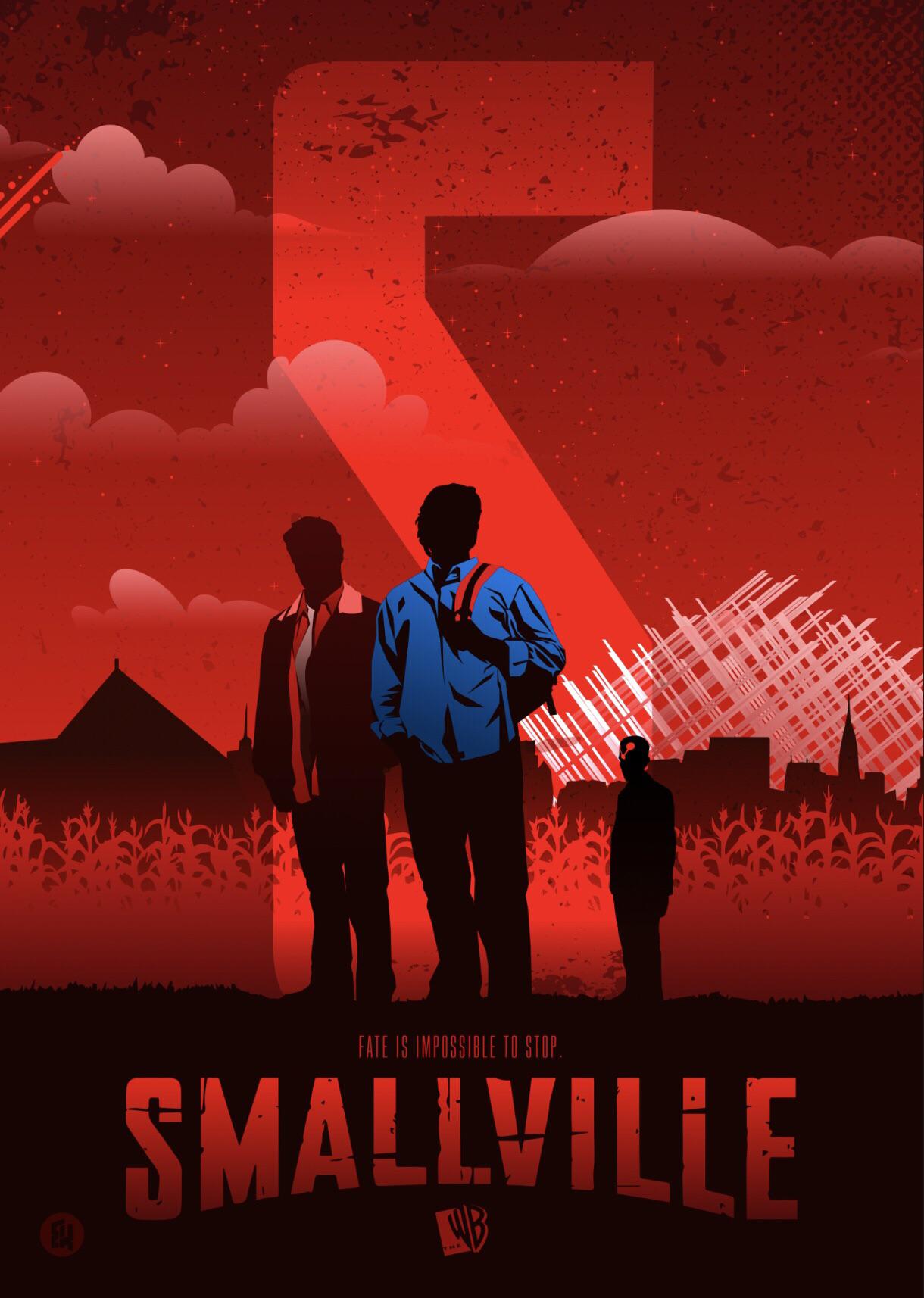
Welcome back to Rewatching Smallville, my weekly dive into the iconic series that explores Clark Kent’s journey before becoming Superman. Whether you’re a long-time fan or new to the show, you’re invited to join in each Tuesday as I revisit episodes and share my thoughts and observations. Be sure to share your own memories and theories in the comments below!
Last week, I said that “Reckoning” was a big deal. I meant it. One hundred episodes in, Smallville sat Clark Kent down in a field of snow and let him be happy for exactly long enough to make sure it would hurt when it ended. Jonathan Kent died. The farm fell quiet. And the show did something genuinely difficult — it earned the grief rather than just staging it.
This week, we live in the aftermath.
“Vengeance” is episode 101, which means it has the unenviable job of following the most emotionally ambitious hour the series had produced to that point. It can’t top what came before, and it doesn’t try. What it does instead is something arguably harder: it sits with Clark in the wreckage and asks what grief actually looks like when you’re a man who can bend steel with his bare hands but can’t hold a coffee mug without thinking about your dad.
The answer, it turns out, is messy. And a little dangerous. And exactly right.
The Watch
Before we get into any of the plot mechanics, let’s acknowledge what the episode is actually about, because the plot mechanics are almost beside the point. A mugger steals Jonathan Kent’s watch off Martha’s wrist in Suicide Slum. Clark spends the episode trying to get it back.
That’s it. That’s the engine.
And it works precisely because the watch is never really about the watch. Clark didn’t even want the watch at the beginning of the episode — when Martha offers it to him, he deflects, telling her to keep it herself. There’s a whole speech Clark doesn’t give in that scene, the one where he admits that he can’t hold something that belonged to his father without feeling the full weight of the fact that his father is gone. Clark Kent, protector of Smallville, cannot handle a watch. So he waves it off and goes back to destroying farm equipment with his bare hands.
Then someone takes it.
The moment the watch becomes something Clark can’t have, it becomes the thing he has to get back. That’s not great emotional reasoning, but it is extremely recognizable human behavior, and the show treats it as such. Clark’s quest to recover Jonathan’s watch is not presented as noble. It’s presented as displacement — grief looking for somewhere to go that feels like action instead of just sitting in the barn feeling terrible.
He had every opportunity to accept his father’s watch and hold onto it. He chose not to. And now he’s about to nearly choke a gang leader to death in a Metropolis back room. Cause and effect, with steps in between.
The Angel of Vengeance, Functional Plot Device
Into this emotional landscape drops Andrea Rojas, who is both a clumsy Daily Planet intern by day and a mask-wearing, rooftop-leaping vigilante by night. Chloe has been tracking her for weeks and has dubbed her the Angel of Vengeance, which is exactly the kind of name Chloe Sullivan would coin with genuine enthusiasm at eleven o’clock on a Tuesday.
Andrea received a heart transplant from a victim of the second meteor shower and gained superhuman strength and agility along with it. She carries a piece of kryptonite in a locket around her neck to remind her of where her powers came from, which is also, as Clark discovers, a remarkably effective way to bring a Kryptonian to his knees mid-confrontation. Points for resourcefulness.
The show uses Andrea primarily as a mirror. She lost her mother to a botched mugging. She got powers. She decided to use those powers to pursue the people responsible, and somewhere along the way the pursuit of justice shaded into something harder to defend. By the end of the episode, she has killed Snake and nearly defenestrated Lionel Luthor from the top of LuthorCorp Plaza.
She is, in other words, what Clark could become if he let the grief drive.
The episode doesn’t belabor this parallel, which is the right call. It plants it in Andrea’s backstory, lets Clark spend enough time with her to recognize what he’s looking at, and trusts the audience to connect the dots. When Andrea finds out that Clark lost his father and says, quietly, “you want justice,” she’s not just guessing about the watch. She’s describing the thing underneath the watch. Clark hears it. The look on his face when he realizes she’s right is one of the better quiet moments Tom Welling gets this season.
She also gets one of the episode’s best exchanges. When Clark unmasks her and asks, “Do you always change in a phone booth?” — a line that lands as an affectionate Superman nod — she deadpans that the janitor was in the bathroom. It’s a good joke. The episode earns it.
Chloe, the Actual Adult in the Room
Allison Mack continues to do more with less than almost anyone else in this cast, and “Vengeance” is a good example of why. Chloe spends the episode functioning as Clark’s conscience, his research assistant, and his reluctant getaway driver, in roughly that order.
The scene where she protests Clark’s plan to confront Snake directly — knowing full well that Clark isn’t thinking straight, that a grieving, guilt-ridden Clark with superstrength going after a gang leader is a combustible combination — is played with exactly the right amount of frustrated helplessness. She’s not wrong about any of it. Clark knows she’s not wrong. He speeds away anyway.
There’s also a small running gag involving Chloe being used as bait to lure out the Angel of Vengeance, which requires her to stand in an alley screaming for help while Clark waits nearby in theoretical readiness. The bit about freaking out every alley cat within a four-block radius is the kind of self-aware humor this show does well when it remembers it’s allowed to be funny. Chloe is a great sport about all of it, which is a core part of her character.
By the end, when Clark admits that he nearly killed Snake and that it was Jonathan’s voice in his head that stopped him, Chloe doesn’t make it into a bigger moment than it needs to be. She just listens. That’s the right instinct, and the show has earned the Clark-and-Chloe dynamic well enough by this point that the quiet scene between them lands.
Lex, Lionel, and the Lie That Keeps On Giving
The episode’s B-plot involves Lionel quietly maneuvering to take over LuthorCorp through something called the Apex Group, Lex doing his best to stop it, and eventually Lex leveraging the secret of Lionel and Jonathan’s final meeting to force his father into a corner and hire him as a consultant instead.
It’s functional plotting. It moves pieces that need to be moved, keeps the Luthor power dynamics churning, and sets up Lex’s season-long slide toward becoming fully, irretrievably the villain we know he’s going to be.
But I keep thinking about something Lex said to Lana in the back half of “Reckoning,” in that scene where he’s drunk and bitter and watching his life fall apart. He looked at her and said he would never lie to her. That he was different from Clark because he would be honest.
It landed as sincere in the moment. That’s what makes Lex so compelling — he can mean something completely when he says it, and still be completely wrong about himself. He genuinely believed, in that moment, that he was the more transparent option. And then he spent the rest of the season, and several seasons after that, lying to Lana in increasingly elaborate ways while maintaining, at every turn, that his dishonesty was somehow more honest than Clark’s.
The mechanics of the LuthorCorp subplot in “Vengeance” are less interesting than the subtext of watching Lex operate. He tells his father that what separates him from the Luthors is leverage, and he’s right, and he uses it without hesitation. That’s not a man who doesn’t lie. That’s a man who lies strategically and calls it intelligence. The gap between who Lex thinks he is and who Lex actually is gets a little wider every episode now, and Michael Rosenbaum keeps finding ways to make you see both versions simultaneously.
The Part That Got Me
I mentioned last week that rewatching “Reckoning” hit me in ways I didn’t fully expect, because the last time I’d watched it was with my dad in January 2006, and he passed away nine months later. I said that some things you can’t get back once they’re gone, and I meant it as a callback to the episode’s themes and also, plainly, as something true about my own life.
“Vengeance” is quieter about it, but it’s still there.
There’s a scene near the end where Martha, alone in the barn, sees one of Jonathan’s jackets hanging up. She starts to cry. It’s not a big theatrical moment. It’s just a woman who’s been holding herself together since her husband died, and here’s his jacket, right where he left it, and she’s suddenly not holding together quite as well.
I know that jacket moment. I know it in the specific way you know something that has happened to you. The object that shouldn’t undo you but does. The ordinary thing that carries the whole weight of the absence.
And then Clark finally puts on the watch. And Lana, who went to every pawn shop in Metropolis looking for it because that’s what Lana Lang does when she cares about someone and doesn’t know how else to show it, gets to watch him put it on. And he admits that he feels lost and alone. Not Superman-adjacent-lost. Just lost.
And then he walks into the farmhouse and hears his father’s voice.
Martha is watching a home video. Jonathan is teaching a young Clark how to drive the tractor. “This young man’s a man of steel,” Jonathan says, and it’s an allusion that lands as something more tender than clever in context. Clark watches his father on a screen. His mother sees that he’s wearing the watch. She hugs him. He cries.
That’s the whole episode, right there in its last two minutes. All the plot, all the Angel of Vengeance, all the gang confrontations and corporate maneuvering — it was all just the path to getting Clark to a place where he could finally stop trying to fix something and just feel it.
It’s a small, specific, extraordinarily well-judged ending. And it works.
The Bottom Line
“Vengeance” isn’t trying to be “Reckoning.” It knows better than to try. What it is instead is the episode you need after a milestone — the one that takes the grief that was weaponized dramatically last week and asks what it looks like in the days that follow. The answer is: not great. Avoidant, a little dangerous, prone to picking fights with gang leaders in back alleys. But also, eventually, human. Real. Clark Kent crying in his mother’s arms over a home video of his dad.
After one hundred episodes of this show building Jonathan Kent into the moral cornerstone of Clark’s entire identity, this is the right way to spend episode 101. Not with another spectacle. Just with the watch, and the jacket, and the voice on the tape.
Some griefs don’t resolve. They just find somewhere to land.
What do you remember about this one? Did the Angel of Vengeance make an impression, or was she always mostly a vehicle for Clark’s emotional arc? And do you think Clark ever fully processes Jonathan’s death, or does it become one of those things he carries quietly all the way to the end? Sound off in the comments below!

