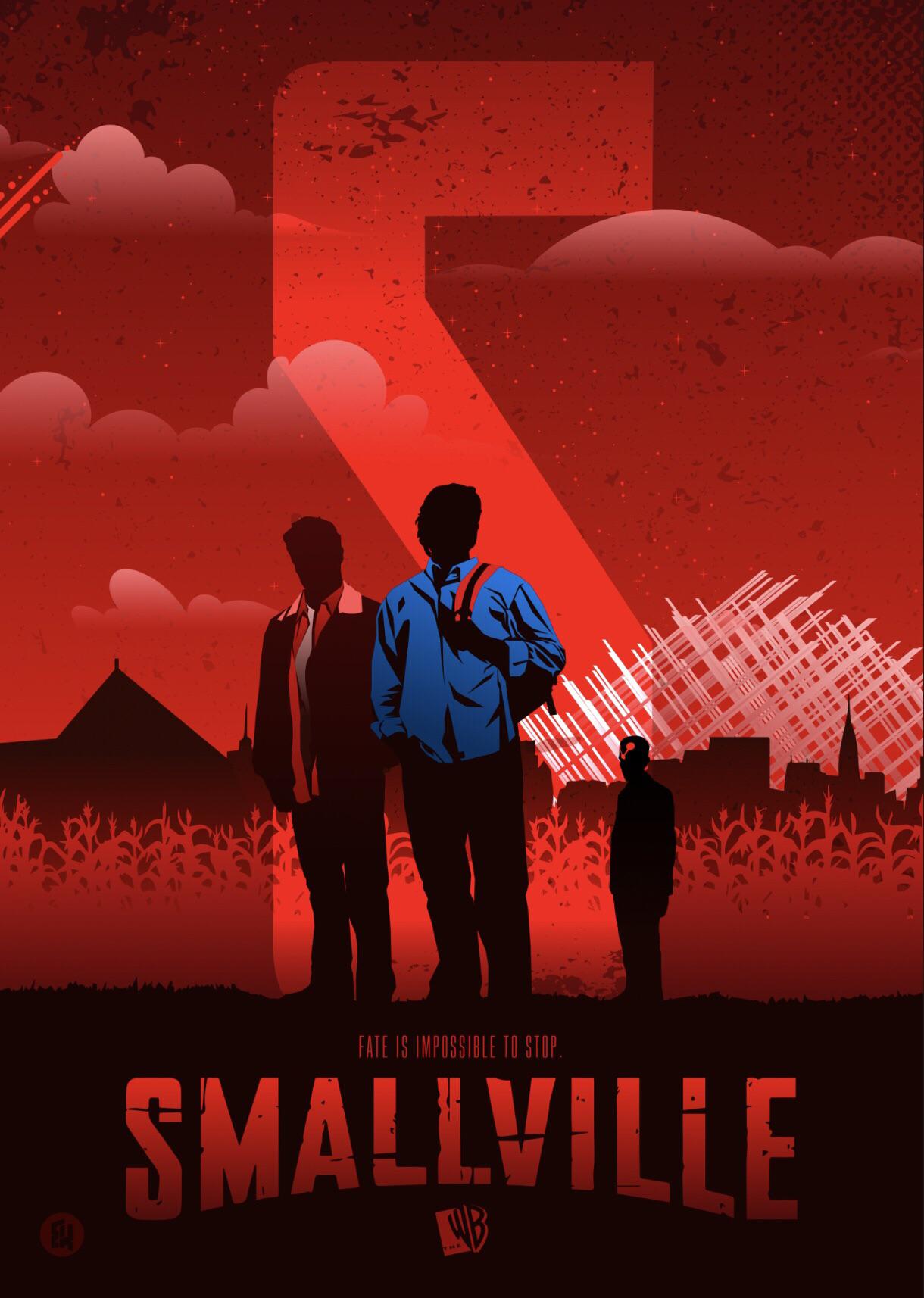
Welcome back to Rewatching Smallville, my weekly dive into the iconic series that explores Clark Kent’s journey before becoming Superman. Whether you’re a long-time fan or new to the show, you’re invited to join in each Tuesday as I revisit episodes and share my thoughts and observations. Be sure to share your own memories and theories in the comments below!
Last week, “Lockdown” did what middle-of-the-season episodes are supposed to do — it kept the pieces moving, deepened the fault lines running through the main relationships, and ended with Clark watching Lex and Lana hug and having absolutely no one to blame for it but himself. It was a functional episode doing careful, deliberate work. And the last line of my write-up promised that what was coming next was a big deal.
It was not an exaggeration.
One Hundred Episodes
Let’s take a moment before we get into any of it, because the number deserves acknowledgment.
One hundred episodes of television is not nothing. It’s not even close to nothing. In network terms, it’s the threshold of syndication, the marker of genuine cultural staying power. For a show like Smallville — which premiered in 2001 on The WB, built its audience out of a combination of Superman mythology and teen drama earnestness, and somehow became appointment television for a generation of comics fans who weren’t entirely sure what they were watching but couldn’t stop — reaching episode 100 is a genuine milestone. It means the show survived its own premise. It means audiences showed up, week after week, willing to follow a version of Clark Kent who couldn’t fly and couldn’t seem to tell Lana Lang the truth about anything. For better and for worse, those hundred episodes happened, and they mattered.
The creative team knew exactly what they had. You don’t write “Reckoning” the way they wrote it if you’re treating it as a routine hour of television. This episode was designed to land. It was designed to be remembered. And it was designed, with considerable precision, to break your heart in a way you would not fully see coming even if you had been told, in advance, what was going to happen.
Mission accomplished. On every count.
The First Timeline: Clark Finally Does the Right Thing, Which Goes About as Well as You’d Expect
The episode opens with Clark in his loft, holding a piece of coal and looking like a man who has thought very hard about something and finally arrived at a decision. When Lana appears, he takes her to the Kawatche Caves and transports her to the Fortress of Solitude. He shows her everything. He demonstrates his powers. And then he crushes the coal into a diamond, uses his heat vision to shape it into a ring, and proposes.
It is, genuinely, a wonderful scene. And it is also, immediately, one of the most complicated things the show has done with these two characters.
Here’s the thing about Clark telling Lana the truth: it’s right. Chloe told him last week, without softening it, that Lana’s connection to Lex was a direct consequence of Clark leaving a vacuum. Five seasons of watching Clark deflect and retreat and protect his secret at the expense of every significant relationship in his life have been building to this moment. When Clark finally opens his hands and shows Lana who he really is — not just the powers, but the vulnerability underneath them, the fear that drove all the lying — it lands as something the show has genuinely earned.
It’s also too late. And it’s doomed. And Clark, on some level, seems to understand both of those things even as he’s doing it.
The proposal is beautiful. Lana’s eventual yes, delivered in the Kent farmyard with snow falling around them, is the kind of scene this show does well when it lets itself be sincere rather than clever. But hovering over all of it is the knowledge — the audience’s knowledge, even if not Clark’s — that this kind of happiness on Smallville tends to have a shelf life measured in hours, not years. Something about the too-perfect staging of that farmyard scene, the diamond ring, the snow, feels less like a beginning and more like a goodbye.
It is a goodbye. Just not the one any of us were expecting.
Lex Luthor: The Most Compelling Wreck in the Room
Meanwhile, Jonathan Kent has just won the Kansas State Senate race, and Lex Luthor is drunk in his mansion, which is about where you’d expect to find Lex on the worst night of his life.
There is something genuinely difficult about Lex in this episode, and “difficult” is meant as a compliment. He is clearly, inarguably, the catalyst for the tragedy of the first timeline. When Lana visits him at the mansion and he notices the engagement ring, his reaction — demanding to know how she could accept a ring from a man who has lied to her repeatedly, then realizing she knows Clark’s secret and grabbing her, forcing her to flee — is not the behavior of a hero. It’s the behavior of a man who cannot accept losing, who is so desperate for validation of his own worldview that he becomes precisely the thing he’d been told he would become. In the first timeline, Lex Luthor’s worst impulses directly cause Lana’s death. That is not ambiguous.
And yet.
Lex losing the election to Jonathan Kent on the same night he watches Lana walk away wearing another man’s ring is not a small thing. The show has spent two seasons carefully building the case that Lex’s feelings for Lana are real — not just possessive, not purely strategic, but genuinely complicated. The “Lexmas” episode wasn’t just a character study in a vacuum; it was the show putting on screen the version of Lex that chose differently, and then showing us that even that version ended in grief. Lex knows, somewhere underneath all of his certainty and control, what he might have been. And he’s watching it walk out of his mansion on Lana Lang’s finger.
He’s sympathetic AND responsible, and the show is honest enough not to let him off the hook for either one. That’s what makes him compelling rather than just cartoonishly villainous. The tragedy of Lex Luthor has always been that he could see clearly what he was doing and couldn’t stop doing it anyway. “Reckoning” puts that quality on full display.
The Reset, and What It Costs
Lana dies. The bus hits her car, the car flips, and Clark arrives too late. It is shot with more restraint than you might expect — the horror is in Clark’s face, not in the spectacle — and John Schneider’s Jonathan pulling a devastated Clark away from the scene is one of the best pieces of acting the show had delivered to that point.
Clark goes to the Fortress. Jor-El gives him a crystal that will reset the day. He also warns Clark, with the particular patience of someone who has said this before and knows it won’t be heard: fate cannot be stopped. If Clark saves Lana, someone else will die.
Clark takes the crystal anyway.
This is not a surprise. Of course he takes the crystal. Clark Kent taking the option that saves the person he loves, even against explicit warning from his own father’s AI ghost, is not a character deviation — it’s character definition. Clark has always believed, at his core, that he can outrun the consequences of his choices. That his speed, his strength, his goodness will be enough. “Reckoning” is the episode that sits him down and explains, with terrible patience, that sometimes it isn’t.
The second timeline is a quieter kind of heartbreak. Clark saves Lana — stops the bus before it hits her, this time — but without having told her the truth, so she breaks up with him instead. He watches Lex kiss her at the mansion. He watches Lois nearly electrocute herself in the apartment Lana would have been in if Clark hadn’t changed things. The pieces slot back into nearly the same configuration, because Jor-El told him they would, and Clark didn’t listen.
And Jonathan goes to meet Lionel Luthor.
Jonathan Kent, and the Weight of a Father
What Lionel shows Jonathan at that meeting is never explicitly revealed, which is the right call. The scene doesn’t need it. What it needs — and what it has — is John Schneider and the accumulated weight of five seasons of Jonathan Kent being the moral center of this show.
Jonathan confronts Lionel, tells him that what separates the Kents from the Luthors is that they have each other, and sends him off his property. And then he walks into the yard, and his heart gives out, and Martha and Clark pull up just in time to watch him die.
John Schneider is extraordinary in those final moments. The look on Jonathan’s face as he sees his family — the way he looks at them before the light goes out — is not a performance that benefits from further description. It simply lands.
Martha Kent holds him as he dies. Clark, who has already lived this day once and traded it for this outcome, watches the man he most wanted to become leave without him.
The show had been building toward this all season — the heart medication, the careful way Jonathan carried himself, the hints of strain the campaign had put on a body that had already been pushed past its limits by Kryptonian power years before. In retrospect, the foreshadowing is everywhere. But knowing it was coming and watching it happen are not the same experience.
Martha, and the Silence After
Annette O’Toole does not get the dramatic speeches in this episode. That’s entirely by design, and it makes her work here more devastating than any amount of dialogue could have managed.
Martha Kent in the aftermath of Jonathan’s death is a woman who has just lost the center of her world and is still, somehow, holding on — for Clark’s sake, because that is what Martha does. The morning of the funeral, as she and Clark quietly prepare, she tells him he can’t feel guilty, that even with the chance to choose he could never have chosen between Jonathan and Lana. It is a generous, careful, loving thing to say to a son who is drowning in guilt. It is also, almost certainly, not the whole truth of what she is feeling. Martha is grieving in the spaces around the words, and O’Toole makes you feel every one of them.
The moment where Clark helps Martha put on her necklace — a small, domestic gesture in the middle of incomprehensible loss — is the kind of detail that separates a good episode from a great one. The episode earns its grief not through spectacle but through specificity. That necklace. That small, quiet act of a son taking care of his mother. It’s the whole episode in miniature.
What “Reckoning” Is Actually About
The title means “an accounting, as for things received or done.” That’s the official definition, and the episode uses it precisely.
What is Clark being asked to account for? Everything. His inability to trust. His habit of retreating behind the secret rather than taking the risk of being known. His assumption that he could save everyone, fix everything, and outrun the consequences of the choices he’d made. Jor-El told him in “Hidden” that someone he loved would pay the price for his resurrection. Jor-El told him in the Fortress that fate could not be stopped. Clark heard both warnings and did what Clark always does — he believed that this time would be different, that he would be enough, that love and speed and the right intentions would carry the day.
They didn’t. They haven’t. They rarely do, in this show’s universe, when Clark tries to shortcut the cost.
Jonathan Kent’s death is not random. It is, in the architecture of the show’s mythology, a debt being collected — for the Kryptonian powers Jonathan was given in Season Three to retrieve Clark from Metropolis, and for the life Jor-El restored in “Hidden.” But it is also, in the more human architecture of the story, the consequence of Clark’s choices rippling outward in ways he couldn’t control. He saved Lana. He lost his father. Those two facts are inseparable, and the show does not let Clark — or us — forget it.
Where Does “Reckoning” Land?
It lands at the top.
Not every episode of Smallville that has reached for greatness has managed to grasp it. “Reckoning” grasps it. It’s a meticulously constructed hour that honors the milestone it was built to mark without letting ceremony override story. The time-travel mechanic is handled with exactly the right amount of restraint — it’s not a gimmick, it’s a trap. The emotional beats are earned by everything that came before. And the death of Jonathan Kent hits the way it was meant to hit: not as a shock twist, but as an inevitability that hurts precisely because you can see all the ways it didn’t have to happen.
One hundred episodes in, Smallville knew what it was doing. It put a piece of coal in Clark’s hand, let him turn it into something beautiful, and then reminded him — and us — that some things you can’t get back once they’re gone.
It was a big deal.
A Personal Note
I want to step outside the review for a moment, because this rewatch hit me in a way I wasn’t entirely prepared for.
I watched “Reckoning” when it originally aired in January 2006. I watched it with my dad.
I remember that we talked afterward about Clark and Lana — about whether they’d actually end up together, whether the proposal could possibly stick. And I remember that we both noticed the same thing, almost at the same time: James Blunt’s “You’re Beautiful” playing over that barn scene in the second timeline, and the way the song ends. I will never be with you. Right there, tucked into what looked like a hopeful moment, the show had already written the ending of Clark and Lana’s story. My dad and I both caught it. We both knew.
My father passed away nine months later. Almost 20 years ago. And rewatching this episode — this specific episode, the one we watched together and talked about together — was something I didn’t fully anticipate until I was already in the middle of it.
There’s a particular kind of grief that hits when you’ve lost someone and then you watch a story about loss that you already knew. You’re not just watching Jonathan Kent die. You’re watching it through the lens of everything that happened after the last time you saw it. The scenes that were affecting before become something else entirely. Martha holding Jonathan. Clark helping her with that necklace. The funeral. All of it lands differently when you’ve stood in that yard yourself, metaphorically speaking.
I’ve written about this before in the context of rewatching Buffy the Vampire Slayer — specifically “The Body,” Season Five’s devastating episode about Joyce Summers’ death. Watching that episode after losing my dad was an experience I can only describe as being ambushed by something you thought you were ready for. The grief on screen and the grief you carry don’t stay separate. They find each other.
“Reckoning” did the same thing this time around.
I don’t say any of this to make this post about me rather than about the episode. The episode is great and deserves everything I said about it above. But part of what makes these rewatches meaningful — at least to me, and hopefully to some of you reading this — is that the stories we watched at different points in our lives carry the weight of those moments with them. This episode will always also be a Thursday night in January 2006, watching TV with my dad, and both of us noticing the same lyric at the same time.
Some things you can’t get back once they’re gone.
What do you remember about watching “Reckoning” for the first time? Does Jonathan’s death hit differently on rewatch, now that you can see all the foreshadowing the season laid in? And do you think Clark ever really makes peace with the choice he made — or is the guilt something he carries all the way to the end? Sound off in the comments below!


This one was a gut punch, for sure.
Like
Pingback: No Tights, No Flights, No Easy Answers: The Creative Minds Behind Smallville | The Confusing Middle