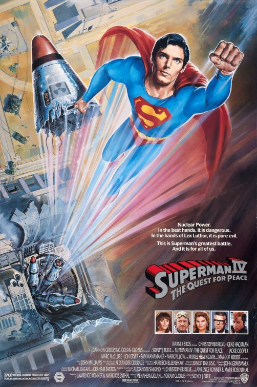
Superman IV: The Quest for Peace
1987
Directed by Sidney J. Furie
Welcome back to Movie Monday. And as always, before we go any further, let me be clear: everything that follows is my own opinion, shaped entirely by my own experience with this film, and none of it is meant as a criticism of anyone who watched Superman IV: The Quest for Peace and genuinely enjoyed it. You are allowed to enjoy things. Cinema is personal. If this movie did something for you, that’s real and valid, and I’m not here to argue you out of it. We good? Good.
Because I have some things to say.
I Was There
I need to establish something before we get into the film itself: I saw this movie in theaters. In 1987. As a kid.
That matters more than it might seem, and I want to take a moment to explain exactly why — because it’s not just a fun biographical footnote. It’s actually the whole context for everything that follows.
Superman has been part of my life for as long as I can remember having a life to speak of. Christopher Reeve’s Superman wasn’t just a movie character to me growing up; he was practically a fixed point in the universe. The original 1978 film — the one with the John Williams score swelling as the credits roll, the one where Reeve managed to make you genuinely believe a man could fly — that film occupies a specific place in my personal mythology that I’m not sure I could fully articulate even now. It’s the kind of thing that gets into you when you’re small and stays there.
Here’s the thing, though: of the four Christopher Reeve Superman films, Superman IV is the only one I ever saw in a movie theater. At least until recently, when a re-release of the original finally gave me the chance to experience that one on the big screen the way it was meant to be seen. Superman II came out in 1980 — the year I was born — which, as you might imagine, made a theatrical viewing somewhat logistically complicated. And Superman III arrived in 1983, when I was three years old, and I think we can all agree that three is probably a few years shy of the appropriate age for my parents to have hauled me to a multiplex. So I caught those films later, on TV, on VHS, in the ways that kids of that era caught things they’d missed. I loved them. They became part of me the way things do when you’re young and impressionable and the cape is red and the theme music is John Williams.
But Superman IV — that one I got to see in a theater. In 1987. As an actual theatrical experience, with a screen and popcorn and everything.
I want to sit with that for a second, because it means something. It means that of all the Christopher Reeve Superman films, the one I have the most visceral, immersive, childhood memory of seeing is this one. The worst one. The catastrophic one. The one that ended the franchise for nearly twenty years. I didn’t get the triumphant original on the big screen as a kid. I got this.
And here’s where it gets genuinely complicated: I know this movie is a disaster. I have known it, on some level, for most of my life. I can catalogue its failures with the practiced ease of someone who has thought about them for decades. And yet — I would be lying if I told you it holds no nostalgic pull for me. It does. It always has. There is a version of my seven-year-old self sitting in that theater who was just happy to see Superman on a screen bigger than the TV in our living room, regardless of what Superman was doing or how unconvincing the special effects were. That kid didn’t care about the Cannon Group’s budget problems. That kid just wanted to see the cape.
So this post exists in a particular tension that I want to be upfront about: I am going to tell you, honestly, that Superman IV: The Quest for Peace is one of the worst films I have ever seen, and I am also going to tell you that it has a permanent place in my personal history that no amount of critical clarity can entirely dislodge. Both things are true. They coexist, uncomfortably, the way a lot of things from childhood do.
Superman IV felt like a betrayal.
That’s the word for it, and I’ve thought about it enough over the decades to be confident in it. Not just a disappointment. Not just a bad movie. A betrayal — of the character, of the cast, of everyone who had invested something real in this version of Superman. And I think knowing that framing is essential to understanding why this film sits where it sits on my list. A betrayal is different from a failure. You can forgive a failure. A betrayal is something you carry.
How We Got Here
To understand what went wrong with Superman IV, you have to understand what happened to it before a single frame was shot.
After Superman III, the Salkind family — Alexander and Ilya, the producers behind the first three films — considered the franchise’s future and eventually sold the Superman rights to Menahem Golan and Yoram Globus of The Cannon Group for five million dollars. If that name doesn’t immediately ring a bell, The Cannon Group was the production company responsible for a particular strain of 1980s action filmmaking that prioritized volume over quality. They had nearly thirty projects in development simultaneously. Superman IV was one of them. One of thirty.
To get Christopher Reeve back, Cannon offered him $6 million, financing for a passion project called Street Smart, and something they probably should have thought harder about: creative input. Reeve took the deal and pitched a story about nuclear disarmament, inspired by the breakdown of the Reykjavik Summit. His heart was in the right place. He wanted Superman to mean something. He wanted the film to matter.
Here is where the tragedy of Superman IV begins to take shape — because what followed was a textbook case of good intentions colliding with catastrophic production circumstances.
Shortly before filming began at Elstree Studios in September 1986, Cannon slashed the budget from $36 million to $17 million. Seventeen. For a Superman film. Reeve wrote about it in his autobiography with a specificity that reads almost like a wound that never quite healed. A scene that called for Superman to walk down 42nd Street was instead filmed at an industrial park in England in the rain, with a hundred extras, no cars, and a dozen pigeons. He wrote that even if the story had been brilliant, they couldn’t have lived up to audience expectations under those conditions.
The story was not brilliant. And the conditions were exactly as described.
What made it to theaters was, according to Jon Cryer — who played Lenny Luthor and by all accounts had a perfectly fine time working with Reeve and Gene Hackman despite everything — an unfinished film. Cannon ran out of money. 45 minutes of footage were cut following a failed test screening. A first Nuclear Man was filmed and then excised entirely, leaving logic gaps in the final cut that the film never bothers to paper over. Whole subplots went with him.
What reached the screen was whatever remained.
The Burden Christopher Reeve Carried
I want to spend some time here, because I think it matters.
Christopher Reeve was not a passive participant in what happened to this film. He sought it out. He negotiated for it. He had a story he believed in — a story about the most powerful being on Earth choosing to intervene in the arms race, to use that power in service of human survival. As superhero premises go, it’s not a bad one. It’s actually a pretty interesting one, the kind of thing that, with the right resources and the right execution, could have been a genuinely compelling conclusion to the Reeve era.
He saw what the production was becoming, and he kept going anyway. You can read that as stubbornness or loyalty or professionalism or some combination of all three. What you can’t do is pretend he didn’t see it. Jon Cryer recounts Reeve pulling him aside before the release and telling him the film was going to be terrible. Reeve already knew. By the end, he described it publicly as “a catastrophe from start to finish” and said the failure was a significant blow to his career.
There’s something genuinely sad about that. Reeve cared about this character in a way that went beyond paycheck and contract. He had been Superman for nearly a decade. He brought something to the role that the films didn’t always deserve, and Superman IV is the sharpest example of the gap between what he was bringing and what was being built around him. He’s still doing his best in this movie. You can see it. Reeve never phones it in, not even here, not even when the special effects are visibly, embarrassingly inadequate.
That diligence, in context, is almost heartbreaking.
Nuclear Man: A Case Study in What Budget Cuts Look Like
Let’s talk about Nuclear Man.
The concept isn’t terrible, as supervillain origin stories go. Lex Luthor steals a strand of Superman’s hair — established early in the film as strong enough to hold enormous weight — uses it to create a genetic matrix, attaches it to a nuclear missile, Superman intercepts the missile and hurls it into the sun, and the resulting energy discharge creates a superhuman entity. It’s comic-booky in the way these films always were, and the basic idea of a villain born from the sun and powered by solar energy has a certain symmetry to it as a foil for Superman.
The execution is another matter entirely.
Nuclear Man, as portrayed in the finished film, is a large man in a gold bodysuit with acrylic fingernails whose voice you never actually hear — at least not the voice belonging to the man playing him. Mark Pillow, the actor in the suit, was dubbed entirely by Gene Hackman, which means that every line Nuclear Man delivers is coming out of Lex Luthor’s mouth, which is a strange creative choice that the film declines to explain. His powers, meanwhile, seem to exist primarily in service of whatever the scene needs them to be at any given moment. He can fly. He has superstrength. He shoots energy beams. He has toxic claws that give Superman radiation sickness. His primary weakness is shade.
What is particularly notable about Nuclear Man is what the film doesn’t tell you, which is that this is actually the second Nuclear Man Lex created. The first one — filmed, performed, and then cut — was a different-looking creature who fought Superman and lost, prompting Lex to go back to the drawing board. Without that context, the version we see in theaters appears somewhat arbitrarily from the sun, fully formed, ready to fight, and the film declines to explain much of anything about his creation in any satisfying way because the scenes that would have done that explanation are sitting on a cutting room floor somewhere.
It is difficult to take a villain seriously when you sense, correctly, that the film has lost track of how he got there.
The Moon fight is the nadir. Superman and Nuclear Man battle on the lunar surface, and the special effects — already strained throughout — simply give up. The wire work is visible. The compositing is flat. The backgrounds look like what they are. Compare a single frame of Superman in flight from the 1978 original to what’s on screen here, and you are looking at two different films with two different philosophies about what the audience is owed.
The budget cuts didn’t just affect what the movie looked like. They affected what it was able to be.
The Good Intentions Problem
Here is a thing I have come to believe about Superman IV after living with it for almost forty years: it is a film that failed not despite its ambitions but partly because of them.
A Superman film with no ambitions, made purely as a cash-extraction exercise, might have been forgettable but competent. What Superman IV attempted was something with genuine stakes — a superhero confronting the arms race, speaking at the United Nations, making an explicit moral argument about nuclear weapons. That’s ambitious. That’s the kind of thing you do when you believe the character is capable of carrying that weight.
The problem is that the ambitions required a foundation that the production couldn’t provide. You can’t make a credible film about nuclear disarmament with $17 million and Israeli special effects crews replacing the original team at the last minute. The gap between what the film was reaching for and what it could actually deliver is not a small one. It’s visible in every underpopulated street scene, every shaky wire flight, every moment where the movie’s eyes are bigger than its budget.
Reeve wanted to do something meaningful with what he knew was probably going to be his final Superman. The tragedy is that the meaningful thing he was trying to do was undermined at every level by the people who held the checkbook. He was trying to build a cathedral and they kept taking away bricks.
Sitting in That Theater
I keep coming back to the theater. To being a kid who loved this character and trusted that the people making the movie loved him too. To the fact that of all the Superman films I could have experienced on a big screen as a child, this is the one I got.
There’s an irony in that which I’ve never quite been able to shake. The greatest Superman movie ever made — the 1978 original, the one that started all of this — I didn’t see that one theatrically until I was an adult, during a re-release that finally gave me the chance. The film that deserved the full cinematic treatment, the swelling John Williams score in a proper theater with a proper screen, I experienced that one first on a television. But this one? The budget-gutted, effects-challenged, Nuclear-Man-having one? That’s my big-screen childhood Superman memory.
And I’ll be honest with you: I don’t entirely hate that. There’s something almost fitting about it. Something very on-brand for a life spent loving things that occasionally let you down.
Because here’s what I’ve made a certain peace with, after nearly forty years of carrying this film around: Superman IV is a disaster, and it’s also mine. It’s on my list of least favorite films, and it also has a permanent claim on a specific rainy evening in 1987 when I was seven years old and Superman was on the biggest screen I’d ever seen him on. Both of those things are true. The critical assessment and the nostalgic pull exist side by side, and neither one cancels the other out.
Number 23 on this list isn’t occupied by the worst film I’ve ever seen. It’s occupied by a film that had every reason to be better than it was, that had a star who deserved better than it gave him, and that took a character I have loved my entire life and sent him out in the most undignified way imaginable. The production disaster, the slashed budget, the rushed effects, the villain who lost his entire origin story on a cutting room floor — all of it adds up to a film that earns its place here not through any single spectacular failure but through the accumulated weight of everything that was stripped away before it reached the screen.
Reeve called it a catastrophe. I’ve called it that too, for most of my life. But I saw it in a movie theater when I was seven, and Superman was on the screen, and for a few minutes before everything went wrong, that was something.
I still love Superman. I always will. This film does not change that. It just makes the love a little more complicated, the way the best and worst experiences of childhood tend to.
Next Time on Movie Monday
We’re continuing the descent next week with number 22 on the list, and if you thought a Man of Steel could have a bad day, wait until you see what happens when the Hulkster gets put in charge of childcare. That’s right — we’re heading into the early nineties, where Hulk Hogan is contractually obligated to protect two children from a villain, and absolutely nothing about that sentence prepares you for how it actually plays out. Mr. Nanny arrives next Monday. Bring your vitamins, brother. You’re going to need them.

