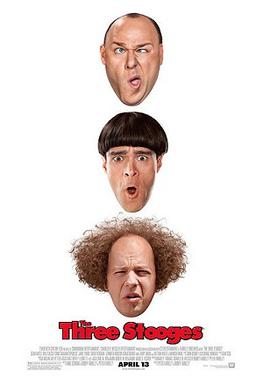
The Three Stooges
2012
Directed by Peter & Bobby Farrelly
Welcome back to Movie Monday. Before anything else, the standard disclaimer: everything that follows is my own opinion, arrived at through my own experience with this film, and is not meant as a slight against anyone who watched The Three Stooges and genuinely enjoyed it. Comedy is one of the most subjective things in the world. If this movie made you laugh, that’s real, and I’m not here to take it from you. We good? Good.
Now. Let’s talk about what the Farrelly brothers did here, and why it earned a spot at number 24 on my list of least favorite films.
A Brief and Honest Confession About Slapstick
I want to get something out of the way upfront, because I think it’s important context for everything that follows: I am not, by nature, a slapstick comedy person. I can appreciate it — I can recognize craft in it, timing in it, genuine physical skill in it — but it has never been my preferred comedic language. Put me in front of a dry wit and I’m home. Put me in front of someone taking a pie to the face and I’ll offer a polite smile and wait to see what happens next.
I mention this not to excuse myself from the critique, but because I think it’s only fair to acknowledge it. A film built almost entirely on slapstick comedy was always going to be working uphill with me as an audience member. That’s on me as much as it’s on the movie.
And yet — and this is the thing — I can appreciate the original Three Stooges shorts. Those old black and white films, fifteen or twenty minutes of Moe and Larry and Curly knocking each other around a room, poking eyes and pulling ears and making sounds that don’t occur in nature — there’s something to them. Something genuine and specifically of their time. I’d catch them occasionally growing up, late at night on TBS, the kind of thing they’d run between actual programming to fill dead air. The kind of thing you’d stumble into and stay with for a few minutes, charmed by the sheer committed absurdity of it. They worked because Moe Howard, Larry Fine, and Curly Howard weren’t imitating a style. They were inventing one. They had a chemistry that was entirely their own, built over years and decades, and it shows in every frame.
So when I say that The Three Stooges (2012) disappointed me, I want to be clear: I came in with reasonable goodwill. That goodwill did not survive the experience.
A Movie Nobody Was Racing to Make
The Wikipedia article on this film contains a production history that, depending on your perspective, is either a testament to the Farrelly brothers’ passion or a sign that the universe was trying to tell them something. The project was in development for over a decade. Phil Hartman was at one point attached to play Moe, which is a genuinely interesting “what if” that we’ll never get to explore because of tragedies that go well beyond movie criticism. Sean Penn was set to play Larry Fine before dropping out. Jim Carrey was set to play Curly — and actually gained forty pounds for the role — before deciding he didn’t want to gain the additional weight required. The whole thing ricocheted between studios and sat in limbo through bankruptcies and casting reshuffles before finally landing at 20th Century Fox and making it to theaters in April 2012.
I tell you all of this not to be glib about a clearly troubled production but because it genuinely matters. When a project spends more than a decade fighting to exist, when it cycles through multiple studios and multiple casting configurations, when it finally arrives after that much friction — there’s a reason to ask whether the finished product was shaped by genuine creative vision or by the accumulated scar tissue of a project that refused to die gracefully. The Three Stooges of 2012 has the feeling, at times, of a movie that made it to the screen through sheer stubbornness, rather than because anyone had a clear and urgent answer to the question of what a modern Three Stooges film should actually be.
The Impression Problem
Here is the central issue with The Three Stooges, and I want to be fair about it because I think the criticism has a nuance that gets lost in broad dismissals: Chris Diamantopoulos, Sean Hayes, and Will Sasso are not bad. They really aren’t. You can tell they committed to this thing. Diamantopoulos apparently showed up to his audition in full costume, got called back fourteen times over six months, and then fired his own agent when he found out he’d gotten the role and hadn’t been told. That is a man who wanted this part. And it shows.
But here’s the problem. What you’re watching, for the entire runtime of this movie, are three capable actors doing very good impressions of Moe Howard, Larry Fine, and Curly Howard. And an impression, no matter how good, is not the same thing as the real thing. It can’t be. The original Stooges had spent years together, building a rhythm, finding the exact timing that made a particular bit land, developing a shorthand that was so deeply ingrained it stopped looking like technique and started looking like instinct. You cannot replicate that. You can approximate the surface of it — the voice, the gestures, the specific sounds — but the timing underneath, the thing that actually made you laugh, that’s not transferable.
Every time Diamantopoulos does something Moe-ish, you’re aware that it’s Diamantopoulos being Moe-ish. Every time Sasso does a Curly shuffle, there’s a faint overlay of performance over performance, an actor playing a character who was himself a specific and irreplaceable human being. It’s like watching a really skilled cover band. You might enjoy the songs. You might appreciate that they’ve clearly done their homework. But you’re aware the whole time that you’re not listening to the original recording, and that awareness keeps a certain distance between you and the experience.
The performances aren’t the problem. The enterprise itself is the problem. This was always going to be a ceiling that couldn’t be broken.
What Physical Comedy Requires
I said I can appreciate the original shorts, and part of what I appreciate is this: the physical comedy worked because it was built on real relationships and real timing, and because Moe and Larry and Curly had done these bits hundreds of times in live performance before a camera ever captured them. The slaps landed in a specific rhythm. The eye pokes had a specific geometry. The whole choreography of it was so practiced that it looked effortless, which is the only way physical comedy ever actually works.
In the 2012 film, the physical comedy feels like physical comedy. You’re watching it happen, cataloguing it, waiting for the next gag, noting whether it landed. There’s a self-consciousness to it that the originals never had, because the originals were operating from muscle memory and this film is operating from imitation of muscle memory. Those are meaningfully different things, and you feel the difference even if you can’t immediately articulate it.
I’ll grant that this is a difficult problem without an obvious solution. You cannot ask three modern actors to actually develop the years of chemistry and live performance experience that produced the original Stooges. But you can at least recognize that the absence of that foundation is going to matter, and you can make creative choices that account for it rather than pretending the gap doesn’t exist.
The Jersey Shore Problem, or: What Were They Thinking?
And then there’s the Jersey Shore subplot, which I have spent time trying to understand and have largely failed.
For context: Jersey Shore was a reality television program that aired on MTV, beginning in 2009, following a group of young people in a beach house in New Jersey doing things that, in retrospect, feel like artifacts of a very specific and already fading cultural moment. The show was, at its peak, enormously popular in a way that is difficult to fully explain to anyone who wasn’t living through it. I was alive during Jersey Shore‘s cultural moment, and I still find it difficult to comprehend.
The Three Stooges was produced by 20th Century Fox and distributed by 20th Century Fox. It is, in no meaningful sense, a product of MTV, which aired Jersey Shore. There is no corporate synergy happening here, no cross-promotional logic that would explain why the climactic third act of a Three Stooges movie involves Moe being cast as a cast member on a reality show on a different network from the one distributing the film. The cast of Jersey Shore — Nicole Polizzi, Mike Sorrentino, Jennifer Farley, and others — appear in the film as themselves, and the movie seems very pleased about this.
At the time, this was probably meant to feel current. Relatable, even. A way of signaling to younger audiences that this wasn’t just a nostalgia project for people who remembered the original shorts. Here were the Stooges, right in the middle of a cultural moment you recognize.
The problem is that cultural moments end. Jersey Shore is not a current phenomenon. It occupies a very specific and already somewhat embarrassing corner of early 2010s culture, and embedding it into the fabric of your Three Stooges film means that the film now wears that moment like a tattoo from a phase you’d rather forget. There is a particular kind of pop culture dating that ages worse than straightforwardly old movies, and this is it. The original Stooges shorts are from the 1930s and they still feel more timeless than this, because they were never trying to be current. They were just trying to be funny.
I understand the impulse. I think it was deeply misguided. And the execution is even messier than the concept, because the Stooges-on-Jersey-Shore storyline doesn’t really generate comedy so much as it generates scenes of Moe slapping reality television personalities, which is perhaps cathartic on some level but doesn’t constitute a third act.
The Night We Rented It
I saw this on a Redbox rental, at a friend’s place, with a small group of people who were probably expecting to have a reasonably good time. We did not have a reasonably good time. I remember the first act being engaging enough in the way that a new thing is always at least briefly engaging. I remember the second act being the point at which the conversations around the movie started to feel more interesting than the movie itself. By the time we reached the third act — the Jersey Shore material, the murder plot resolution, all of it — I’m not sure any of us were really watching anymore. The movie had lost the room. Not through any dramatic failure or moment of particular terribleness, but just through the slow accumulation of jokes that didn’t quite land, set pieces that didn’t quite build, and a general sense that everyone on screen was working much harder than the material deserved.
That’s maybe the most damning thing I can say about it. A lot of bad movies are actively bad in memorable ways. The Three Stooges is passively disappointing in a way that leaves very little behind. I couldn’t tell you specific scenes that failed. I can tell you that by the end, we were talking about something else.
Why Number 24
Weekend at Bernie’s II, sitting just above this one on the list at number 25, had the specific disadvantage of being attached to something I loved, and it failed on those terms as well as its own. The Three Stooges doesn’t quite have that personal sting — I was never a devoted Stooges fan, never had the kind of formative relationship with those shorts that would make a bad reimagining feel like a betrayal. What it has instead is a different kind of failure: the failure of ambition without adequate foundation. A project that spent over a decade trying to exist, finally made it to the screen, assembled genuinely capable performers, and still couldn’t figure out what it was actually trying to do or why it needed to be done. Add the Jersey Shore material, subtract whatever goodwill the leads managed to generate, and you arrive at a film that earns its place on this list not through spectacular awfulness but through sustained, expensive, well-intentioned mediocrity.
The Farrellys said publicly that this was the riskiest project they’d ever done, and the one closest to their hearts. I believe them. And I think that sometimes the projects closest to your heart are the ones where love for the source material prevents you from asking the hard question: is there actually a version of this that works?
Next Time on Movie Monday
We’re taking a break from the descent next week — a palate cleanser is in order, and frankly, we’ve all earned one. Join me for the first Movie Monday of the month, where instead of cataloguing cinematic disappointments, we’re heading into the woods with two very different animals and the friendship that neither of them asked for but both of them needed. Disney’s The Fox and the Hound arrives next Monday, and I promise it will be considerably more emotionally devastating and considerably less likely to feature the cast of a defunct reality television program. See you then.

