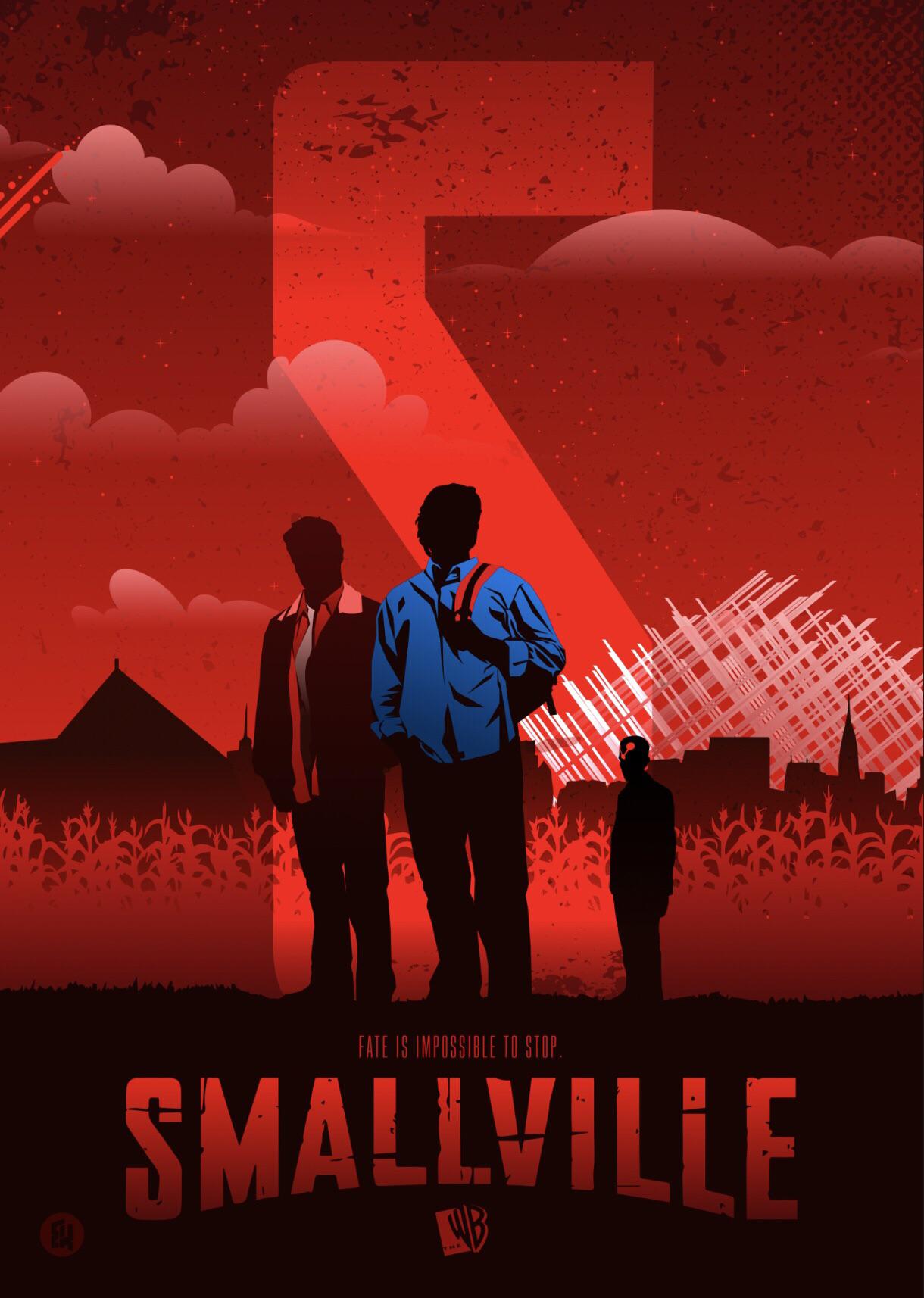
Welcome back to Rewatching Smallville, my weekly dive into the iconic series that explores Clark Kent’s journey before becoming Superman. Whether you’re a long-time fan or new to the show, you’re invited to join in each Tuesday as I revisit episodes and share my thoughts and observations. Be sure to share your own memories and theories in the comments below!
Last week, “Lexmas” did something genuinely remarkable for a network drama in its fifth season — it paused its own mythology, stepped outside its usual structure, and delivered what I’d argue is Michael Rosenbaum’s finest hour on the show. It was melancholy and operatic and quietly devastating, and it ended with Lex Luthor making the choice that defined him, forever, while his mother’s reflection wept in a window. It was a lot to follow.
“Fanatic” does not really try to follow it.
That’s not entirely a criticism. Coming down from the emotional altitude of “Lexmas” was always going to require some kind of gear shift, and “Fanatic” is very much a first-gear episode — grounded, plot-driven, more procedural than philosophical. Where “Lexmas” asked what kind of man Lex Luthor could have been, “Fanatic” asks something considerably smaller: what happens when a college student becomes dangerously obsessed with him? The answer, as it turns out, is fine. Serviceable. Occasionally engaging. But not exactly the stuff of legend.
After the last few episodes, “meh” feels like a larger drop than it probably should.
The Villain of the Week Problem
Let’s start with Samantha Drake, because she is the engine of this episode’s plot and also its most significant liability.
Samantha is introduced as a member of the Central Kansas A&M Students for Lex Luthor — a campus fan club that, in the context of this show, reads as both plausible and mildly alarming. She asks for a photo with Lex at a campaign meeting. She wears a “Lex” charm around her neck. She knows things about him that no casual supporter would know. Lex, to his credit, looks visibly unsettled by her before she’s done anything threatening, which is either good instincts or the writers telegraphing their hand approximately forty minutes early.
From there, Samantha’s trajectory is swift and escalating in ways that the episode doesn’t quite earn. She tears down Jonathan Kent’s campaign posters. She and her group corner Jonathan in the barn and beat him up. She decides, when Jonathan’s poll numbers actually go up after the attack, that the only logical next step is assassination. She kills her two co-conspirators when they object. She shaves her head bald in homage to Lex — which is, genuinely, a choice — and then goes to his house to tell him what she’s done for him, at which point Lex, understandably, reacts with horror and she knocks him out.
The head-shaving moment is the episode’s most memorable image and also kind of a microcosm of its problem. It’s bold enough to lodge in the memory, but it doesn’t connect to anything deeper. Samantha doesn’t have a coherent psychology so much as a plot function. She exists to create a threat to Jonathan, to implicate Lois in that threat, and to give Clark something to run toward in the final act. As villain-of-the-week roles go, she’s neither interesting enough to elevate nor bad enough to be entertainingly terrible. She’s just there, doing increasingly extreme things, until she isn’t.
The show has done better with this kind of character. It’s also done worse. Samantha Drake lands somewhere in the thoroughly forgettable middle.
Lois in the Crosshairs (Literally)
To the episode’s credit, it finds a reasonably clever way to deploy Lois Lane in the middle of all this. Jonathan fires his campaign manager — a stuffed-shirt named Sosnick who wants to dress the Kents like they’re attending a board meeting rather than running for Senate — and hires Lois as his replacement, which is either a bold strategic choice or evidence that Jonathan Kent has lost considerable judgment under the pressures of the campaign trail. Probably a little of both.
Lois as campaign manager is fun in the way that Lois is almost always fun — she’s energetic, opinionated, and constitutionally incapable of softening a take. Her butting heads with Samantha over poster sizes reads as exactly the kind of collision these two characters would have. And the episode’s structural gambit — opening with Lois holding a sniper rifle aimed at Jonathan before cutting back forty-eight hours to show us how we got there — is the most genuinely effective storytelling move in the hour. It’s a simple hook, but it works. For a few minutes, anyway, you’re leaning forward.
The resolution of that thread is less satisfying. Lois, knocked out and forced at gunpoint to take the shot, manages to turn the tables on Samantha at the last moment. Clark, hearing the rifle fire with his super-hearing — which the episode itself acknowledges is physically impossible, since bullets travel faster than sound, and gets credit for flagging — superspeeds in front of Jonathan and catches the bullet without anyone noticing. It’s competently executed. It’s also exactly the kind of scene that Season Five has been training us to expect more from.
Clark, Lana, and the Conversation Chloe Would Really Prefer Not to Be Having
The more interesting material in “Fanatic” — or at least the material that sticks — is the subplot threading through Clark and Lana’s relationship, which has apparently stalled out in a specific and awkward way since Clark’s death and resurrection earlier in the season.
Lana confronts Clark about why they haven’t been intimate since he came back. Clark, being Clark, deflects. Lana, correctly, identifies the deflection and pushes. Clark, still being Clark, pivots to accusing her of pulling away first by moving to Metropolis and throwing herself into astronomy coursework, which — while not entirely wrong — is also a fairly transparent attempt to redirect blame when the actual subject makes him uncomfortable.
It’s a realistic argument, honestly. Couples have worse ones for more trivial reasons.
The conversation that follows — Clark going to Chloe at the Daily Planet to talk it through — is the episode’s most entertaining scene and also its most quietly revealing. What Clark is trying to explain, in the most circuitous way possible, is that he isn’t sure what would happen if he lost control of his abilities in an intimate moment. Chloe, to her enormous credit, processes this in real time with visible discomfort and then proceeds to be genuinely helpful anyway, because Chloe Sullivan is a better friend than most people deserve. Her coinage of “Krypto-hag” for her role in this dynamic is the episode’s best line, delivered with exactly the right mix of exasperation and affection.
There’s something genuinely interesting underneath the awkward comedy here. Clark’s invulnerability — the thing that makes him effectively indestructible — is also the thing that makes closeness dangerous in ways he can’t fully predict or control. The show has gestured at this before, but “Fanatic” is the first time it’s stated it this directly. It won’t be the last. Clark’s powers as an obstacle to genuine intimacy is a thread that runs through the entire mythology of this character, and the fact that Smallville is willing to address it with some specificity rather than just glossing over it is worth noting, even if the execution here occasionally tips from “touchingly awkward” into just plain awkward.
Lana and Clark close the episode in the barn, agreeing to slow down and try to rebuild the relationship with more intention. It’s a reasonable resolution to the episode’s emotional conflict. It also, notably, ends with Lana revealing that she’s been studying the meteor showers — comparing the first one to the second, noticing something that didn’t crash like a meteor, theorizing that a ship might have arrived in that first shower and that whoever came in it has been in Smallville ever since.
Clark’s response is to say nothing and look alarmed.
Which, fair.
The Luthor Subplot: Fathers, Sons, and Burned Evidence
Running parallel to all of this is a quieter thread involving Lionel, Lex, and a fixer named Griff — the same Griff who appeared briefly in “Lexmas,” hired to dig up or manufacture dirt on Jonathan Kent.
In “Fanatic,” Lionel intercepts Griff before Lex can meet with him, pays him handsomely for the envelope of incriminating evidence, glances at whatever’s inside, and burns it. The episode doesn’t tell us what was in the envelope. It doesn’t need to. The important thing is that Lionel has now actively intervened to protect Jonathan Kent — or at least to deny Lex a weapon — and the reasons for that protection remain opaque in a way the show is clearly enjoying.
The scene between Lex and Lionel at the episode’s end, when Lex has correctly deduced what his father did, is one of the better exchanges in the hour. Both Rosenbaum and John Glover have done this particular dance — Lex’s frustrated certainty, Lionel’s infuriating deflection — enough times that they can do it in their sleep, and they still make it compelling. Lex’s frustration at Lionel’s refusal to simply support him, stated plainly and without the usual rhetorical maneuvering, has a rawness to it that cuts through. For a moment, Lex sounds less like a political rival and more like a son who has simply never understood why his father won’t choose him.
The Art of War quotation exchange is a nice touch — Lex reciting the passage from memory and then noting, with dry precision, that he still would have preferred a bike for his fourteenth birthday. It’s a small moment. It lands.
Lionel also tries, earlier in the episode, to offer Martha the money to fund the rest of Jonathan’s campaign. Martha refuses. By the episode’s end, after Jonathan’s hospitalization and Lois’s report that the campaign is officially broke, Martha changes her mind and goes to meet Lionel in his car.
The episode closes on that image without comment or resolution. Lionel’s interest in the Kent family is too pointed, too persistent, to be simple generosity. What exactly he’s protecting — and why — is a question “Fanatic” is content to leave unanswered.
As it should be. Jonathan Kent is taking his heart medicine in quiet moments. He’s hanging upside down unconscious in barns. He’s insisting on going ahead with rallies against medical advice. The season is building toward something, and “Fanatic” is adding small, careful weight to one side of the scale.
So Where Does “Fanatic” Land?
Honestly? In the middle. Squarely, unambiguously in the middle.
This is not a bad episode of Smallville. It moves efficiently, gives most of its main cast something to do, and features a couple of genuinely good scenes — the Chloe conversation, the Luthor showdown, Lana’s closing revelation in the barn. The Lois-as-campaign-manager material is fun, even if the sniper plot that grows out of it doesn’t quite deliver on its premise.
But “Fanatic” is also sandwiched between “Lexmas” and wherever the season is heading next, and it can’t entirely escape the shadow of what came before. After an episode that functioned as a genuine character study — one of the better ones this show has produced — “Fanatic” is a reminder that not every hour can operate at that level. Sometimes the show has to do its housekeeping. Advance the Jonathan Kent Senate race. Remind us that Lana is getting closer to Clark’s secret. Check in on the Luthor family dysfunction. Keep the pieces moving.
“Fanatic” keeps the pieces moving. It does so competently and without much flair. Samantha Drake will not be remembered as one of Smallville‘s more memorable antagonists. The Clark and Chloe conversation about Kryptonian intimacy concerns will absolutely be remembered, for reasons that are mostly Allison Mack’s fault in the best possible way.
Season Five has set a high bar for itself. “Fanatic” doesn’t clear it. But it doesn’t knock it over either, and sometimes that’s enough.
What do you remember about “Fanatic”? Does Samantha Drake register as a memorable villain for you, or does she fade into the background of the season’s larger story? And how do you feel about the show finally addressing Clark’s very specific relationship anxieties — earned character work, or more deflection from what we really want to see? Let me know in the comments below!

