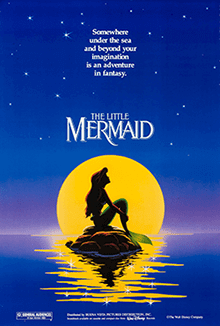
The Little Mermaid
1989
Directed by John Musker & Ron Clements
Welcome back to Movie Monday. First Monday of the month means the countdown of my hundred least favorite movies goes on pause and I get to spend some time with a Disney film I genuinely love. Last month it was Oliver & Company, a scrappy little movie that shared a pitch meeting with something much bigger without anyone quite realizing it at the time. This month we land on the film that pitch meeting eventually produced: The Little Mermaid, the movie that turned “Disney is figuring itself out again” into “Disney is back, full stop.”
I’ve watched this movie more times than I could possibly count. Let’s get into why.
Where I Come From on This One
This was appointment viewing in my house. Not in the sense that I sat down and watched it once with reverence. In the sense that the tape got worn thin from repetition, the way certain VHS copies from that era just did if a household had a kid who’d found a movie they loved.
I didn’t know, watching it as a kid, that I was watching something that mattered to the history of an entire animation studio. I just knew Ursula scared me in the specific, delicious way that only the best Disney villains manage, and that “Under the Sea” was the kind of song that got stuck in a kid’s head for the rest of the afternoon and most of the evening too. It’s only looking back as an adult, and looking into how this thing actually got made, that I’ve come to appreciate how close it came to not happening the way it did at all.
A Story Almost Shelved Twice
The Little Mermaid has a genuinely strange origin, because in a sense Disney tried to make this movie twice, decades apart, and abandoned it the first time.
Walt Disney himself had wanted to adapt Hans Christian Andersen’s fairy tale back in the years right after Snow White and the Seven Dwarfs, as part of a planned package film built around several of Andersen’s stories. That project got cancelled before it went anywhere, and the idea sat dormant for close to fifty years.
It resurfaced almost by accident. Ron Clements found the Andersen story while browsing in a bookstore in 1985, while he and John Musker were directing The Great Mouse Detective. Clements pitched it in a two-page treatment at one of the “gong show” idea meetings that Jeffrey Katzenberg had started holding with the animation staff. Katzenberg passed on it initially, worried it was too similar to a proposed sequel to the live-action mermaid comedy Splash. The very next day, though, he came back around and greenlit it for development, in the same wave of approvals that gave the go-ahead to Oliver & Company.
There’s something almost funny about that timing in hindsight. The pitch meeting that would eventually launch the Disney Renaissance sat in the same room as the pitch meeting for a movie about a homeless kitten and a dog with a Billy Joel voice. Nobody walked out of that room knowing which one was about to change everything.
While digging through old files during production, the crew also stumbled onto concept art that artist Kay Nielsen had done for Walt’s abandoned 1930s version. A lot of the story choices the 1980s team made independently turned out to echo decisions Nielsen and his contemporaries had already landed on fifty years earlier, without anyone on the new team having seen that old work first.
Katzenberg’s Skepticism and the Almost-Cut Song
Even after approving the project, Katzenberg wasn’t fully convinced it would be a hit. He reportedly warned Clements, Musker, and the rest of the staff that because the film would appeal heavily to a female audience, it would likely underperform compared to Oliver & Company, which had just become the studio’s biggest animated box office success in a decade.
He came around eventually, and by the time the film was closer to completion he was predicting it would be Disney’s first animated feature to clear $100 million domestically. It fell short of that specific number in its initial run, landing at roughly $84 million domestically, but it still out-earned Oliver & Company by a wide margin and became the highest-grossing animated film from its initial theatrical run up to that point.
One of the film’s signature songs nearly didn’t survive test screenings at all. “Part of Your World” reportedly played poorly with a young test audience, who got restless during the number, and Katzenberg wanted it cut entirely. Musker, Clements, Howard Ashman, and animator Glen Keane all pushed back, pointing to the famous story of “Over the Rainbow” almost being cut from The Wizard of Oz for similar reasons. Keane held his ground until the film was further along, and a second test screening with a more finished, colorized version of the scene tested much better with a different group of kids. The song stayed, and it’s hard to imagine the movie without it now.
Building a Broadway Musical Underwater
Howard Ashman’s arrival on the project is one of those hinge points that’s easy to undersell. He came aboard originally to contribute a single song to Oliver & Company, but his influence on The Little Mermaid went much further. He pushed to change a minor English butler crab character into a Jamaican crab and to shift the musical style of the whole film around that choice, which is how Sebastian became Sebastian. Alongside Katzenberg, Clements, and Musker, he helped reshape the story into something with a genuinely Broadway-style structure, where the songs weren’t decoration but load-bearing parts of the storytelling.
Ashman and composer Alan Menken had already made a name for themselves writing the Off-Broadway hit Little Shop of Horrors, and that partnership produced the entire score here. It paid off about as well as a partnership can. The film won the Academy Award for Best Original Score and Best Original Song for “Under the Sea,” and the soundtrack eventually went six times platinum, an enormous achievement for an animated film at the time.
The Most Expensive Bubbles Disney Ever Drew
The animation side of this production is where the sheer scale of the studio’s investment really shows. More money and staff went into The Little Mermaid than any other Disney animated film in decades, and the studio opened an entirely new satellite animation facility in Florida partly to help support it.
The underwater setting demanded more effects animation than anything Disney had attempted since Fantasia. Effects supervisor Mark Dindal estimated that over a million individual bubbles were hand drawn for the film, on top of airbrushing, backlighting, and other optical tricks needed to sell the sensation of being underwater. Some of that bubble work was farmed out to a production facility in Beijing, since there wasn’t enough in-house capacity to handle it all.
There’s also a neat bit of trivia buried in the credits of animation history here. The Little Mermaid was the last Disney film to be finished using the traditional hand-painted cel process and the last to use the multiplane camera, the same tool the studio had relied on since Snow White. The next film, The Rescuers Down Under, moved to a new digital ink-and-paint system developed with Pixar. A prototype version of that system was actually tested on a handful of shots in The Little Mermaid itself, including the film’s closing shot of Ariel and Eric’s wedding ship sailing off under a rainbow, which makes that particular image a genuine bridge between two different eras of the studio’s technical history.
The animators also went further than usual with live-action reference footage, filming actors performing key scenes to guide the animation. Ariel’s underwater movement drew partly from footage of Sally Ride during actual spaceflight, used as a reference for how hair might drift in a weightless environment, which is a wonderfully specific and slightly odd detail to learn about a mermaid cartoon.
Casting Choices That Almost Happened
Pat Carroll’s Ursula is one of the most purely enjoyable villain performances in the Disney canon, and it’s strange to learn how far down the casting list she actually was. The role was originally written with Bea Arthur in mind, and after Arthur turned it down, the studio considered a fairly wide range of performers before landing on Elaine Stritch. Stritch was actually cast and recorded material, but clashed with Ashman’s approach to the music, and Carroll ultimately stepped in and made the role hers.
Ursula’s visual design pulled from drag performer Divine, with an assist from a suggestion Ashman made based on his fondness for Dynasty, specifically Joan Collins’s Alexis Carrington. It’s a combination that shouldn’t work on paper and absolutely does on screen.
A few other casting near-misses are worth mentioning too. Jim Carrey reportedly auditioned for Prince Eric, and comedians Bill Maher and Michael Richards were both considered for the role of Scuttle. It’s genuinely difficult to imagine the finished film with any of those choices in place of what we actually got.
What the Movie Made Possible
None of this context matters much if the finished film hadn’t landed, and it landed hard. Critics were enthusiastic on release, and that reception has held up remarkably well in the decades since. Roger Ebert singled out Ariel specifically for being a character who thinks and acts on her own initiative rather than passively waiting on fate, which was a genuinely notable thing to say about a Disney heroine in 1989. Janet Maslin at The New York Times called it a film designed to delight audiences of every kind, and that’s about as accurate a one-line summary of its appeal as I’ve seen.
The film earned three Academy Award nominations, which made it the first Disney animated feature to be nominated for anything since The Rescuers back in 1977. It also became Disney’s first animated feature to earn both major box office and critical acclaim since The Jungle Book, more than two decades earlier. In 2022, it was added to the National Film Registry for its cultural and historical significance, which is about as formal a stamp of importance as a movie can receive.
The bigger story, though, is what came after it. The Little Mermaid didn’t just succeed on its own terms. It re-established the musical structure as the standard format for Disney animated films, a format the studio had drifted away from through the 1970s and much of the 1980s. Beauty and the Beast, Aladdin, and The Lion King all followed in the years immediately after, and Walt Disney Feature Animation grew from roughly 300 staff members in 1988 to over 2,000 by the end of the following decade. That’s the actual shape of the Disney Renaissance, and this is the film that kicked the door open for it.
The film’s reach didn’t stop at theaters and home video either. A prequel television series ran on CBS in the early 1990s, a direct-to-video sequel centered on Ariel’s daughter Melody arrived in 2000, and a stage musical adaptation opened on Broadway in 2008 with new songs added by Menken and lyricist Glenn Slater. Disney’s theme parks folded the property in just as thoroughly, with meet-and-greet spots for Ariel, a dark ride version of the story at both Disney California Adventure and Walt Disney World, and an entire themed land at Tokyo DisneySea built around the film’s world. A live-action remake arrived in 2023 starring Halle Bailey, with Menken returning alongside Lin-Manuel Miranda to handle new music, which is about as clear a signal as exists that this particular story still has commercial life left in it more than three decades later.
Watching it now, it’s easy to just enjoy it as a well-built, gorgeously animated musical about a headstrong young mermaid who wants something bigger than the life she was handed. But it’s worth remembering every so often that this particular fairy tale almost got shelved twice across two different decades, and that the confidence it eventually gave an entire animation studio wasn’t guaranteed. It could very easily have stayed a two-page pitch in a drawer somewhere.
What’s your own history with this one? Was it appointment viewing in your house the way it was in mine, or did it come to you later? Let me know in the comments.
Next Monday, we’re back to the countdown, and I know this next one is going to ruffle some feathers. The next entry on my list of least favorites is Cinderfella, the 1960 musical-comedy take on Cinderella starring Jerry Lewis. I already know how some may push back on this one. I’m doing it anyway. See you next week.

