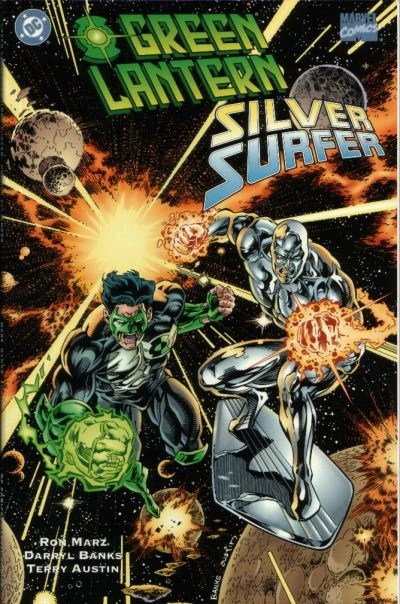
There’s a very specific kind of thrill that only exists if you were buying comics off a spinner rack or out of a cardboard long box in the mid-90s. It’s the thrill of the “special.” Not an ongoing series, not an annual, but a one-shot event book with a cover that practically screamed at you from across the shop: this is a big deal, and if you don’t buy it right now, you are going to hear about it from everyone at school on Monday.
That’s exactly the energy I remember around Green Lantern/Silver Surfer: Unholy Alliances. I was a Green Lantern kid before I really understood what that meant, still getting used to the idea that the ring belonged to some guy named Kyle Rayner instead of the space cop with the jaw you could cut glass with. And here was a book promising that my new, unproven Green Lantern was about to share a cover with the Silver Surfer, a Marvel character I mostly knew from cartoons and older kids’ back issues. It felt like watching two neighborhood legends who’d never met finally get introduced at a birthday party, and you weren’t sure if they’d hit it off or start a fight in the backyard.
Thirty years later, with a longbox habit that never fully went away, I pulled this issue back out to see if it still holds up, or if it’s one of those nostalgia traps that only works if you don’t look too closely. The answer, it turns out, is a little bit of both, which honestly feels like the most 90s comics answer there is.
The Setup: A Prologue Nobody Told You Was a Prologue
Cover-dated February 1996, Unholy Alliances was written by Ron Marz with art by Darryl Banks and inks from Terry Austin, the same creative team steering Green Lantern at the time. What a lot of readers didn’t realize when they picked this up off the shelf is that they weren’t just holding a novelty crossover. They were holding the quiet, table-setting prologue to DC vs. Marvel, the massive event miniseries that would let fans vote on which universe’s characters would win in a fight and eventually spawn the gloriously weird Amalgam Universe.
That context matters, because it explains why the plot of this one-shot feels less like a done-in-one adventure and more like the first act of something bigger. The story opens with Cyborg Superman, fresh off destroying Coast City in the main Green Lantern books, finding his way into what turns out to be the Marvel universe. He starts wrecking a populated planet to rebuild Warworld, because if there’s one thing Cyborg Superman loves, it’s redecorating with rubble. The Silver Surfer shows up to stop him, and in the middle of that fight, a third figure arrives: Parallax, who used to be Hal Jordan before grief and cosmic power turned him into something considerably scarier.
Meanwhile, back on what we now understand is a completely different Earth, Kyle Rayner is doing something delightfully mundane. He’s designing a logo for his friend Radu’s coffee shop when an axe-wielding brute named Terrax shows up and starts causing chaos in the park. Terrax, if you don’t know him, is a former Herald of Galactus, which is a job title that tells you everything about the scale of trouble Kyle just walked into. He gets help from an unexpected source: Thanos, who arrives just in time to send Terrax packing and then recruits Kyle into a scheme that’s a lot less noble than it first appears.
When Grief Meets Grief
The emotional center of this book, if a crossover cash-grab can be said to have one, is the meeting between Silver Surfer and Parallax. Both characters are defined by loss and by having given up something essential of themselves. The Surfer gave up his freedom and, in a sense, his soul to save his homeworld by serving Galactus. Parallax lost the woman he loved and the city he swore to protect, and let that grief curdle into a belief that he had the right and the power to undo it.
Marz leans into this parallel more than you’d expect from a book that exists mostly to justify putting two cosmic heavy hitters on the same cover. The Surfer can genuinely relate to Hal’s pain, which is what makes it so easy for Parallax to talk him into helping restore Oa and Coast City using their combined power. It’s a legitimately clever bit of character work, using the Surfer’s own history of being manipulated by a more powerful being to explain why he’d fall for it again, this time as a willing accomplice rather than a victim.
Of course, Thanos is using Kyle’s power ring the entire time to drain the residual cosmic energy left behind by Oa’s destruction, all part of a scheme to close the dimensional rift between the two universes on his own terms. When Parallax and Silver Surfer figure out they’re being played, the book delivers the moment you bought the issue for in the first place: the actual fight between the four cosmic-tier characters, with reality itself getting rebuilt and demolished as collateral damage.
It resolves the way these things usually do, with the heroes recognizing they were pawns and working together to drain the excess power, closing the rift and sending Thanos and the Surfer back to their own universe. Kyle gets a farewell moment with a character who, for one issue, treated him like a legitimate peer instead of the new kid holding a legendary ring. And then, in the last panel, a glowing box sits in a New York alley, a dangling thread that pays off directly in DC vs. Marvel #1.
Does It Actually Hold Up?
Here’s where I have to be honest with you, because pretending every comic from my childhood is a masterpiece does nobody any favors.
The plot mechanics are pure mid-90s crossover logic. Thanos needing Kyle’s specific ring energy to power a machine is the kind of plot device that exists because the story needs an excuse to keep Green Lantern relevant in a book that’s really about two much older, much more powerful characters settling cosmic business. Terrax shows up mainly to give Kyle something to punch before the real threat arrives, and once he’s served that purpose, he’s shipped back to his own universe and never mentioned again. If you’re looking for tight, efficient plotting, this isn’t it.
But where the book earns its keep is in the character voice work, especially for Kyle. Marz writes him with the same wide-eyed, slightly overwhelmed energy that made the early Kyle Rayner issues work in the first place. He’s not pretending to be Hal Jordan. He’s a struggling artist who got handed enormous power and is trying to figure out how to be a hero without a rulebook, and that voice survives contact with two of Marvel’s biggest cosmic players completely intact. There’s a specific moment where Kyle, realizing he’s been used, calls Thanos out directly, and it reads less like a rookie posturing and more like someone who’s genuinely angry about being lied to. That’s good character writing hiding inside an event book that didn’t strictly need it.
Darryl Banks and Terry Austin’s art also holds up better than you’d expect. Banks had a clean, dynamic style that suited the cosmic scale of the story, and Austin’s inks give everything a polish that a lot of 90s crossover art sorely lacked. Silver Surfer, in particular, looks genuinely otherworldly here, which is not a guarantee when a DC-house artist draws a Marvel character for the first time.
The 90s Comic Collecting Angle
I want to talk for a second about what it actually felt like to own this book in 1996, because I think that context is as important as the plot itself.
Crossovers like this weren’t just stories. They were events you prepared for. You’d hear rumblings in Wizard magazine, catch a glimpse of the cover in a Diamond Comic Distributors order form your local shop owner let you flip through, and then you’d show up on release day hoping the shop hadn’t sold out. There was no internet spoiler culture waiting to tell you exactly what happened before you got your hands on the actual pages. You bought the book, you read it standing in the parking lot because you couldn’t wait until you got home, and then you spent the next week trying to explain the plot to friends who hadn’t picked it up yet.
Unholy Alliances had an added layer of mystery because most readers had no idea it was connected to anything bigger. DC and Marvel doing a joint miniseries felt like a rumor too big to be true, the kind of thing you’d hear about and assume was fan fiction someone was passing off as an announcement. So when this one-shot dropped with that glowing box in the last panel and no clear explanation of what it meant, it became the thing you brought up at the shop the following Wednesday, hoping someone behind the counter had more information than you did.
That anticipation is something I genuinely miss. Not in a “everything was better back then” way, because plenty of things about comics in the 90s were a mess, foil covers and dubious storytelling choices included. But there was a patience baked into being a fan that doesn’t really exist anymore, and reading this issue again brought a lot of that feeling back. I still have my original copy, a little soft at the corners from being read and reread, tucked into a longbox that has moved with me through more apartments than I care to count. Books like this are why I never could bring myself to sell off the collection, even during the years when money was tight and a box of old comics felt like an easy way to make rent.
Where It Fits in the Bigger Picture
For anyone tracing the larger DC vs. Marvel continuity, this issue matters more than its slim page count suggests. It’s the story that establishes the DC and Marvel universes exist as separate dimensions rather than the same shared reality, a distinction that becomes crucial for every crossover that follows, right up through JLA/Avengers years later. Ron Marz would go on to reference the events of this issue in later Green Lantern stories, including a nod in Parallax: Emerald Night where Hal Jordan mentions chasing Cyborg Superman “across the universe and even into another.” Small references like that are the kind of connective tissue that made mid-90s DC feel like a genuinely cohesive universe, even when the story doing the connecting was a crossover gimmick.
It’s also worth noting that Kyle’s design work for Radu’s coffee shop, the thing he’s doing when Terrax shows up, actually pays off later in the ongoing Green Lantern series when the logo appears in an issue years down the line. That’s the kind of small continuity touch that tells you Marz was thinking about Kyle as a whole person with a life outside the ring, not just a placeholder hero waiting for Hal Jordan to come back.
Final Verdict
Unholy Alliances isn’t a perfect comic, and it was never trying to be one. It’s a piece of marketing wearing a story’s clothes, designed to build hype for a bigger event and sell readers on the idea that two entire publishing universes were about to collide. But it’s also a genuinely fun read with real character work buried inside the spectacle, especially for Kyle Rayner, who comes out of this issue feeling more like a hero in his own right than he did going in.
If you were there in 1996, standing in a comic shop wondering what that glowing box in the last panel meant, this issue probably still gives you a little bit of that same electricity. And if you weren’t, it’s a solid entry point into understanding just how strange and ambitious mainstream comics were willing to get before crossovers became a predictable, quarterly occurrence.
Did you collect comics during the DC vs. Marvel era, or discover this one later through back issue bins or reprints? I’d love to hear what your first cosmic crossover was and whether it holds up the way this one did for me. Drop a comment and let’s talk about it.

