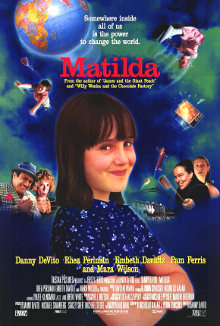
Matilda
1996
Directed by Danny DeVito
Same disclaimer as always, and I mean it more than usual this week: this list is built entirely off my Flickchart rankings, which means it reflects nothing but my own head-to-head preferences played out over thousands of matchups. It is not a measure of quality, cultural impact, or how much a movie deserves your love. If Matilda is a film you grew up on, a film you still watch every fall when the light starts to change, a film that quite possibly shaped your sense of humor and your sense of justice as a kid, I am not here to take that away from you. I’m just explaining why, on my own personal ledger, it lands at number twelve.
Last week I wrote about Rat Race and the way its shock comedy dares you to wince instead of laugh. Matilda is a different animal entirely. This isn’t a film I can accuse of missing its own tone or hiding behind stunt casting. It knows precisely what it’s doing at every moment, and it does most of it well. That’s what makes this one harder to write than most of the entries on this list. I’m not defending a low ranking against a movie’s flaws this week. I’m defending it against a movie that mostly earns the love it gets, just not quite from me.
A Faithful, Loving Adaptation
Danny DeVito took on directing duties here after developing the project through his own Jersey Films, and the affection for Roald Dahl’s 1988 novel shows in nearly every choice on screen. Nicholas Kazan and Robin Swicord’s screenplay keeps the shape of the book intact. Matilda‘s neglectful parents, her tyrannical headmistress, her gift for telekinesis born out of frustration rather than magic for magic’s sake, and her rescue by a teacher who finally sees her all survive the transition from page to screen with their teeth intact. That’s not a given. Dahl adaptations have a long history of softening the author’s cruelty into something more palatable, and this one largely resists that temptation.
DeVito also narrates the film himself, which gives the whole thing a storybook remove even as it plays out some genuinely dark material. It’s a smart choice. Hearing Harry Wormwood’s own actor set up his daughter’s abuse and neglect in a warm, knowing voice keeps the film from feeling as bleak as its ingredients might suggest on paper.
Getting the Rights Right
The path to this film even existing wasn’t especially smooth. Universal Pictures won the rights to adapt Matilda back in November of 1993, following a competitive bidding war against Columbia Pictures for Kazan and Swicord’s script. Once DeVito attached himself to direct, disagreements over budget with the producers at Bregman-Baer led Universal to put the project into turnaround, and it eventually landed at TriStar Pictures, a sister company to Columbia, which is how the studio that lost the original bidding war ended up making the movie anyway.
There’s also a small piece of casting trivia I like a lot. Miriam Margolyes, who would go on to play the equally memorable Aunt Sponge in James and the Giant Peach that same year, actually auditioned for the role of Trunchbull before Ferris landed it. It’s fun to imagine that alternate version of the film, though I don’t think it would have changed my own reaction to it much either way.
The Gilliam-by-Way-of-DeVito Look
Visually, this is one of the more distinctive kids’ films of its decade. DeVito and cinematographer Stefan Czapsky leaned hard into wide-angle lenses and exaggerated perspective, a style with clear DNA from Terry Gilliam’s work. Trunchbull’s office towers over Matilda in ways that feel less like set design and more like a child’s actual memory of an intimidating adult. The Wormwood household is shot with the same distorted confidence. Every room in this movie looks like it’s actively working against the people who don’t belong in it, and Matilda spends most of the runtime as someone who doesn’t belong.
I respect this choice enormously as craft. It’s the rare kids’ movie that trusts its visual language to do emotional work rather than just settling for bright colors and flat coverage. My hesitation isn’t with the technique itself. It’s with how that technique interacts with the material sitting underneath it, and that’s where I start to peel away from the audience that adores this film.
Where the Uneasiness Creeps In
Here’s my honest issue with Matilda, and it has less to do with any single scene than with the overall experience of watching it. Dahl’s books have always lived in a strange, specific register where real cruelty gets filtered through a child’s exaggerated perception of it, and that balance is genuinely hard to translate to live action. The book works because it’s prose, and prose lets your imagination soften or heighten the ugliness as it needs to. Put actual actors in an actual iron maiden, put an actual grown woman hurling an actual child by her pigtails across an actual schoolyard, and the exaggeration doesn’t read as safely cartoonish to me the way it apparently does for most viewers. It reads as unsettling in a way the film’s storybook narration doesn’t quite talk me out of.
Pam Ferris’s Agatha Trunchbull is a genuine performance, not a cardboard cutout of a villain, and that’s exactly the problem for me. She’s frightening in a way that feels grounded even inside all that Gilliam-esque distortion, and the film asks me to laugh at her cruelty roughly as often as it asks me to fear it. I can see why that tonal tightrope walk is beloved. Dahl fans will tell you it’s the whole point. I just find myself watching it from a slight remove instead of getting swept up in it, admiring the construction rather than feeling the thing the construction is built to make me feel.
This is not a complaint about the film being too dark for children. Dahl’s whole career is built on trusting kids with darkness adults often don’t. My issue is narrower and more personal than that. It’s that the same qualities that make this film brave and faithful to its source are the ones that keep me at arm’s length from it, and I don’t think that’s a flaw in the movie so much as a mismatch with my own particular taste.
I’ve tried to pin down why this same combination works so effortlessly for other Dahl adaptations I love and doesn’t quite land for me here, and the closest I’ve come is that some of those films let the whimsy lead and let the cruelty hide underneath it, while Matilda often puts them side by side in the same frame and asks you to hold both at once. That’s a genuinely bold storytelling choice, and it’s clearly the correct one for the vast majority of people who’ve grown up with this movie. I just find myself doing the tonal math a beat too consciously to fully lose myself in it the way I want to.
A Cast Doing Everything Right
None of this is a knock on the performances, which are close to uniformly excellent. Mara Wilson carries the film with a stillness that’s remarkable for a child actor, never overplaying Matilda’s intelligence or her hurt. Embeth Davidtz gives Miss Honey a wounded gentleness that makes her backstory land even in a film that has to rush through a lot of plot. Danny DeVito and Rhea Perlman are gleefully awful as the Wormwoods, committing fully to characters who could easily have become one-note. And Ferris, again, is doing real work as Trunchbull even if my own reaction to that work is complicated.
There’s also a piece of behind-the-scenes commitment here that’s hard not to respect once you know about it. Ferris got chalk dust in her eyes filming the climactic eraser sequence because the scene required her to keep them open, and she needed several hospital visits to flush it out. The scene where Trunchbull swings Amanda Thripp by her pigtails required a harness rigged through the girl’s hair with the wires looped around Ferris’s fingers, and the force of the spin tore her finger badly enough to need stitches. That’s the kind of practical, bruised commitment that a lot of modern effects-driven filmmaking has lost, and it’s baked into every frame of that sequence.
The production also found some memorable real-world stand-ins for its fictional world. Trunchbull’s imposing home is the actual Crank House in Altadena, while Matilda’s own house was shot on a quiet residential street in Whittier. There’s a nice bit of tribute buried in the set dressing too. The portrait of Miss Honey’s late father Magnus that hangs in her old house is an actual photograph of Roald Dahl himself, a quiet nod from a film that clearly wanted to honor the author even while adapting him for the screen.
A Story Behind the Story
There’s one more piece of context that changes how I watch this film every time I revisit it. Mara Wilson’s mother, Suzie Wilson, was diagnosed with breast cancer during filming and died in April of 1996, just months before the movie’s release. The film is dedicated to her memory, and DeVito has said he made sure she got to see the final edit before she passed so she could watch her daughter’s performance. Knowing that reframes the film’s central relationship, a girl finally seen and cared for by someone who chooses her, into something quietly devastating happening just off screen during production. It’s the kind of detail that makes me want to sit with this movie’s sincerity even when the tone elsewhere keeps me at a distance.
The Critical and Commercial Picture
Matilda arrived to real critical affection. It holds a 92 percent approval rating on Rotten Tomatoes across 25 reviews, with an average score of 7.6 out of 10, and the site’s consensus praises DeVito’s direction alongside the film’s faithfulness to Dahl’s spirit. Metacritic places it at 72, a solidly favorable score. Roger Ebert gave it three stars out of four, singling out Trunchbull as a villain kids could enjoy specifically because she was too outsized to take entirely seriously while still landing as genuinely mean, and noting that most children have felt at some point that their own parents weren’t being fair to them either. Empire’s Caroline Westbrook also gave it three stars and praised DeVito’s direction.
Audiences responded warmly too, with a CinemaScore of B+, suggesting the darker material never actually alienated the crowds it was aimed at. What audiences didn’t do was show up in the numbers the studio hoped for. The film opened at $8.5 million domestically, finishing third for its weekend behind A Time to Kill and Independence Day, and went on to gross $33.5 million domestically and $47 million worldwide against a $36 million budget. That made it a box office disappointment on release, a rare instance of a well-reviewed, well-loved film simply not connecting with a wide enough audience in theaters. Its afterlife on home video is where the movie actually found the audience it has now, and where most of its reputation as a classic was built.
Where That Leaves It
I want to be clear about what’s driving this ranking, because it isn’t a laundry list of complaints. Matilda is well made, well acted, faithful to a book I respect, and clearly the product of people who cared about getting it right. Ferris and Wilson alone would be enough to justify the film’s reputation. I don’t think this movie makes a wrong choice so much as it makes choices that consistently sit just slightly outside where my own taste lives. The visual daring that critics rightly praise is the same daring that keeps me watching from a small remove instead of getting pulled all the way in, and no amount of respect for the craft on display has managed to close that gap for me on any of my rewatches.
That’s really the whole case. Not a bad movie. Not even a movie I’d talk anyone out of loving. Just a movie that, for whatever quirk of my own wiring, has never quite clicked the way it clearly has for almost everyone else who’s seen it.
Next Time on Movie Monday
Next week we’re leaving beloved classics behind entirely, in more ways than one. We’re heading into rapture, betrayal, and a Growing Pains alum trying to convince the world the Antichrist runs the United Nations. Left Behind, the 2001 theatrical release of the direct-to-video Christian thriller starring Kirk Cameron, is next on the list, and I promise you this one earns its spot for reasons that have nothing to do with tone being too subtle for me. See you Monday.
 The Confusing Middle