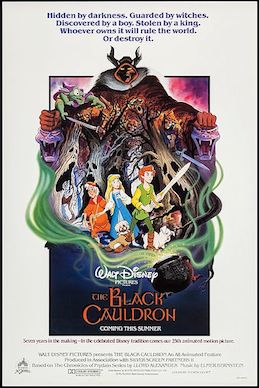
The Black Cauldron
1985
Directed by Ted Berman and Richard Rich
Welcome back to Movie Monday. As we do every first Monday of the month, we’re setting aside the disasters for something I actually enjoy. This month we’re going dark — darker than Disney had ever gone before, in fact — with the studio’s 1985 animated film The Black Cauldron.
And I want to be honest about something from the start: I came to this one late. Embarrassingly late, honestly. This was a film I knew of for most of my childhood. I was aware it existed. I knew it was Disney. I knew it was supposed to be scary and weird and different. But for whatever reason, our family never owned it on VHS, and it never seemed to turn up when we were browsing the video rental shelves. The Black Cauldron was like this ghost film that I kept hearing about but never actually encountered.
That changed in college. I finally sat down with it, and I have to tell you — I immediately understood why this movie has the cult following it does. It’s flawed in ways I’ll get to, but it is also genuinely unlike anything else in the Disney catalog. And the story of how it got made, how it almost didn’t get made, and how it nearly took the entire Disney animation studio down with it is one of the most fascinating chapters in animation history.
Let’s talk about all of it.
Where It Falls
The Black Cauldron sits at an interesting and slightly uncomfortable position in the Disney timeline. It belongs to what film historians and animation critics have come to call the “Dark Age” of Disney animation — that stretch from roughly The Jungle Book (1967) to The Little Mermaid (1989), when the studio was trying to figure out what it was supposed to be without Walt Disney at the helm. I covered this era last month with The Fox and the Hound, which I’d put near the top of that pile.
The Black Cauldron lands somewhere in the middle. It is neither the quiet confidence of The Fox and the Hound nor the cheerful mediocrity of some of the era’s lesser entries. It is something stranger and more interesting than either: a film that was genuinely trying to do something ambitious and new, that got caught in an extraordinary amount of institutional chaos, and that emerged on the other side as something incomplete but undeniably alive. Watching it knowing what it went through feels a little like watching a boxer who took a dozen hits before the bell and still somehow made it through the round.
A Studio at War With Itself
Here’s where the story gets genuinely compelling, because the production history of The Black Cauldron is almost more interesting than the finished film.
Disney had acquired the rights to Lloyd Alexander’s Chronicles of Prydain series back in 1973, with actual production beginning in 1980. From the very beginning, the project was ambitious in a way that made people at the studio nervous. The goal was explicit: they wanted to make a PG-rated film that would attract an older audience. Disney had spent years making movies that appealed primarily to very young children, and the people running the studio in the early eighties understood that this was a problem. Teenagers were going to the movies. Disney wanted teenagers. The Black Cauldron was supposed to be the answer.
That ambition created immediate friction with the studio’s institutional conservatism.
Director John Musker — who would later co-direct The Little Mermaid and Aladdin — was initially attached to the project and found his ideas repeatedly dismissed by the older guard. Producer Joe Hale came on board and made a series of significant creative decisions, including discarding visual character artwork submitted by Tim Burton, who was working at Disney at the time. That’s a sentence worth sitting with for a moment. Tim Burton’s concept art, rejected.
Hale brought in directors Ted Berman and Richard Rich, and the team began building something genuinely dark. The Horned King — voiced by John Hurt in what is a legitimately terrifying performance — was reimagined as a gaunt, hooded figure with a spectral presence and glowing red eyes. There would be no comic relief villain here. No bumbling henchmen with slapstick running gags. The Horned King was meant to frighten you, and he does.
Then came the test screening.
The Katzenberg Intervention
Shortly before the film’s planned Christmas 1984 release, a test screening was held at the studio’s private theater in Burbank. The film — and particularly the climactic sequence in which the Cauldron-Born, an army of undead warriors, pour out into the world — proved genuinely too intense for the children in the audience. The newly appointed Disney studio chairman Jeffrey Katzenberg ordered cuts.
What followed was the stuff of animation legend. Producer Joe Hale, who had spent years building this film, objected strenuously. Katzenberg responded by having the film physically brought into an editing bay and beginning to edit it himself. Hale informed the newly appointed Disney CEO Michael Eisner, who called Katzenberg directly in the editing room and told him to stop. Katzenberg did — but he also insisted the film be reworked, and the Christmas 1984 release was pushed to July 1985 so that changes could be made.
The finished film was cut by approximately twelve minutes. Many of those cuts involved violent content — extended sequences of the Cauldron-Born mauling the Horned King’s own henchmen, scenes that apparently left test screening children genuinely unsettled. You can actually see the seams in the finished film if you know where to look. The Cauldron-Born sequence has recognizable jumps in the soundtrack where material was removed, continuity lapses that exist because the scenes were excised after the fact rather than written out from the beginning.
What did we lose? Based on accounts from people who worked on the film, we lost some of the darkest animation Disney had ever produced. The scenes that survived are already pushing the edge of what the studio had ever done. The scenes that were cut were apparently more intense still.
What the Film Gets Right
None of this is to say that what remains is a failure. Far from it.
John Hurt’s performance as the Horned King is extraordinary. Hurt brings the same gravity and controlled intensity to this role that he would bring to films like The Elephant Man (1980) — a quality of focused, aristocratic menace that never tips into camp. When the Horned King speaks, you feel the chill. He is one of the genuinely underrated villain performances in Disney’s catalog, largely because so few people have seen the film.
The animation itself, for all the chaos behind the scenes, contains moments of real beauty. The Black Cauldron was the first Disney animated film to incorporate computer-generated imagery — used here for the cauldron itself, for a boat, for floating orbs of light, for bubbles. It looks slightly primitive by later standards, but at the time it was genuinely groundbreaking. You are watching the future arriving in real time.
The world of Prydain has a visual texture that feels genuinely different from the bright, clean aesthetic of the studio’s earlier work. This is a dark, misty, medieval world, and the artists committed to it fully. The Horned King’s castle is legitimately imposing. The cauldron’s sequences have a dread weight that the cut scenes would have only amplified.
And then there is Gurgi, voiced by John Byner, who is either deeply charming or profoundly annoying depending on your tolerance for childlike creature companions — I find him charming — and whose self-sacrifice in the film’s climax hits with genuine emotional force. A creature who spent the entire film being underestimated jumps into the Black Cauldron to save his friends, knowing what it will cost him. It’s a genuine moment. The film earns it.
The Box Office Disaster and What It Meant
The Black Cauldron was, by any financial measure, a catastrophe. It cost $44 million to produce — making it the most expensive animated film ever made at the time — and grossed just $21.3 million domestically. It was not only outgrossed by The Care Bears Movie, a film made for a fraction of the budget, but also by a theatrical rerelease of One Hundred and One Dalmatians, a film that had already been in theaters twenty-four years earlier. It earned the nickname “the film that almost killed Disney.”
The fallout was significant. The animation department was moved from the original Animation Building at the Burbank studio to a facility in nearby Glendale. The film was not released on home video until 1998 — thirteen years after its theatrical run — which is a large part of why so many people my age grew up having heard of it but never seen it. Disney essentially tried to make it disappear.
And yet it didn’t disappear. It found its audience eventually, one VHS rental and late-night cable screening at a time, and it built the cult following it has today. People who love The Black Cauldron tend to love it with a particular intensity, the way you love something you had to work to find. There’s a sense among its admirers that the world got it wrong, that this film deserved better, that the version that exists is only a fragment of what it could have been if the scissors had stayed in the drawer.
I’m one of those people. Coming to it in college, without the childhood nostalgia that softens so many of these films in our memories, I watched it fresh and found something that genuinely surprised me. It is not a perfect film. It is not even a fully realized film. But it is a bold film, and boldness in the Disney Dark Age was rarer than it should have been.
The Legacy
There’s a postscript worth noting. In 2016, Walt Disney Pictures re-acquired the film rights to The Chronicles of Prydain with the intention of adapting the book series into a live-action feature film series. As of this writing, that project remains in early development with no director, producer, or screenwriter attached.
Lloyd Alexander, the author of the original books, put it as well as anyone when he reflected on the 1985 film: he found no resemblance between the movie and his books, but he enjoyed the movie as a movie. What he hoped was that anyone who watched it would then go read the books, which he described as a more powerful, moving story with considerably more depth.
That seems right to me. The film is not the books. But the film is its own strange, dark, troubled, beautiful thing, and it deserves to be seen.
Final Verdict
The Black Cauldron is a film that was cut against its will, released into a marketplace that didn’t want it, buried by its own studio for over a decade, and then quietly, stubbornly refused to be forgotten. John Hurt is terrifying. The animation has genuine ambition. The Horned King is one of the most effectively menacing villains Disney ever put on screen. And the version we have, for all its visible scars, is still more interesting than a dozen safer, more polished films from the same era.
I came to it late. I’ve been making up for lost time ever since.
Next Monday we return to the regularly scheduled disasters, and the next entry on my list is one I find genuinely baffling — not just bad, but baffling in the particular way that movies are when you can’t quite figure out who they were made for. That film is Hope Floats, the 1998 romantic drama starring Sandra Bullock and Harry Connick Jr., which combines a country music soundtrack, a small-town Texas setting, and a premise that should theoretically work, and somehow produces a film that left me feeling like I’d missed something everyone else understood. We’ll dig into it next week.

