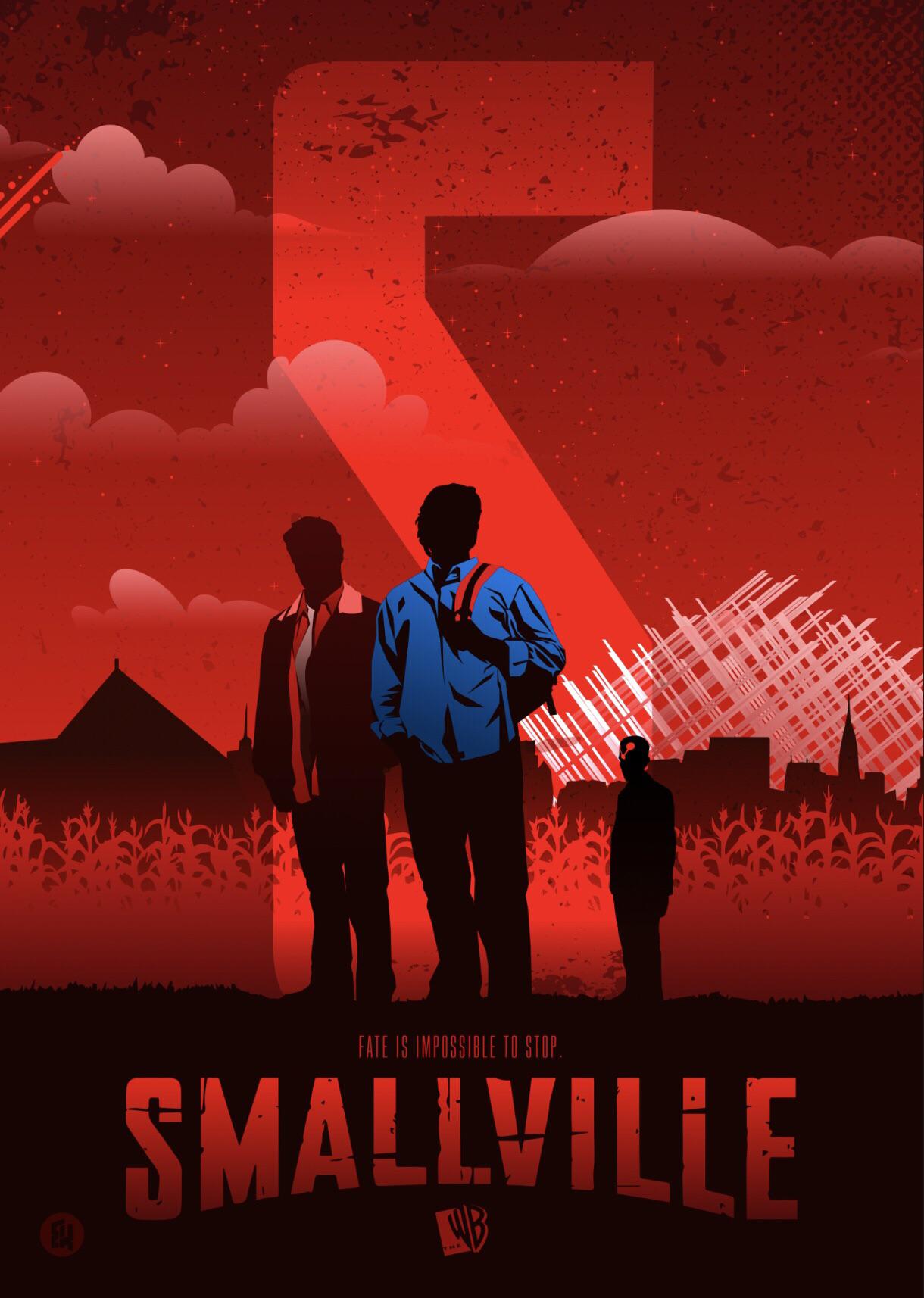
Welcome back to Rewatching Smallville, my weekly dive into the iconic series that explores Clark Kent’s journey before becoming Superman. Whether you’re a long-time fan or new to the show, you’re invited to join in each Tuesday as I revisit episodes and share my thoughts and observations. Be sure to share your own memories and theories in the comments below!
Last week, “Tomb” gave us an Allison Mack showcase disguised as a ghost story, and it earned every quiet moment of that Chloe-and-her-mother ending. It was the kind of mid-season episode that reminds you why this show works best when it trusts its characters over its plot mechanics.
This week, Smallville does something it’s always been pretty good at: it takes a hero you already know from the comics, strips away the cape and the mythology, and asks what the origin story actually feels like from the inside. The answer, in the case of Victor Stone, is: lonely. And a little angry. And deeply human in spite of everything that’s been done to make him less so.
“Cyborg” is episode 103, and it’s a better episode than its reputation — or lack thereof — might suggest.
Before We Get Into It: Who Is Victor Stone?
Because the episode earns a deeper conversation about this, let’s take a moment.
In the comics, Victor Stone made his first appearance in DC Comics Presents #26, back in October of 1980 — created by Marv Wolfman and George Pérez as part of their foundational run on The New Teen Titans. The origin there is darker than what Smallville gives us. Victor’s parents were scientists who used their son as a test subject for intelligence enhancement experiments when he was a child — experiments he deeply resented. As a teenager, he was an athlete, estranged from his parents and their world. Then a lab accident happened. A dimensional portal ruptured, a creature came through, and Victor’s mother was killed. His father, desperate and guilty, rebuilt his son’s body with experimental cybernetic parts to save his life.
Victor survived. But he woke up looking like a machine. And he had to figure out how to live inside that.
The comics version of Cyborg has always been fascinating precisely because his tragedy isn’t really the accident — it’s the aftermath. The alienation. The question of whether you’re still yourself when half of what you are is metal and circuits. He’s a hero whose superpower is also his wound, and Wolfman and Pérez used him to explore questions about identity, bodily autonomy, and belonging that were genuinely ahead of their time for a mainstream superhero comic in 1980.
Decades later, Victor Stone’s profile has risen enormously. He graduated from the Teen Titans to full Justice League membership during the New 52 relaunch in 2011, becoming a founding member of DC’s premier superhero team. He’s appeared in Justice League animated series, had a prominent role in the theatrical Justice League film, and has become one of the more recognizable DC heroes of the modern era. The character’s journey from “team’s tech guy” to full-blown cultural touchstone is one of comics’ better long-game success stories.
Smallville‘s version of Victor Stone, introduced here in Season Five, is a significant adaptation. The LuthorCorp experimentation replaces the parental tragedy of the comics origin, and Victor’s backstory is simplified — a car accident survivor rebuilt against his will by corporate science rather than by a grieving father. It loses some of the complicated emotional texture of the source material (the father-son dynamic in the comics is genuinely rich and thorny). But what it keeps is the essential core: a young man who didn’t ask for any of this, who is trying to figure out whether he’s still the person he was before someone decided to turn him into an experiment, and who is looking at the person he loves and wondering whether she can possibly still love him back.
That’s Victor Stone. And on Smallville, he’s played by Lee Thompson Young.
A Word About Lee Thompson Young
This is the part of the post I’ve been thinking about how to write since I knew we were getting here.
Lee Thompson Young was 29 years old when he passed away in August of 2013. He had been a working actor since he was a teenager — The Famous Jett Jackson made him a Disney Channel staple in the late ’90s and early 2000s — and by the time of his death, he was a series regular on Rizzoli & Isles. He was, by every account, a kind and thoughtful person who brought genuine care to his work.
Watching him in “Cyborg,” that care is evident. Victor Stone is not a showy role. The episode doesn’t ask Young to carry extended monologues or big dramatic sequences. What it asks him to do is be present — to be the kind of person Clark Kent would instinctively want to help, and to make you understand why Katherine would cross whatever distance existed between them to find out if he was still alive. Young does both of those things with a warmth and an understated dignity that the episode is lucky to have.
He was good at this. He deserved more time to show people how good.
If you’ve never looked him up, take a moment. He was a real talent, and “Cyborg” is a small but genuine piece of his work.
The Cold Open and What It Sets Up
The episode wastes no time establishing its stakes. Victor Stone is in a cage in a laboratory, being injected with something by a doctor who is clearly not comfortable with what he’s been asked to do. Dr. Hong — and credit here to the episode for making him sympathetic right out of the gate — apologizes, hands Victor a photograph of a girl, and helps him escape.
Victor runs. Alarms go off. He punches through a metal door like it’s drywall. He gets into the street, and Lana Lang hits him with her SUV at 30 miles per hour, and Victor just… walks it off. The car crumples around him. He’s fine.
It’s a solid cold open because it does the essential work efficiently. We understand what Victor is — or what’s been done to him — before anyone has to explain it. And we understand that he’s trying to get somewhere, to someone, before anything else happens to him.
The someone, of course, is Katherine. And the photograph is everything.
Victor and Clark: The Scene That Works Best
Clark tracks Victor down — because Clark Kent always tracks down the thing that doesn’t add up — and their initial meeting is appropriately tense. Victor throws Clark into a wall and is surprised when Clark shakes it off. Clark X-rays Victor and sees the metal skeleton underneath. They size each other up, two people who are very much not what they appear to be on the surface, and then Clark does what Clark does: he offers to help.
Their barn conversation is the episode’s best scene, and it works because both characters are talking around the thing they actually mean. Victor is describing his situation — the accident, the experimentation, the rebuilding — but he’s really asking whether he’s still a person. And Clark is listening, and recognizing, and trying to give advice he himself hasn’t figured out how to take.
When Victor asks Clark point-blank if he’s bionic too, Clark’s response — “I’m different” — is vintage Smallville Clark. He can’t tell the truth, so he tells the smallest, most technically accurate version of it that he can manage. It’s a limitation we’ve watched for five seasons now, and it still has consequences. Victor asks if Lana knows, and Clark admits she doesn’t. And then Victor asks for advice about whether to tell Katherine he’s alive, and Clark says — with the kind of self-awareness that’s rare for him — that he’s really not the best person to be asking about that.
He’s right. He’s completely right. And the episode is going to spend the rest of its runtime proving it.
The Clark and Lana Problem
Here’s the thing about “Cyborg” that gets overlooked when people talk about it: it’s as much a Clark-and-Lana episode as it is a Victor Stone episode. And it uses Victor’s situation as a prism to show us exactly where Clark and Lana are — and why that’s not a great place.
Lana is, in this episode, doing things that make complete sense for Lana and that are consistently frustrating for Clark. She defends Lex when Clark accuses him. She visits Victor in the barn and encourages him to tell Katherine the truth — advice she delivers with genuine conviction, without seeming to register that she herself is not being told the truth by her own boyfriend. She’s advocating for honesty in someone else’s relationship while existing inside a web of Clark’s secrets that she doesn’t even fully know is a web.
And then there’s the ending. Victor and Katherine reunite, and it’s a good reunion — warm and quiet and earned. Lana watches it happen, and she looks at Clark, and the look on her face is unmistakable. She’s watching what she wants. She’s watching a couple whose love survived something enormous because one of them chose honesty. And she’s standing next to a man who loves her and cannot, will not, bring himself to make that same choice.
The barn conversation that follows is one of the more honest conversations Clark and Lana have all season, which makes it one of the sadder ones. Lana asks him why he quit football. Clark shrugs. She asks him why he always hides what he’s feeling. She tells him that Victor and Katherine’s relationship is what theirs was at its best — and that mostly theirs just goes in circles. She asks him directly: does he still love her?
He says yes. He always has, he always will.
And Lana leaves without another word.
Because “yes, I love you” is not the answer to the question she was actually asking. The question she was asking is closer to: why won’t you let me in? And Clark doesn’t have an answer to that one. He never does. Loving Lana has never been Clark’s problem. Trusting her with the truth of what he is — that’s the thing he can’t get to. And “Cyborg” frames that limitation with more clarity than a lot of episodes do, because we’ve just spent an hour watching what it looks like when someone makes the other choice.
Victor told Katherine. Clark can’t bring himself to do the same. The parallel is generous enough not to underscore itself, but it’s there, and it’s doing real work.
Lex and the Season’s Longer Game
Lex is operating on multiple levels in “Cyborg,” which is where Michael Rosenbaum lives best. On one level, he’s the episode’s antagonist — whatever he knew about the SynTechnics project, he ends up delivering Victor back into the laboratory and overseeing the procedure Clark interrupts. On another level, he keeps inserting himself into moments of genuine helpfulness: he offers to get Victor better doctors, he shows up at Dr. Hong’s garage, he frames himself as someone trying to rein in a rogue scientist rather than enable one.
The episode is deliberately cagey about how much of Lex’s version of events is true. Did he know about Kreig’s methods? Was the project something Lex authorized or something that happened underneath him? Smallville has always been most interesting with Lex when it won’t quite answer those questions, and “Cyborg” holds the line.
What it’s less ambiguous about is the patience. Lex notes, specifically and with clear intention, that Lana came to him. Not Clark. Him. He marks the moment for Clark like someone filing away evidence. That’s not a man responding to a crisis. That’s a man watching a chessboard.
The Martha Subplot (And What Lionel Is Actually Doing)
Poor Martha Kent. She can’t catch a break this season, and “Cyborg” continues her particular ordeal with the blackmail plotline that carries over from “Lockdown” — someone has a DVD of Clark pulling Lana from a warehouse explosion, and they want money to keep quiet about it.
Lionel Luthor, because Lionel Luthor cannot simply not be involved in something, inserts himself into the situation, runs off the blackmailer, and wins Martha’s trust. She tells him, sincerely, that she doesn’t turn her back on friends because of what people think.
And then the episode cuts to Lionel in his office, paying off the blackmailer himself, watching his own copy of the DVD, and freezing the frame on Clark’s face. “Your secret is safe with me, Kal-El.”
It’s John Glover being John Glover, which means it’s excellent. The scene recontextualizes every gracious thing Lionel has done in this episode and makes it worse. He wasn’t protecting Martha. He was positioning himself. He bought the secret so he’d be the one holding it. And the fact that he knows the name Kal-El — Clark’s Kryptonian birth name — is a detail the show drops quietly here that’s going to matter a great deal before the season is out.
The Bottom Line
“Cyborg” isn’t trying to be an event episode. It’s a mid-season character piece with a guest star at its center, and it uses that guest star’s situation smartly — both as its own self-contained story and as a mirror for the Clark-and-Lana dynamic that’s been grinding slowly toward its inevitable reckoning all season long.
Lee Thompson Young brings Victor Stone to life with warmth and economy, and the character is strong enough that you want more of him immediately. (The show does bring him back, and that’s a good thing.) The DC Comics version of Cyborg has become one of the more significant heroes in the modern era, and watching this episode now, knowing where Victor Stone ends up in the comics mythology, gives it a kind of added weight — a sense of possibility around a character who’s just getting started.
Lex is menacing in the background. Lionel is menacing everywhere. Clark and Lana are circling a conversation they can’t quite have. And a young man who woke up half-machine, who wasn’t sure the woman he loved could possibly still want him, gets to find out that she does.
That last part is what the episode is really about. Not the kryptonite bracelet. Not the laboratory. The photograph a doctor pressed into Victor’s hand before helping him escape, and the reason he was running toward it rather than just running away.
It’s enough.
What are your memories of Victor Stone’s first Smallville appearance? Did Lee Thompson Young’s performance land for you the way it did for me, and did you find yourself wishing the show had done more with the character earlier in the run? And where does “Cyborg” rank among the Season Five standalone episodes for you? Drop your thoughts in the comments below!

