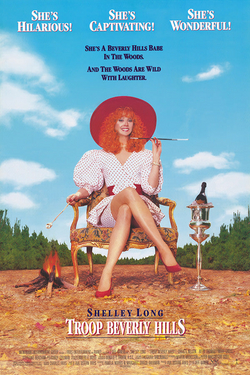
Troop Beverly Hills
1989
Directed by Jeff Kanew
Welcome back to Movie Monday. Before we go any further, the usual disclaimer applies: everything that follows is my own opinion, shaped entirely by my own experience with this film, and none of it is meant as a criticism of anyone who watched Troop Beverly Hills and genuinely loved it. People love this movie. People have loved this movie for decades. There is a whole cult built around it, and if you are a card-carrying member of that cult, you are allowed to keep your card. We’re good? Good.
Because I have some things to say about socialites in the wilderness.
A Little Context First
Here is where I have to confess something that slightly complicates the narrative: I saw Troop Beverly Hills as a kid, and I remember kind of liking it.
Not in a transformative, formative, this-movie-changed-who-I-am sort of way. More in the way that you like most things you watch on a Saturday afternoon when you are nine years old and your options are limited. It was on. It had funny moments. Shelley Long wore increasingly impractical outfits in the woods. That was enough for nine-year-old me.
But here is the thing about movies you watched as a kid and remember fondly: sometimes, when you return to them with adult eyes, the affection survives. The good ones hold up. The nostalgia is confirmed. And sometimes, you sit there wondering what exactly you were responding to, because the movie you remembered and the movie you are now watching do not quite match up.
Troop Beverly Hills falls into that second category for me. I do not hate it. I do not think it is an embarrassment to cinema. But I rewatched it for this list, and I found myself reaching for something that kept slipping just out of my grasp — some actual substance underneath the shiny surface — and coming up largely empty. It landed at number 20 on my Flickchart least-favorites list, and that ranking feels about right. Not a disaster. Not a catastrophe. Just a movie that had all the raw materials to be something and chose, at nearly every available opportunity, to be merely adequate instead.
The Setup, or: What This Movie Is Actually About
In case you have never seen it or need a refresher: Troop Beverly Hills follows Phyllis Nefler (Shelley Long), a Beverly Hills socialite in the middle of a divorce from her husband Freddy (Craig T. Nelson), who made his fortune running a chain of auto shops. In an attempt to stay connected to her daughter Hannah during what promises to be a contentious custody battle, Phyllis volunteers to become the den mother of Hannah’s leaderless local Wilderness Girls troop.
What follows is essentially the story of an underdog proving herself — except that the underdog is a woman who lives in a Beverly Hills mansion, has a full-time housekeeper, and once takes her troop to camp out at the Beverly Hills Hotel during a rainstorm because the Beverly Hills Hotel is simply the most logical place to go. The film’s central comic tension is that Phyllis’s version of wilderness survival is very, very different from the traditional version, and that this somehow makes her troop the scrappy outsiders who need to prove themselves to the world.
I will get back to that premise in a moment, because it is doing some heavy lifting that I am not sure it can fully support.
The villain of the piece is Velda Plendor (Betty Thomas), a retired army nurse who runs the rival Culver City Red Feathers troop with the kind of iron-fisted militarism usually reserved for, well, actual armies. She is appalled by Phyllis’s unorthodox methods, declares Phyllis’s custom merit badges invalid, and spends the rest of the film trying to dismantle Troop Beverly Hills through increasingly convoluted schemes. The climax involves a wilderness jamboree, a snake-infested swamp, some cheating, and a broken ankle. You can probably guess how it ends.
The Beverly Hills-as-Underdog Problem
Let me be honest about the thing that has always nagged at me about this movie, because I think it is the core reason the film doesn’t quite work: the film is asking you to root for people who are, by any reasonable measure, among the most comfortable people on the planet.
This is the joke the critics noticed in 1989, and Roger Ebert was one of them — he went in expecting the film to skewer the Beverly Hills lifestyle and found instead that it was celebrating it. The Washington Post’s Rita Kempley put it more sharply: these are not underdogs. These are children whose camping gear comes from Giorgio boutique. The film wants you to feel the injustice of Velda stripping them of their customized merit badges for facials and jewelry pricing, but it is difficult to manufacture that injustice when the people being wronged are this thoroughly insulated from actual hardship.
Now, to be fair, I think there is a version of this premise that works. There is a real idea buried somewhere in here about a woman who has spent her entire adult life being told that her particular skills — her taste, her social intelligence, her ability to work a room and make people feel seen — don’t count as real skills. Phyllis supported Freddy through what was supposed to be law school, he took that foundation and built his own empire, and now she is being dismissed as a frivolous person by a woman who runs her scout troop like a boot camp. That is actually a story worth telling.
The film gestures at that story. It does not commit to it. Instead, it leans heavily into the comedy of Phyllis being exactly who she is — extravagant, warm, hopelessly over-the-top — and frames that as triumph. Which is fine! It is a perfectly acceptable arc. But it stops well short of the sharper film hiding underneath, the one that would have taken Phyllis’s competence seriously enough to explore what it actually costs a woman to have that competence dismissed for decades.
Shelley Long: The Film’s Best and Worst Argument
There is no question that Shelley Long is working hard here, and there is no question that she is the best thing the movie has going for it.
Long is genuinely funny in this role. She commits to Phyllis completely — the outfits, the obliviousness, the particular brand of well-meaning cluelessness that somehow keeps producing positive results. The scene where she attempts to teach the girls wilderness survival using Beverly Hills as the terrain is exactly the kind of bit that should not work as long as it does, and it works almost entirely because Long plays it with such earnest conviction. She is not in on the joke. She is the joke, and she knows it, and she sells it anyway.
And yet.
Janet Maslin of the New York Times compared Phyllis to Private Benjamin, which is a useful reference point precisely because it shows where this film falls short. Private Benjamin worked because Goldie Hawn’s character actually had to change — she was confronted with real discomfort, real failure, real stakes — and the comedy came from watching her discover that she was capable of more than she had been told. The transformation felt earned because the challenge was real.
Phyllis Nefler never really has to transform. She starts out charming and warm and instinctively good at connecting with people, and she ends up charming and warm and instinctively good at connecting with people. The obstacles are either removed by circumstance or overcome too easily. Gene Siskel called Long “no Goldie Hawn when it comes to comedy,” which feels unfair to Long but fair to the material — Hawn was given something to push against. Long is given a movie that mostly gets out of her way and lets her be delightful, and delightful is not the same as interesting.
Betty Thomas and the Villain Problem
Betty Thomas, who would go on to direct films including a certain animated chipmunk franchise (yes, I see the irony, given what we covered last week), plays Velda Plendor with a commitment that deserves better source material.
Velda is the kind of villain who exists to be wrong about everything so that the hero can be proved right about everything. She is militaristic where Phyllis is warm. She is rigid where Phyllis is flexible. She cheats at the jamboree. Her own daughter eventually abandons her in favor of winning. She ends up working as a cashier at Kmart, making store-wide announcements about cookies. The film treats this as a punchline, and it is one, but it is also the kind of punchline that tells you the movie was never really interested in Velda as a person.
The most interesting thing about Velda is buried in the background: she is a retired army nurse who has transferred military discipline into the world of competitive scouting, and there is something genuinely unhinged about that that the film is too polite to fully explore. A meaner, sharper version of this movie would have leaned into the absurdity of someone applying actual tactical thinking to children’s jamboree competitions. Instead, Velda is just the obstacle, the thing standing between Troop Beverly Hills and their recognition, and once that function is served, she is discarded.
Thomas is doing her best in a role that is essentially a cardboard villain with army boots on. She is convincing in the meanness and she gets a few good moments, but the material never gives her anywhere to go.
The Cameos: A Period Piece in Real Time
One genuinely interesting thing about Troop Beverly Hills is how effectively it functions as a time capsule of a very specific moment in American celebrity culture.
The film features cameo appearances from Kareem Abdul-Jabbar, Cheech Marin, Frankie Avalon, Annette Funicello, Robin Leach, Dr. Joyce Brothers, and Pia Zadora, among others — a collection of names that is itself a kind of archaeological record of what it meant to be famous in 1989. Robin Leach! Of Lifestyles of the Rich and Famous! Making a cameo in a movie about Beverly Hills socialites! The synergy is almost elegant.
These cameos do not really serve the story in any meaningful way. They are furniture — recognizable faces doing brief recognizable things to signal to the audience that this world is populated by real celebrities, which is I suppose meant to reinforce the idea that Beverly Hills is as exotic a setting as any jungle. But they are also genuinely enjoyable in the way that period celebrity cameos often are, which is to say they are enjoyable primarily because they are a window into exactly when this movie was made.
And speaking of windows into exactly when this movie was made: the cast also includes a young Carla Gugino, a very young Kellie Martin, and in her film debut, a young Jenny Lewis — who would go on to have a genuinely remarkable music career and who, in 2015, shot a music video referencing this film specifically, which suggests the experience made more of an impression on her than it did on me.
What Works, What Doesn’t, and What Almost Does
I want to be fair, because fairness is the deal I made with myself when I started this list.
The film’s heart is in the right place. Phyllis’s genuine affection for these girls — her willingness to show up for them, to take their specific circumstances seriously, to meet them where they are rather than where a manual says they should be — is actually touching when the movie slows down enough to let it breathe. There is a scene where the girls tell Phyllis she has given them a new sense of self-esteem, and it lands with more weight than it probably should given how breezy everything surrounding it has been.
The girls themselves are a reasonably well-drawn ensemble for a late-1980s family comedy. Each one has a specific parental situation — the daughter of an unemployed actor, the daughter of a boxer, the daughter of a plastic surgeon, a girl whose jet-setting parents are never home — and the film at least gestures toward the idea that these children have their own versions of difficulty that exist alongside their obvious privilege. It does not develop those threads particularly well, but it acknowledges them, which is more than it had to do.
And Shelley Long is, as I said, genuinely charming throughout. She carries more than her share of the film’s weight.
What does not work is the villain, who is too cartoonishly evil to generate real stakes. What does not work is the underdog framing, which strains credulity every time you are asked to feel genuine concern for the welfare of children who have a personal housekeeper helping run their troop. What does not work is the resolution, which feels entirely too tidy and too easy — Freddy and Phyllis get back together, the troop wins, Velda gets her comeuppance, nobody has had to change in any particularly meaningful way.
And what almost works — what tantalizes me about this film even now — is the version of it that could have existed if anyone had been willing to push a little harder. The story of a woman reclaiming her identity and her competence in the middle of a divorce is genuinely interesting. The comedy of Beverly Hills as the wilderness is genuinely funny in places. The chemistry between Long and the young cast is genuinely warm. All the pieces were there.
They just never quite assembled into something that earns the cult status the film has spent the last 35 years accumulating.
The Cult Classic Question
I want to address the cult thing directly, because I think it complicates any honest assessment of this movie.
Troop Beverly Hills has, unquestionably, found an audience. It has been described as a feminist film. Writing for Elle in 2014, one critic argued that the film’s refusal to reduce its characters to a punchline and its “unrestrained celebration of girliness, glorious girliness” are precisely what has allowed it to endure. And I do not entirely disagree with that reading. There is something in this movie that celebrates a particular kind of competence — social intelligence, emotional attunement, the ability to make people feel valued — that films of this era frequently dismissed as frivolous.
But cult status is not the same as quality, and nostalgia is a powerful distorting lens. The things that have made this film beloved — Long’s performance, the 1980s aesthetic, the warm heart at the center of it — are real, and they are worth celebrating. They are just not quite enough to elevate what is, at its core, a formulaic underdog story with an underdog who owns multiple designer handbags and a Beverly Hills address.
Number 20 on the list feels correct. It is not the worst movie I have seen on this journey, not by a considerable distance. But it is a movie that keeps asking for more goodwill than it has fully earned, and after a while, the asking starts to show.
The Verdict
Troop Beverly Hills is harmless and occasionally charming and almost entirely forgettable in the best possible way — which is to say it will not ruin your afternoon, but it will not particularly enrich it either. Shelley Long deserved a sharper script. Betty Thomas deserved a more interesting villain to play. The girls in the troop deserved a film that took their specific circumstances as seriously as it claims to.
What we got instead is a breezy, well-intentioned, thoroughly pleasant piece of 1989 that works best as nostalgia and least well as cinema. My nine-year-old self was not wrong to enjoy it. My adult self just wishes there had been more to enjoy.
Number 20. Harmless. Nostalgic. Occasionally funny. Fundamentally forgettable. A movie that dared to tell young girls to be themselves, and then didn’t have quite enough confidence in that message to trust it without covering it in sequins.
Which, come to think of it, is a very Phyllis Nefler thing to do.
Next Time on Movie Monday
Since it is the first Monday of the month, we are taking our regularly scheduled break from the worst list for a Disney animation palate cleanser — and this month’s selection is one that has occupied a genuinely strange corner of the Disney canon for going on four decades now. Next week we visit Prydain, we meet a young pig keeper named Taran, and we come face to face with the film that Disney spent years pretending it hadn’t made. The Black Cauldron arrives next Monday — darker than you remember, stranger than it has any right to be, and considerably more interesting than its troubled history might suggest. Whether that makes it a hidden gem or a cautionary tale about what happens when a studio loses its nerve is a question we will work out together.
Bring your enchanted sword. Leave your cauldron-born at the door.

