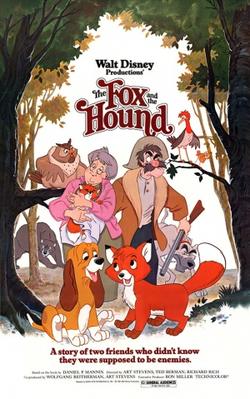
The Fox and the Hound
1981
Directed by Art Stevens, Ted Berman, and Richard Rich
Welcome back to Movie Monday. As we do every first Monday of the month, we’re setting aside the disasters for something I actually love. This month we’re heading into the woods with Disney’s 1981 animated film The Fox and the Hound — and I want to be upfront about something before we go any further: this one wrecked me as a kid, and it still does.
Not in the cathartic, cry-at-a-good-movie way. In the way that settles somewhere beneath your sternum and stays there. The way that certain stories earn the right to hurt you because they’re being honest about something the world is actually like.
The Fox and the Hound is the rare Disney film that tells you the truth. And for a lot of us who grew up in the eighties, it was one of the first movies that did.
Where It Falls
Before we get into the weeds, it’s worth placing this one in context, because the context matters. The Fox and the Hound belongs to what film critics and animation historians have taken to calling Disney’s “Dark Age” — roughly the period between The Jungle Book (1967) and The Little Mermaid (1989), when the studio was navigating the aftermath of Walt Disney’s death, an exodus of key creative talent, and a general uncertainty about what Disney animation was supposed to be or who it was supposed to be for.
The films of that era — Robin Hood, The Rescuers, The Many Adventures of Winnie the Pooh, The Great Mouse Detective, Oliver & Company — are a mixed bag by any honest assessment. Some of them are genuinely charming. Most of them are visibly straining. None of them have quite the confidence of the films that preceded them or the ambition of the Renaissance that followed.
The Fox and the Hound sits somewhere near the top of that pile, which is both a compliment and a caveat. It’s one of the better films of a difficult era, which means it’s doing real things while also bearing the unmistakable marks of a studio in transition — slightly uneven animation, songs that don’t quite earn their place, moments where the seams show. You can feel the growing pains. That doesn’t make the film lesser. If anything, knowing what was happening behind the scenes makes the parts that work feel more remarkable.
A Studio at War With Itself
The production history of The Fox and the Hound is genuinely fascinating, and it’s impossible to understand the film without it.
Development started in earnest in spring of 1977, when director Wolfgang Reitherman — one of Disney’s legendary Nine Old Men, the core group of animators who had built the studio’s golden age — championed the project based on Daniel P. Mannix’s 1967 novel. Reitherman’s involvement immediately created tension, because by the late seventies, the studio was actively trying to transition to a new generation of directors and animators. Producer Ron Miller was backing the younger talent. Reitherman, not unreasonably, didn’t entirely trust them. The result was a power struggle that ran through the entire production and shaped the finished film in ways both visible and invisible.
The Nine Old Men — Frank Thomas, Ollie Johnston, and others — completed their work early and retired, handing the film off to a generation of animators who would go on to define what Disney became. The names on that list are staggering in retrospect: John Lasseter. Ron Clements. Glen Keane. Tim Burton. Brad Bird. Henry Selick. These are the people who would build the Disney Renaissance and, in Lasseter’s case, essentially invent Pixar. The Fox and the Hound was their training ground. You can feel it — the ambition pressing against the limitations, the craft not quite matching the vision in every frame, but the earnestness undeniable.
Then, on September 13, 1979 — his 42nd birthday — animator Don Bluth walked into Ron Miller’s office with Gary Goldman and John Pomeroy and quit. Fourteen more animators followed. Bluth and his team had animated substantial portions of the film and asked to receive no screen credit. Miller had the departing animators off the lot by noon.
This was not a minor disruption. Bluth was one of the most gifted animators on the lot, and losing him and his entire team mid-production required hiring and promoting new talent on the fly, delayed the film’s release from Christmas 1980 to summer 1981, and forced quality control to lean heavily on veteran assistant animators to compensate for the experience gap. Bluth would go on to found his own studio and produce The Secret of NIMH — which is a great film in its own right — while the team he left behind finished The Fox and the Hound as best they could.
What’s remarkable is that you can watch the finished film and mostly not see the fracture lines. The seams are there if you’re looking for them, but the emotional core holds.
The Last Stand of the Old Guard
One of the more poignant footnotes in the film’s production is the question of what to do with Chief.
In Mannix’s novel, Chief dies — hit by a train while chasing Tod, and that’s that. In the film, Chief is merely injured, his leg broken. This change was not made without argument. Animator Ron Clements — who would later direct The Little Mermaid and Aladdin — was blunt about it: Chief needed to die. Without a death, Copper’s motivation to hate Tod reads as disproportionate and the emotional stakes collapse. Younger members of the story team agreed and took the argument to upper management.
Director Art Stevens held firm: “We never killed a main character in a Disney film and we’re not starting now.” And upper management backed him.
The decision is defensible. It’s also a useful window into the institutional conservatism that both sustained and constrained Disney animation during this period. The studio was genuinely uncertain how much darkness its audience — particularly its young audience — could handle, and erring on the side of caution was reflexive. What the film loses in narrative logic it partially recovers through Ollie Johnston’s lovely piece of animation of Chief stomping around with his leg in a cast, and the audience never doubts that Copper’s rage is real even if its trigger feels slightly deflated.
Tod and Copper
Here’s what the film gets absolutely right: the friendship itself.
Mickey Rooney voices adult Tod with a warmth that resists sentimentality, and Kurt Russell — cast after reading for the role while filming the Elvis TV movie — brings something genuinely melancholy to adult Copper. There’s a quality in Russell’s performance in the later scenes that sounds like a man who understands exactly what he’s lost and can’t explain it, which is exactly what’s called for.
The younger performances from Keith Mitchell and Corey Feldman, as young Tod and Copper respectively, establish the friendship in a way that makes the later loss land properly. They’re just kids who found each other. The pledge of eternal friendship they make in the woods feels completely sincere, which is exactly why it has to be broken. The film earns its heartbreak by making sure you’re invested first.
And Pearl Bailey as Big Mama the owl is — genuinely — one of the warmer presences in Disney animation of this era. Her version of “Best of Friends” is the film’s emotional thesis statement: two creatures who don’t belong together, belonging together anyway, with the film fully aware that it can’t last.
The Heartbreak Is Inevitable
What elevates The Fox and the Hound above a lot of its contemporaries in the Dark Age is that it’s honest about something most children’s films actively work to avoid: you can love someone completely and still lose them. Not because anyone dies, not because anyone turns villainous, but because the world has already decided what you’re supposed to be to each other, and you don’t get a vote.
Copper doesn’t choose to become a hunting dog. Tod doesn’t choose to be a fox. Their natures aren’t character flaws and they aren’t failures of friendship. They’re just what they are, and what they are eventually pulls them into opposition with everything the world around them expects. Amos Slade isn’t even really a villain — he’s a hunter with a hunting dog, operating exactly as hunters with hunting dogs operate. The conflict isn’t between good and evil. It’s between love and circumstance, and circumstance wins.
That’s a sophisticated thing to put in a film aimed at children. The ending, where Tod and Copper share one last smile across a distance neither of them will cross, is one of the most genuinely bittersweet moments in the Disney catalog. It doesn’t promise they’ll find a way back to each other. It doesn’t soften the loss. It just acknowledges that what they had was real and that real things can end, and then it lets you sit with that.
For a lot of Gen X kids and elder Millennials, this was among the first movies to deliver that particular lesson. I’ve talked to enough people my age to know I’m not alone in remembering where I was when I first understood what the ending actually meant.
There’s something to be said for a film that trusts its audience enough to hurt them correctly.
A Note on the Legacy
The young animators who cut their teeth on The Fox and the Hound — Keane, Clements, Lasseter, Bird, Burton, Selick — would go on to produce some of the most celebrated animated films ever made. The film served as a bridge: the Nine Old Men passing down their craft to a generation that would eventually carry Disney animation to heights the Dark Age films could only gesture toward.
The Fox and the Hound isn’t the best film any of those people ever made. But it’s the film that helped make them. There’s a reason the animation community has always had a soft spot for it beyond nostalgia. Glen Keane’s work on the bear sequence near the end is still routinely cited as a landmark piece of character animation — visceral, kinetic, and built with an attention to weight and physics that was well beyond what the studio had been doing even a few years earlier. You can feel someone proving something in every frame of it.
That sequence alone is worth the price of admission.
Final Verdict
The Fox and the Hound is imperfect in ways that are inseparable from the circumstances of its making — a studio mid-crisis, a production disrupted by mass resignations, a generation of animators simultaneously losing their footing and finding it. It has songs that don’t quite land and pacing that occasionally loses the thread.
But at its center is something that holds: a friendship between two creatures who were never supposed to be friends, rendered with enough honesty that its loss genuinely registers. It doesn’t end happily. It ends truthfully. And for a studio that had spent decades training its audience to expect the former, that was a harder and more valuable thing to offer.
This one still gets me. Every time.
Next Monday we return to the regularly scheduled disasters — and next week’s entry is a deeply personal one for me. We’re covering Superman IV: The Quest for Peace, which I say as someone who has been a die-hard Superman fan his entire life. I love Superman. I genuinely, unironically, completely love Superman. Which is exactly why we need to have an honest conversation about what happened in 1987. I’ll see you then.

