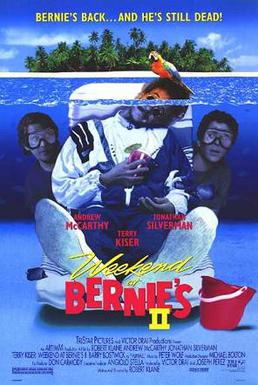
Weekend at Bernie’s II
1993
Directed by Robert Klane
Welcome back to Movie Monday, where we continue our methodical, occasionally painful journey through the films that have earned their place at the bottom of my Flickchart rankings. Before we get into it, the usual disclaimer applies: everything that follows is purely my own opinion. If Weekend at Bernie’s II is a film you love, or one that holds a warm place in your memory, I genuinely respect that. Nostalgia is a powerful and personal thing, comedy is subjective, and I am not here to tell you that your taste is wrong. I’m here to tell you that mine apparently diverges from yours on this particular entry, and I’d like to explain why. We good? Good.
First, Let Me Tell You About the Original
I want to be upfront about something before I start picking apart this sequel, because I think it’s important context: I actually like the first Weekend at Bernie’s. Not in a guilty pleasure, ironic distance kind of way. In a genuine, unironic, I-watched-this-on-repeat-throughout-my-pre-teen-years kind of way.
At some point in my childhood, someone in my household recorded Weekend at Bernie’s off of HBO onto a VHS tape — the highest honor a movie could receive in those days, because it meant someone thought it was worth preserving — and that tape became part of the rotation. The kind of movie you’d pop in on a Saturday afternoon when nothing else was calling your name. The kind of movie that, through sheer repetition, achieves a status in your memory that probably outpaces its actual quality. I’ll admit it freely: the original Weekend at Bernie’s is not cinematic gold. It is a broad, cheerfully dumb comedy built almost entirely around a single joke — two guys dragging their dead boss around a beach house and pretending he’s alive — and it sustains that joke for about ninety minutes through a combination of Terry Kiser’s genuinely committed physical performance and a kind of breezy summer energy that makes the whole enterprise go down easy.
But somehow, inexplicably, it worked for me. It became a comfort movie. A classic, by the highly personal and not-at-all-objective standard of a kid who just wanted something fun to watch on a weekend afternoon. I have affection for it that I can’t entirely explain and don’t feel the need to justify.
Which is exactly why Weekend at Bernie’s II hit differently than it might have otherwise. This wasn’t just a bad movie. It was a bad movie attached to something I loved, and that changes the calculus considerably.
The Question Nobody Was Asking
Let’s start with the most fundamental problem: did anyone actually need a sequel to Weekend at Bernie’s?
The original was released in 1989 and performed well enough at the box office despite reviews that were, generously, mixed. It found its real audience on cable and home video, which is exactly how it ended up on that VHS tape in my house. It became the kind of movie people had seen, the kind of movie people had fond memories of, and the kind of movie that, in a reasonable world, would be allowed to exist as a complete and self-contained thing.
Instead, someone looked at those home video numbers and decided that what the world needed was more Bernie. Four years later, in 1993, Weekend at Bernie’s II arrived — and I want to pause on that four-year gap for a moment, because it tells you something. This was not a sequel that was rushed out while the iron was hot. The iron had been cooling for four years. The cultural moment, such as it was, had largely passed. Andrew McCarthy and Jonathan Silverman were not exactly at the height of their powers in 1993. Terry Kiser had spent the intervening years doing what actors do when they’re not playing a beloved dead boss in a moderately successful comedy. And yet here they all were, reconvened, to make another one.
The question I kept coming back to, even as a kid watching this for the first time, was a simple one: why? Not in an outraged way. Just in a genuine, puzzled, what-exactly-was-the-plan-here way. The first movie’s entire premise was predicated on the single joke of Bernie being dead and everyone not realizing it. How do you sequel that? What is the next logical step for a story that was already operating on pure absurdist premise with no particular place to go?
The answer Weekend at Bernie’s II arrives at is: voodoo.
The Voodoo Problem
I want to try to be fair here, because I recognize that on paper — very theoretical, abstract paper — there is a version of a Weekend at Bernie’s sequel involving a voodoo subplot that could have worked. Horror comedy is a real genre. Absurdist escalation is a real narrative tool. If the original movie was already operating in a heightened reality where two grown men could parade a corpse around a beach party without raising serious alarm, perhaps adding supernatural reanimation to the mix was not inherently the wrong instinct.
But the version we actually got is not that version.
In Weekend at Bernie’s II, the reanimated Bernie only moves when he hears music. This is the joke. This is the central comedic engine of the entire film. Bernie dances when music plays. He stops when it doesn’t. Larry and Richard — still played by Andrew McCarthy and Jonathan Silverman, still wearing the same expressions of mild exasperation they wore throughout the original — spend the bulk of the movie figuring out how to keep Bernie moving by keeping music in his vicinity, which eventually leads to the image of a reanimated corpse with a Walkman strapped to his head being guided around the U.S. Virgin Islands by a catchy beat.
It is, to put it gently, a lot less funny than the people making it appear to have believed it would be.
The original film’s comedy worked — to whatever extent it worked — because the joke had a specific social dimension. Bernie was dead and everyone assumed he was alive because everyone was too self-absorbed or too drunk or too distracted to notice. There was something almost satirical in it, a commentary on the shallow social world the characters occupied. The sequel strips that away entirely. Bernie is now literally animated by supernatural forces, which removes the comedy of obliviousness and replaces it with the comedy of a dead man shuffling around to Caribbean music. These are very different jokes, and only one of them is actually a joke.
I remember watching this as a kid and feeling the specific, sinking disappointment of a sequel that didn’t understand what made its predecessor work. I didn’t have that vocabulary then, obviously. I just knew that it wasn’t funny in the same way, that the Bernie stuff felt different and wrong, and that I was watching something that had mistaken the surface elements of the original for the actual substance of it.
McCarthy, Silverman, and the Art of Looking Confused
I want to be careful not to be uncharitable to the two leads, because I don’t think the problem is really with them. Andrew McCarthy and Jonathan Silverman are not bad actors. McCarthy in particular has experienced something of a cultural rehabilitation in recent years — his documentary about the Brat Pack era is genuinely thoughtful and worth watching, and it reveals a more reflective and self-aware person than his eighties output might have suggested. Silverman, for his part, went on to headline a network sitcom called The Single Guy in the mid-nineties, which lasted two seasons, which is at least two seasons more than some things get.
But in Weekend at Bernie’s II, both actors are essentially performing the same function they performed in the original — Larry is the schemer, Richard is the reluctant voice of reason — without the benefit of a script that gives those dynamics anywhere interesting to go. The chemistry that made them watchable in the first film is still technically present. You can see it, if you squint. But it’s buried under a plot that keeps interrupting whatever they might be building together to remind you that there’s a reanimated corpse nearby doing something that the movie believes is funnier than it is.
McCarthy, I’ll note, seems to be trying. There are moments where you can see him committing to the physical comedy, leaning into the absurdity, attempting to will the material into something more than it is. Silverman seems somewhat more aware of what kind of movie he’s in. Neither of them is doing career-best work, but neither of them is really given the opportunity.
Terry Kiser and the Diminishing Returns of Playing Dead
Here is where I’ll grant a genuine concession: Terry Kiser’s physical performance in the original Weekend at Bernie’s was actually impressive. Playing a corpse for an entire movie — being manipulated, carried, dropped, posed, and generally treated as a prop while maintaining the absolute stillness and limpness that the joke requires — is harder than it looks. Kiser committed to it completely and deserved more credit than he probably received.
In the sequel, the requirements of the role change considerably. Now Bernie moves. Now Bernie dances. The physical comedy is no longer about rigidity and dead weight; it’s about jerky, supernatural locomotion and reactions to music. And something about that shift diminishes the achievement. Part of what made Kiser’s work in the first film interesting was the constraint. Remove the constraint, animate the corpse, and you have something that is merely a performer doing funny walks on a beach in the Virgin Islands. It’s a lesser showcase for a performer who had demonstrated he was capable of something more specific.
The Comfort Movie Betrayal
What sticks with me most, thinking back on Weekend at Bernie’s II, is not any particular scene that failed or any joke that landed badly. It’s the feeling of watching something I had affection for get diminished by a follow-up that didn’t respect what made the original worth remembering.
This is a specific kind of disappointment, different from the disappointment of a bad movie you came to cold. When you love something — even something small, even something that doesn’t hold up perfectly to scrutiny, even a cheerfully dumb comedy about a dead boss on a beach — and then something arrives that claims to be more of that thing but fundamentally isn’t, the feeling is less like watching a bad movie and more like watching a bad impression of something you care about. The shapes are familiar. The names are the same. But whatever made it feel like itself is gone, replaced by something louder and less considered, and no amount of Caribbean scenery or dancing corpses can fill that absence.
Weekend at Bernie’s II cost somewhere between fifteen and seventeen million dollars, earned about twelve million back, and received a 13% on Rotten Tomatoes alongside a Metacritic score of 16 — which, for context, puts it in the range of films that critics don’t merely dislike but actively find unredeemable. The Seinfeld writers apparently agreed, using it as a shorthand joke in a Season 8 episode where Elaine rents it on a staff recommendation and ends up yelling at her television. I understand the impulse.
It sits at number 25 on my list because Flickchart, through accumulated head-to-head comparisons, determined that it edges out Once Bitten by a small but decisive margin. I can’t argue with the math. Once Bitten was a mediocre film I found more uncomfortable than funny. Weekend at Bernie’s II is a mediocre film that also managed to let me down, and disappointment carries its own weight in these rankings.
Why Number 25
Once Bitten, sitting just below this one at number 26, was a film I encountered with no particular investment and found lacking. Weekend at Bernie’s II had the additional disadvantage of arriving as the sequel to something I genuinely loved, and failing on those terms as well as its own. That combination — the badness of it plus the specific betrayal of it — is what earns it the slightly higher placement. It’s not a dramatically worse film. It’s just a film with more ways to fail me, and it made use of all of them.
The VHS tape of the original is still out there somewhere, probably, in whatever landfill or thrift store bin has claimed it. The version of me who wore it out is still somewhere in my memory, too, watching Larry and Richard haul Bernie around a beach party and finding it funnier than any reasonable adult probably should. That movie earned its place. This one did not.
Next Time on Movie Monday
We keep descending. Next Monday brings us to number 24, and I want to prepare you appropriately: we’re leaving the land of vampires and reanimated corpses and heading somewhere that somehow — somehow — manages to feel like a greater affront to comedy than any of the films we’ve covered so far. We’re going to the 2012 Farrelly Brothers production of The Three Stooges, a film that asked the question “What if we cast three very capable comedic actors as Moe, Larry, and Curly, put them in a modern setting, and invited Jersey Shore cast members to participate?” and answered it with ninety-two minutes that the ghosts of Moe Howard, Larry Fine, and Curly Howard presumably spent watching through their fingers. Nyuk nyuk nyuk. I have regrets.
See you Monday.


I was working at a dollar theater when this piece of garbage released. I’m sure it sold tickets but it wasn’t in our theater very long. People were done with Bernie by ‘93.
Besides, wouldn’t Bernie be Skeletor by that point?
LikeLiked by 2 people
I didn’t really like rge 1st one.
LikeLiked by 1 person