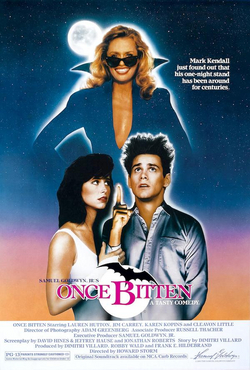
Once Bitten
1985
Directed by Howard Storm
Welcome back to Movie Monday, where we continue the slow, occasionally bewildering descent through the films that have earned the dubious distinction of ranking among my least favorites on Flickchart. As always, I want to be upfront before we get into it: everything that follows is purely my own opinion. If today’s film holds a warm and special place in your heart, I respect that. Comedy is deeply personal, nostalgia is a powerful force, and I am not here to tell you that your taste is wrong. I’m just here to tell you that mine apparently is, at least by the standard of a movie that a lot of people seem to have genuinely enjoyed. We good? Good.
Number 26 is Once Bitten.
The Cable TV Era, Where Everything Was Possible and Nothing Was Screened
I want to start by being honest about how I encountered this film, because context matters, and the context here is important: I watched Once Bitten as a kid on cable television. I don’t remember the exact year or the exact circumstances. I don’t remember whether it was a lazy Saturday afternoon or a late night when I should have been asleep. What I remember is the vague, slightly fuzzy impression the film left — not unpleasant exactly, but not particularly memorable either. The kind of movie that just sort of… existed on cable, wedged between something you actually wanted to watch and a commercial for a 1-800 number you were definitely not going to call.
This was the era of cable television as a vast, unsupervised wilderness. If you were a kid in the eighties or early nineties and you had access to HBO or Cinemax or even just a robust basic cable package, you were essentially wandering through an unguarded museum of movies that were not necessarily curated for your age group. Nobody was checking. Nobody was asking questions. The parental controls had not yet been invented in any meaningful way, and so you watched things. You watched all kinds of things. Some of those things were wonderful. Some were confusing. Some were Once Bitten.
The premise, for anyone who has managed to avoid it: a 400-year-old vampire countess — played by Lauren Hutton with the kind of commitment that the material does not entirely deserve — needs to drink the blood of a male virgin three times before Halloween each year in order to maintain her immortality and her youth. The problem, as the film is very eager to tell you, is that male virgins are increasingly hard to find in 1980s Los Angeles. Enter Mark Kendall, played by a young Jim Carrey, an innocent and deeply earnest high school student who has been trying unsuccessfully to convince his girlfriend Robin to take their relationship to the next level. The Countess finds him, bites him, and the rest of the film is a loosely organized series of scenes in which Jim Carrey exhibits increasingly strange vampire-adjacent behavior while his girlfriend tries to figure out what is wrong with him before the Countess can complete the trilogy of bites that will turn him permanently.
That is the movie. That is the whole movie. And somehow it still manages to feel longer than it is.
The Humor Problem
The jokes in Once Bitten are built almost entirely on a foundation of virginity gags, innuendo so broad you could drive a truck through it, and the comic premise that an innocent teenage boy is being stalked by a beautiful vampire who keeps biting him on the inner thigh. In 1985, in the context of a certain kind of raunchy teen comedy that was very much having a moment, this probably landed with at least some portion of the audience. Forty-plus years later, the humor has not aged gracefully.
I want to be specific about what I mean when I say “hasn’t aged gracefully,” because I think there’s an important distinction between comedy that feels dated because its references are old and comedy that feels dated because its underlying assumptions are no longer ones we share. Once Bitten is mostly in the second category. The jokes frequently rely on an understanding of virginity as embarrassment, of male sexual inexperience as something inherently comic, and of the entire premise of an adult woman — supernatural or otherwise — repeatedly drugging and physically assaulting a teenage boy as something that plays as farce rather than as anything worth examining more carefully. I’m not suggesting the film needed to be a moral treatise. I’m suggesting that the joke doesn’t quite work when you pull on that thread even slightly.
And then there is the simple fact that, beyond the conceptual problems, the jokes just aren’t particularly funny. Comedy is the most subjective art form there is, and I’m well aware that something not making me laugh is not the same as something being objectively bad. But when I try to isolate what the humor in Once Bitten is actually doing — when I look for the setups and the payoffs and the comic logic that strings a joke together — I mostly find a kind of limp, fumbling energy that never quite commits to anything. The film is rated R, but it has the sensibility of something that couldn’t decide whether it wanted to be raunchy or safe and ended up being an uncomfortable hybrid of both. Too edgy to be a family film. Not edgy enough to be genuinely transgressive. Occupying a middle ground where not much of anything happens with any real conviction.
The humor is dated, the premise is creepy when you think about it too hard, and the jokes mostly don’t land. As far as comedy crimes go, committing all three simultaneously is something of an achievement.
Jim Carrey, Pre-Everything
Here is where I have to be careful, because there is a version of this post that is deeply unfair to Jim Carrey, and I don’t want to write that version.
The unfair version goes like this: Jim Carrey would go on to be one of the biggest comedy stars of his generation — Ace Ventura, The Mask, Dumb and Dumber, all arriving within the same twelve-month window in 1994, an eruption of stardom that felt almost unprecedented in its speed and intensity. Knowing what he would become makes Once Bitten feel like an artifact, a before-the-transformation chrysalis, a relic of the years when his particular brand of rubber-faced physical comedy hadn’t yet found the right vehicle. In 1985, he was still figuring things out. This was his first major lead role. You can see the energy. You can see the physicality. The talent is clearly there, even if it’s running laps in a very small yard.
That’s the fair version, and I want to be clear that I mean it sincerely. Carrey was not a hack in 1985. He was a genuinely gifted performer who would go on to prove it many times over.
But here’s the honest part: watching Once Bitten, it is genuinely difficult to separate Carrey’s performance from the material surrounding it, and the material surrounding it is a problem. He is doing his best. There are moments where the physical comedy works on its own terms, where you can see flashes of the performer he would become. But the film doesn’t know what to do with him. It asks him to be broad and then undercuts the broadness with a script that can’t quite support it. The result is a performance that I struggle to evaluate on its own merits because the whole enterprise keeps getting in the way. It’s not that Carrey fails. It’s that the film fails around him, and there’s no fully clean way to distinguish one from the other.
Lauren Hutton and the Wasted Countess
If anyone deserves a moment of genuine appreciation in this film, it is Lauren Hutton, who plays the Countess with a straight-faced commitment that the movie absolutely does not earn. Hutton was a genuinely accomplished actress and model by the time Once Bitten was made — she had appeared in American Gigolo, had been one of the most prominent faces in fashion throughout the 1970s, and had a real screen presence that does not evaporate just because the material is thin. The Countess, as written, is not a particularly interesting character. She wants the thing she wants, she sends her minions to get it, she shows up at a high school Halloween dance to steal a teenage boy from his girlfriend, and she ages rapidly when her plan is foiled. There is not a lot of psychological depth on the page.
Hutton plays her anyway with a kind of imperious, slightly campy elegance that is more interesting than the role deserves. There’s a version of this movie — a better version — where the Countess is genuinely menacing and the comedic horror elements have real bite, and Hutton would have been more than capable of carrying that version. Instead she’s stranded in the version that exists, doing more with less than anyone reasonably should have had to, and probably aware the whole time that the screenplay was not going to do her any favors.
Cleavon Little, who plays Sebastian, the Countess’s long-suffering manservant, is in a similar position. Little was a talented actor best known for Blazing Saddles, and he brings a dry, world-weary quality to his scenes that provides occasional moments of relief. He also deserved better than this.
The Blur of Mediocrity
When I think back on Once Bitten — both the childhood viewing and whatever revisitation Flickchart demanded of me before it landed at number 26 — what I come back to most is the absence of anything I can point to and call remarkable. Not the scenes that failed spectacularly. Not the moments that crossed a line or made me actively wince. Not the one joke that almost worked before collapsing. Just a general, pervasive sense of a film that moved from beginning to end without leaving any particular impression on the landscape.
The great bad movies — the ones that achieve cult status, the ones that people watch ironically and then find themselves watching sincerely — usually have something. An excess of ambition. A performance that went so far in one direction it loops back around to fascinating. A scene so misconceived it becomes its own event. Once Bitten doesn’t really have any of that. It is a film that commits no memorable crimes and commits no memorable acts of grace. It simply happens, for 94 minutes, and then it is over, and the experience fades with a speed that suggests the film was never quite substantial enough to hold its shape in memory.
That is, in some ways, a harsher verdict than outright failure. Outright failure is at least interesting. Outright failure suggests that someone wanted something badly enough to fall short of it in a way you can examine. Once Bitten wanted to be a breezy, mildly raunchy teen horror comedy in the vein of whatever was selling tickets that particular November, and it achieved that goal adequately and without distinction, and then it drifted into the cable television ecosystem where it spent the next several decades existing in the peripheral vision of anyone who happened to be up late with the remote in their hand.
I was one of those people, once. I watched it. I did not laugh very much. I changed the channel or went to bed or moved on to whatever came next. And some years later, Flickchart told me it was 26 spaces from the bottom of my list, and I could not find it in myself to argue.
The Numbers, Because They Are What They Are
Once Bitten was made for $3.2 million and earned around $10 million domestically — a modest profit, and actually a decent return for an era when the teen comedy market was crowded and competitive. It opened at number one at the box office on 1,095 screens, which is not nothing. By the metrics that mattered to the studio, it was a functional release that did approximately what it was supposed to do and was then largely forgotten.
The critical reception was, generously, mixed. Rotten Tomatoes currently places it at 10% — a number that suggests the critical community was not charmed. Metacritic, working from a small sample, gives it a 64, which seems considerably more generous than the film’s reputation would suggest. The divergence between those two scores is itself a kind of small comedy, a numerical argument that will never fully resolve.
The film has accumulated a modest cult following over the years, as most films do if they circulate long enough. There is a corner of the internet where Once Bitten is appreciated as a piece of eighties nostalgia, a time capsule of a particular kind of harmless, cheerfully dumb comedy that doesn’t get made quite the same way anymore. I understand that affection, even if I don’t share it. Nostalgia does not require quality. It only requires that the thing existed at the right moment in your life, and for some people, Once Bitten was that thing.
For me, it was just something that was on.
Why Number 26
Once Bitten sits at number 26 because Flickchart put it in enough head-to-head comparisons that its placement eventually crystallized into something I couldn’t dispute. It is not the worst film on this list. It does not have the ambitions of some of the entries below it, and it does not fail as dramatically as the ones that swung for something and missed badly. It is simply a film I do not enjoy, built on humor that doesn’t land for me, anchored by a premise that I find more uncomfortable than funny, populated by performers who deserved better material, and remembered with the vague fuzziness of something that passed through my childhood like weather — present for a while, leaving no particular damage, and then gone.
The locker room. The Halloween dance. The coffin. The rapidly aging Countess. It is all technically there in my memory, all technically accessible if I reach for it. But it lives in a kind of soft focus, the way dreams do in the hours after you wake up — there, but not quite there, receding even as you try to look directly at it.
That’s Once Bitten. A film that happened. A film that was, briefly, at number one at the box office. A film that starred someone who would become one of the most recognizable comedy performers of the next decade. A film I watched as a kid and have spent roughly thirty-five years failing to think about.
Number 26. We have reached it. We move on.
Next Time on Movie Monday
I’ll be back next Monday with number 25, and I want to prepare you appropriately: we’re heading somewhere that makes Once Bitten look like a model of narrative coherence and artistic ambition by comparison. We’re going to Weekend at Bernie’s II — a film that took the one-joke premise of its predecessor, asked what would happen if you added a voodoo subplot, and answered that question in ways that no reasonable person was requesting. A dead man dances. Chaos reigns. I have questions that I suspect will go permanently unanswered. Join me.
In the meantime, if Once Bitten is your film — if it was the thing that was on when you needed something to be on, and it delivered, and it has earned its place in your heart — the comments are open and I genuinely mean it when I say I’d love to hear what you see in it that I’m missing. The cult of the comfortable mediocre film is a real thing, and I hold no grudge against anyone who’s a member.
What do you think? Is Once Bitten an underseen gem of eighties horror comedy, or does it belong right here at number 26? Drop your thoughts in the comments below.

