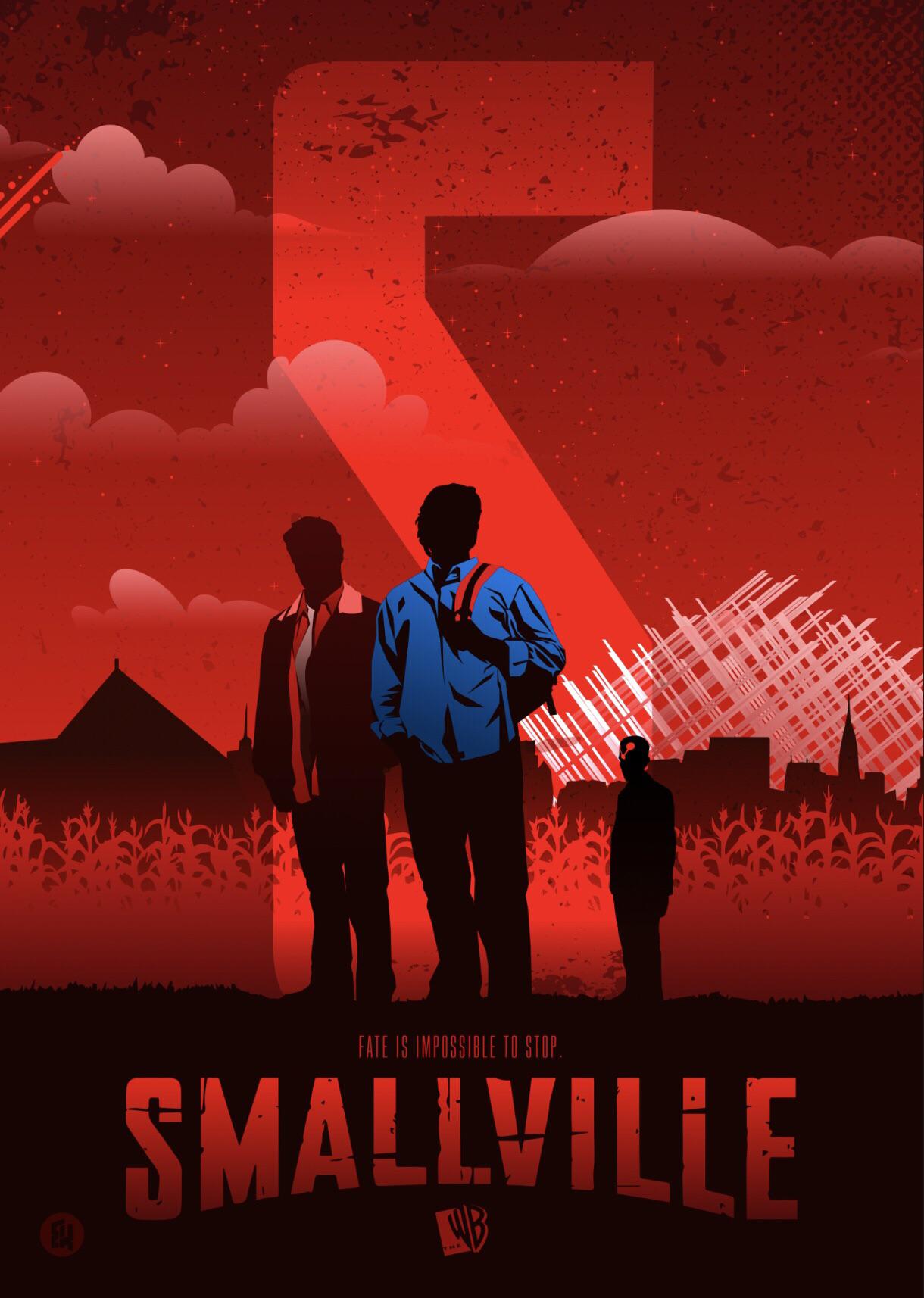
Welcome back to Rewatching Smallville, my weekly dive into the iconic series that explores Clark Kent’s journey before becoming Superman. Whether you’re a long-time fan or new to the show, you’re invited to join in each Tuesday as I revisit episodes and share my thoughts and observations. Be sure to share your own memories and theories in the comments below!
Last week, “Exposed” gave us a functional if uneven hour — the Clark-Lois chemistry doing the heavy lifting, Tom Wopat and John Schneider delivering genuine warmth in their Dukes of Hazzard reunion, and a villain so forgettable I’ve already said everything there is to say about him. It was middling in a specific, occasionally entertaining way, and it left the season’s larger chess pieces — Lex’s Senate run, Jonathan’s political future, Milton Fine lurking at the edges — more or less where they were. “Splinter” picks all of those pieces up and does something with them.
This is the best episode of Season Five so far. It’s not a close call.
“Splinter” is the kind of hour that reminds you why the show could be genuinely great when it decided to be. It has a high-concept premise executed with real commitment, a villain operating in full view while remaining invisible, and some of the darkest material Tom Welling has been asked to play in the entire run of the series. It’s not perfect — Smallville never quite is — but it earns its ambitions in ways that several previous episodes this season have not.
Let’s get into it.
Silver K and the Art of Paranoia
The premise: Clark pricks his finger on a mysterious silver meteor rock delivered to Lana and promptly descends into a spiral of paranoid delusions. He becomes convinced that Chloe is feeding his secret to Lionel. That his father is conspiring against him in exchange for cash. That Lex and Lana are having a secret affair. That everyone he loves has been working against him the entire time.
This is, as concepts go, extremely well-suited to Smallville. The show has spent four-plus seasons building the architecture of Clark’s anxieties — the secret that has to be kept, the friends who don’t fully know him, the father figures whose motives he can never be entirely certain of. Silver kryptonite doesn’t invent Clark’s fears. It takes fears that already exist in some form and turns up the volume until Clark can’t hear anything else. That’s good writing, or at least the skeleton of good writing, and Steven S. DeKnight does enough with it that the episode earns real momentum as the paranoia escalates.
The structure of the delusions is clever. Each one is plausible enough to sting. Chloe really does have an open line of communication with Lionel — we’ve known about it for a while, and Clark’s suspicion that it might be more sinister than Chloe claims is not an unreasonable extrapolation. Jonathan receiving money from Lionel looks, from the wrong angle and with the wrong context, exactly like what Clark thinks it is. And Lex and Lana? The show has been seeding tension there all season, enough that Clark’s jealousy is a live wire even without silver kryptonite in the picture. The episode picks the most structurally load-bearing fears and applies pressure to exactly the right spots.
What makes it work as drama rather than just a clever gimmick is the escalation. Clark doesn’t snap all at once. The delusions stack. By the time he’s at the Luthor mansion squeezing Lex’s wrist hard enough to make him scream, he’s already convinced of Chloe’s betrayal and his father’s collusion. Each new confirmation feeds the last. The paranoia isn’t just a condition he’s suffering — it’s a logic, internally consistent and increasingly airtight, that Clark is trapped inside.
The Darkest Clark Gets
There is no diplomatic way to say this: Clark Kent, in “Splinter,” does terrible things to people he loves.
He hits Martha. Not in the abstract, not off-camera — she goes across the room. He shoves Jonathan against a wall. He finds Lana in the basement of the Luthor mansion and begins choking her. These are not small moments and the episode doesn’t treat them as small. Welling plays the horror of each one — particularly the Lana scene, when Clark’s eyes clear for just a moment before Fine intervenes and he realizes what he’s doing — with a weight the material demands.
This is worth dwelling on because Smallville doesn’t always trust its own dark material. The show has a long history of presenting Clark at his worst and then soft-pedaling the aftermath — the Red K episodes especially tend to resolve with a reset button and a barn conversation that makes everything feel tidier than it should. “Splinter” is different. Clark isn’t just reckless or romantically impulsive this time; he’s genuinely dangerous. He attacks his own mother. He nearly kills his girlfriend. The scene where Jonathan delivers the line — “You were never my son. You were the thing I found in a cornfield” — is devastating precisely because Clark is so far gone that he can receive that sentence and have it confirm everything he already suspects rather than pierce through his delusions the way it should.
That line deserves its own moment of recognition. It’s the episode’s darkest beat and John Schneider delivers it with the specific reluctance of a man saying something he would never say — not because it’s untrue, exactly, but because truth stripped of love is its own kind of cruelty. Jonathan doesn’t mean it. But he has to say something extreme enough to break through, and it doesn’t work, and the failure of that attempt is as painful as anything else in the hour.
Tom Welling is very good here. He’s playing a Clark who is recognizable — the gestures, the voice, the physicality are all Clark — but filtered through something that makes every scene feel slightly wrong, slightly off-register in a way that builds discomfort before the violence arrives. The paranoid Clark who catches Chloe’s Lionel email and immediately goes cold is a different creature from the one who walked in. Welling finds the transition and plays it as gradual, which is the right call.
Fine Is Pulling Every String
And then there’s Milton Fine.
James Marsters gets to do something genuinely interesting in “Splinter,” which is to play Fine at two distinct registers simultaneously. The Fine that Clark interacts with while under the silver kryptonite’s influence is helpful, calm, concerned — exactly what a trusted professor should be, and exactly what a manipulator hoping to direct Clark’s paranoia would present. The Fine operating in the margins of the episode, the one we’re watching even when Clark isn’t, is something else entirely.
The reveal — that Fine himself introduced the silver kryptonite, that the entire episode has been his orchestration from start to finish — is both earned and slightly disturbing in retrospect. Every reassurance Fine offered Clark during his breakdown was a performance. Every moment of apparent concern was misdirection. He superspeeds. He has heat vision. He calls Clark “Kal-El.” He extracts the splinter with a device that is, meaningfully, not something a human professor would own. And then he walks away, because he has done exactly what he intended to do.
What did he intend to do? The episode leaves this productively open. The obvious reading is that Fine was testing Clark — stress-testing his relationships, measuring how quickly the paranoia would isolate him, seeing how dangerous he becomes when he doesn’t trust the people around him. Whether that’s reconnaissance for a larger plan or something more specific to Fine’s Kryptonian agenda, the show isn’t saying yet. What it’s established is that Fine is not an ally operating at the margins of Clark’s world. He is an active architect of events, and Clark is the project.
Marsters is doing precise, patient work here. The Fine who appears at Lana’s dorm room with just enough of the right words to redirect Clark, the Fine who plays confused when Clark accuses him of knowing about the truck — these are performances within a performance, and Marsters plays them without a tell. He’s building something with this character and “Splinter” is the episode where that construction becomes visible.
It’s also worth noting the final scene, where Fine goes to the Black Ship and simply reabsorbs the silver kryptonite back into himself. It’s a brief shot, and it does a lot of work. There is no silver kryptonite. There never was. Fine is the weapon, and he carries it inside him, and he can deploy it whenever he wants. That’s a chilling closing image for an episode that has been building dread all hour.
The Subplots That Pay Off
“Splinter” is doing real work on multiple fronts beyond the central paranoia narrative, and it handles most of them well.
The Chloe revelation lands as a genuine payoff. Martha and Jonathan have not known about Chloe’s knowledge of Clark’s secret, and the moment when they find out — not from Clark, not in a prepared conversation, but in the middle of a crisis with a chunk of green kryptonite in Chloe’s hands — is exactly the kind of organic revelation this show occasionally gets right. Allison Mack plays the awkwardness of being discovered without playing it as a confession, which is correct: Chloe isn’t apologizing because she doesn’t think she has anything to apologize for. The closing scene between Clark and Chloe, where she tells him she would die before betraying his secret, hits with the appropriate weight after everything that’s just happened. Their friendship has been tested in the worst possible way and survived, and both Mack and Welling play the relief of that as quietly as it deserves.
The Lex-Lana warehouse scene is one of the episode’s more interesting detours. Lex brings Lana to Warehouse 15 and shows her the ship — not out of generosity, but because she’s the only person who’s seen it open and she’s therefore useful. Lana knows this. She tells him she knows this. And she decides to help him anyway, because the ship is the thing she wants answers about and Lex has access she doesn’t. It’s a pragmatic alliance between two people who don’t fully trust each other, which is a more interesting dynamic than most of what this show does with Lex and Lana individually. Michael Rosenbaum is playing the calculation without letting it tip into obvious villainy — Lex isn’t lying to Lana, exactly; he’s just showing her the version of the truth that serves his purposes — and that restraint is what makes the scene work.
The Jonathan Senate thread continues to build with appropriate patience. The suggestion that Jonathan should run was planted in “Exposed.” Here, the episode returns to it twice: once in Martha’s worried resistance (she’s thinking about Clark’s secret, about what scrutiny might do to their family) and again in the barn scene where Clark argues, with some force, that they can’t let fear be the thing that makes their decisions. Clark doesn’t know everything we know about what’s coming. The barn scenes keep hitting differently because of it.
Clark and the Luthor Mansion’s Extremely Relaxed Security Policy
This is perhaps the moment to acknowledge something the show has simply decided not to care about.
Clark Kent and Lex Luthor have not been friends for some time now. Clark has said so, explicitly, on multiple occasions. The two of them have had the conversation where Lex acknowledges that their friendship is over. And yet, in episode after episode, Clark continues to walk through the front door of the Luthor mansion like he’s stopping by to borrow a cup of sugar. Security guards apparently have standing orders to wave him through. The cameras presumably capture his face and no one does anything about it. In “Splinter,” he doesn’t just enter the mansion — he assaults a security guard (off-screen, but still), finds Lex, grabs his wrist hard enough to leave a bandage in the final scene, throws him across a room, and then uses superhuman tracking abilities to locate Lana in the basement.
And then at the end of the episode, Lionel advises Lex that he probably shouldn’t let it get out that “a jealous young man” beat him up.
No one in this episode takes meaningful steps to prevent Clark from ever entering the mansion again. Lex could install better security. He could press charges. He could at minimum have a conversation with Clark about the fact that Clark has now physically attacked him twice in recent memory. Instead the show will reset and Clark will presumably be back in the mansion library in three episodes looking for answers about some new threat, and Lex’s security staff will nod him through again.
This is a Smallville tradition at this point. The show needs Clark and Lex to be in proximity, so the show finds ways to put them in proximity, and the question of why anyone at Luthor Corp would continue allowing an unauthorized visitor with a history of property damage to wander the estate is simply not one that “Splinter” or any other episode is particularly interested in answering. It remains, as always, deeply silly. And yet it would be dishonest not to also say that the Clark-Lex confrontation in this episode, for all the logistical absurdity of Clark’s presence there, is extremely well-played by Rosenbaum. Lex trying to talk a silver-kryptonite-infected Clark down from violence is a specific kind of helpless, and Rosenbaum sells it completely.
So Does “Splinter” Work?
Yes. Largely, emphatically, with only the usual Smallville caveats.
It’s the best episode of Season Five so far, and it gets there by doing the thing this show is most capable of when it commits: it takes the mythology it has built over five seasons and applies real pressure to it. The paranoia works because the fears are real. The dark Clark material works because Welling is willing to go there. Fine works because Marsters is building a long game with real patience. The Chloe payoff works because the show has been setting it up for years and finally lets it land in a scene that earns the weight.
The mansion security situation remains a collective delusion we all share in order to keep the show moving. Some prices are worth paying.
“Splinter” is not the episode where Season Five announces itself as a classic season. But it is the episode where the season stops feeling like it’s warming up.
What do you remember about “Splinter”? Does the paranoia premise land as effective drama, or does it feel like a familiar reset-button episode in disguise? And where do you fall on Milton Fine — is the patient manipulation angle working for you, or are you ready for the show to push his arc into higher gear? Let me know in the comments below!

