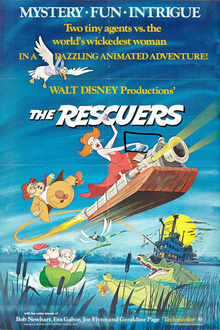
The Rescuers
1977
Directed by Wolfgang Reitherman, John Lounsbery, and Art Stevens
Welcome back to Movie Monday! As we do every first Monday of the month, we’re setting aside the cinematic disasters for a palate cleanser. This month we’re visiting Devil’s Bayou with Disney’s 1977 adventure The Rescuers — a film I have genuine affection for without being able to claim it changed my life. I think that’s actually the more honest place to write from: not the breathless nostalgia of a childhood obsession, and not the clinical distance of someone who watched it once for research. Just fondness. The fondness you have for something that does its job well and doesn’t ask for more credit than it deserves.
Here’s what I want to argue, though: The Rescuers deserves considerably more credit than it usually gets.
The film tends to be treated as a footnote in the Disney canon — a competent, charming entry in what’s often dismissively called the “Dark Age” of Disney animation, sandwiched between the studio’s classic golden era and the Renaissance it wouldn’t achieve until The Little Mermaid in 1989. That framing isn’t entirely wrong, but it’s not entirely fair either. The Rescuers is a more emotionally sophisticated film than that reputation suggests, and it got there the hard way: through a messy, complicated, years-long development process that very nearly produced a completely different movie.
That story is worth telling before we talk about the film itself.
How a Polar Bear and a Lion Almost Made This Movie
The Rescuers entered development in 1962, when Walt Disney optioned Margery Sharp’s novels The Rescuers (1959) and Miss Bianca (1962). The initial versions of the story were shelved after the plot got tangled up in Cold War politics — at one point the mice were helping a Norwegian poet escape from a Siberian prison, then the setting shifted to Cuba, and Walt Disney ultimately killed the project because he didn’t want an animated film with that much international intrigue. Which is fair. That does sound less like a children’s movie and more like a 1960s spy thriller with fur.
When the project was revived in the early 1970s, it came back in a completely different form. The studio was trying to develop it as a vehicle for the younger animators, led by Don Bluth, while the senior staff provided oversight. The source material they chose was Miss Bianca in the Antarctic, and the story at that point featured a scheming penguin and a captured polar bear. Louis Prima was cast as the bear. Redd Foxx was cast as a lion named Gus. Floyd Huddleston wrote songs. It sounds absolutely unhinged, and I say that with affection.
The problem was that the penguin wasn’t convincing as a villain — if your antagonist needs to dominate a polar bear, he can’t come across as vaguely comedic — and the Arctic setting was apparently too stark for the animators to work with. Director Wolfgang Reitherman eventually killed that version too, with the decisive logic that the movie should simply be: “A little girl gets kidnapped and the mice try to get her back, period.” The bear was reduced to a cameo — there’s a throwaway scene in the final film where Bernard hears a lion roar at a zoo and runs off terrified — and the whole elaborate setup was stripped away.
What emerged from that process was leaner, cleaner, and more emotionally grounded. Sometimes addition-by-subtraction works.
The setting shifted to Louisiana after Reitherman, while in Europe promoting Robin Hood, read Sharp’s books and became fixated on the villain. The Diamond Duchess from Miss Bianca became the template for a new antagonist. There was a brief period where they considered using Cruella de Vil from 101 Dalmatians — animator Ken Anderson even drew sketches of her in bell-bottom pants and platform shoes — but veteran animator Milt Kahl refused, correctly pointing out that Marc Davis had animated Cruella definitively and there was no point attempting a sequel to the character. Kahl then proceeded to channel that energy into designing and animating the new villain himself, and the result is one of Disney’s finest.
Madame Medusa: The Last Great Kahl Villain
This was Milt Kahl’s final film with the studio, and he knew it, and he intended to go out with something definitive. Medusa’s appearance was based on Kahl’s then-wife, Phyllis Bounds — a detail that adds a certain uncomfortable biographical charge to a character defined by her terrifying volatility — and Kahl was so determined to make her his best work that he ended up animating nearly all of her scenes himself.
The result is a masterclass in villainous physicality. Medusa is all sharp angles and wild gestures; she moves like someone who has never once considered whether her emotions are appropriate to the situation. She puts on eyelashes while driving a swamp boat at speed. She wears increasingly unhinged couture in a crumbling riverboat in a bayou. She shoots at children. There’s a scene where she confronts Penny about the missing diamond, and the escalation from theatrical sweetness to genuine menace happens in seconds — Geraldine Page’s voice performance matches Kahl’s animation beat for beat, all clenched sweetness tipping over into something properly frightening.
Here’s what I think makes Medusa underrated: she’s not evil in the abstract the way Disney villains often are. She’s evil in a recognizable way. Her cruelty toward Penny isn’t impersonal — it’s the cruelty of someone who views other people as instruments and becomes genuinely offended when those instruments fail to perform. The way she weaponizes Penny’s desire to be loved is specific and calculated and ugly, and the film doesn’t soften it. Penny is a small child who has been told, implicitly, that the price of being wanted is doing something terrifying. That’s a sophisticated emotional premise for a film aimed at children.
Medusa has another quality that’s easy to overlook: she’s genuinely funny. Not despite being frightening, but in the same breath. The Mr. Snoops scenes work because Medusa treats her business partner with the same theatrical contempt she has for everyone else, and Joe Flynn — in his final role, the film released after his death in 1974 — plays Snoops as a man who has spent so long being degraded that he’s developed a kind of weary professionalism about it. Their dynamic is a great comic double act, and it makes the scene where Snoops finally escapes on his raft, laughing at Medusa as she clings to the sinking smokestacks, genuinely satisfying.
It’s also worth noting the detail that Snoops’s appearance was caricatured from journalist John Culhane, who had been interviewing Disney animators and was apparently gradually tricked into posing for various facial expressions, his movements eventually ending up on Snoops’s model sheet. Culhane later said that becoming a Disney character was beyond his wildest dreams of glory. There’s a very specific kind of man who would describe being immortalized as an incompetent henchman in those terms, and I respect it.
Bob Newhart, Eva Gabor, and the Odd Couple at the Heart of It
The film’s emotional center isn’t the villain, though — it’s Bernard and Bianca, and the casting is one of those happy accidents that makes you wonder what would have happened with any other choice.
Bob Newhart’s Bernard is defined by the same quality that made Newhart’s stand-up and television work so distinctive: the carefully maintained composure of a person who is dealing with something unreasonable and refusing to fully acknowledge just how unreasonable it is. Bernard is superstitious, nervous, and highly reluctant to fly — that last trait is reportedly a genuine Newhart quality, which is the kind of character-actor-meets-role alchemy that you can’t engineer. He stammers. He counts steps to avoid bad luck. He is, by any reasonable measure, not the obvious candidate to rescue an orphan from a heavily armed swamp villain. Newhart plays all of this with complete sincerity, which is exactly right.
Eva Gabor’s Bianca is his perfect counterweight: sophisticated, decisive, and genuinely adventurous in a way that isn’t undercut by self-consciousness. Her Hungarian nationality was Gabor’s own, which gives the character a specificity that a generic European accent wouldn’t. Bianca chooses Bernard as her co-agent not because she doesn’t see his limitations — she absolutely does — but because she sees something in him that he doesn’t see in himself. That dynamic is the film’s quiet emotional engine, and it’s earned by two performers who play the relationship as a real one, not a comedic bit.
What’s interesting about Bernard and Bianca is what the writers chose not to do with them. An early approach depicted them as married professional detectives. The filmmakers ultimately decided that novices in a new relationship was more compelling — and they were right, but not just for romantic reasons. Making them genuinely inexperienced raises the stakes. These are not agents who know what they’re doing. They are a timid mouse janitor and a society mouse with good intentions, improvising their way through a genuinely dangerous situation, and the film takes that danger seriously.
Jim Jordan as Orville the albatross deserves a mention here. Jordan was eighty years old when the film was completed, hadn’t performed publicly since the death of his wife and comedy partner Marian Jordan in 1961, and was coaxed out of retirement specifically for the role. His work on Orville — dignified and slightly put-upon and completely committed — was his last public performance. There’s something quietly moving about that. The film is full of veteran performers at the ends of their careers: Flynn’s last role, Jordan’s last performance, Kahl’s last film. It reads, in retrospect, as a kind of passing of the torch that the film itself doesn’t know it’s making.
The Songs Nobody Talks About
The music for The Rescuers comes courtesy of the songwriting team of Carol Connors and Ayn Robbins, who came to the project with an interesting backstory: Connors had co-composed “To Know Him Is to Love Him” with the Teddy Bears, while Robbins had been a personal secretary to, among others, Eva Gabor. At the time of writing the film’s songs, they were also nominated for an Academy Award for Best Original Song for “Gonna Fly Now” from Rocky — which means the Rescuers score was being written by people who were, at that particular moment, among the more successful songwriters in Hollywood.
The songs reflect that professionalism. “Someone’s Waiting for You,” performed by Shelby Flint, is the film’s emotional heart and its best piece of music — a gentle, genuine ballad about loneliness and hope that works as a standalone song and as character definition. It tells you everything about Penny’s situation without stating any of it directly. Flint’s performance is unshowy and entirely right.
“Tomorrow Is Another Day” is more conventional but serves its function, and “The Journey” as an opening title piece sets the film’s tone efficiently: slightly melancholy, genuinely warm. The approach of having the songs serve as narrative rather than being sung by characters is notable — the film follows the Bambi model rather than the more typical Disney approach, and it creates a more unified emotional texture than the usual stop-everything-and-sing structure.
The “Rescue Aid Society” number at the beginning, which introduces the international mouse organization to an appropriately absurd degree, is the one moment of genuine comic pageantry, and Bob Newhart’s deadpan participation in it is perfect.
What the Film Actually Gets Right
Here’s the case I want to make: The Rescuers is a film about what it costs to show up for someone who needs you. Bernard and Bianca have no particular obligation to rescue Penny. They volunteer for it. They proceed through the mission incompetently and with significant personal risk, and they succeed largely because they refuse to stop. The film frames this not as heroism in any grand sense, but as the simpler and more demanding thing — showing up and continuing to try even when you’re out of your depth.
Penny’s situation earns this framing. She’s a child who has been failed by every system that should have protected her, who sends a message in a bottle because she can’t think of anything else to do, and who is initially skeptical that anyone is coming because she’s learned not to expect it. The moment she realizes that two small mice have traveled from New York because they got her letter is handled with enough restraint that it avoids sentiment without sacrificing genuine feeling.
Rufus the cat, voiced by John McIntire, has only a few scenes, but the “Faith is a Bluebird” sequence is one of the more genuinely moving pieces in the Disney catalog of the era. It’s a poem, not a song, and it’s offered not as a consolation but as a truth — which is different. Rufus doesn’t promise Penny that everything will be fine. He tells her that faith is what you bring to uncertainty, which is a more honest thing to say and a harder thing to dramatize effectively.
The film is also genuinely funny in ways that hold up. Evinrude the dragonfly, whose exhaustion is communicated entirely through buzzing sounds, is a great comic creation — he grew from an incidental character into a major one specifically because the filmmakers kept discovering comedic potential in depicting his fatigue. The bayou creatures, originally conceived as a martial home guard, were rewritten as a volunteer community of helpful eccentrics, which is a better choice in every way.
A Note on the Film’s Historical Footnote
The Rescuers came out in 1977, the same summer as Star Wars, which is as good an illustration as any of where Disney animation stood in the cultural conversation at that moment. The studio was not winning. The film’s box office was actually extraordinary by the standards of the era — it briefly achieved the highest gross of any animated film — but it wasn’t going to compete for space in the cultural memory with George Lucas’s space opera.
It’s also the film that, two decades later, became the subject of a recall when it was discovered that someone had inserted a barely-visible image of a topless woman into two non-consecutive frames during post-production — something you couldn’t see during normal viewing at 24 frames per second, but could catch on VHS. Disney recalled 3.4 million copies in 1999. Someone spent significant effort hiding that in a children’s movie. The layers of choices required to make that happen boggle the mind, and I genuinely have no further commentary to offer.
Final Verdict
The Rescuers is not Disney’s greatest film, and it doesn’t need to be. It’s a well-crafted, emotionally honest piece of work from a studio in transition, featuring one of the finest villain performances in the Disney animated canon, a central character relationship built on genuine affection rather than formula, and a story that takes its young audience’s emotional intelligence seriously.
The film earned a sequel — The Rescuers Down Under in 1990 — making it the first Disney animated feature to receive one. That sequel is, in many respects, the more technically accomplished film, arriving as it did at the beginning of the Renaissance. But the original has something the sequel doesn’t: the feeling of a film made by people who were genuinely trying to prove something, working within real constraints, handing down something between the old generation and the new.
Among the young animators who got their start on The Rescuers were Glen Keane, Ron Clements, and Andy Gaskill — people who would go on to define what Disney animation became in the decade that followed. There’s something fitting about that. The film that nobody quite puts in the first tier helped create the people who built the first tier.
That’s not a footnote. That’s a legacy.
Are you fond of The Rescuers, or is it one that’s slipped through the cracks for you? And who’s your favorite Disney villain from the so-called Dark Age? Let me know in the comments. Next Monday we return to the regularly scheduled disasters — and we’ve got a memorable one waiting.

