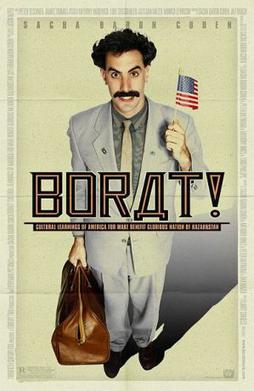
Borat
2006
Directed by Larry Charles
Welcome back to Movie Monday, where we continue the long and occasionally humbling march down the list of films that have consistently lost head-to-head battles in my Flickchart rankings. As always, I want to be upfront about something before we get into it: the contents of this post are purely a reflection of my own opinion. One man’s trash is another’s treasure, and I am fully aware that the film we’re discussing today has a passionate, devoted fanbase. I know I’m going to catch some grief for this one, and honestly, I understand why. But here we are.
Number 27 is Borat.
Yes, that Borat. Borat! Cultural Learnings of America for Make Benefit Glorious Nation of Kazakhstan, the 2006 mockumentary starring Sacha Baron Cohen that critics adored, audiences embraced, and the entire internet quoted for roughly the next five years. I know what you’re thinking. I can hear the keyboard warriors warming up their fingers already. But before you fire off that comment, I want you to know that I went into this film genuinely wanting to like it. I really did. And I came out the other side flat, vaguely uncomfortable, and more than a little relieved it was over.
The Netflix DVD Experience
There’s something appropriately nineties-adjacent about the way I first encountered Borat, even though it came out in 2006. I rented the DVD through Netflix — back in the era when Netflix was still a company that mailed you a little red envelope and you had to remember to send it back before you could get the next one. I had heard from seemingly everyone I knew that this was one of the funniest movies they had ever seen. The cultural noise around Borat was deafening. Catchphrases were everywhere. People were doing the accent at parties. It had won a Golden Globe. Roger Ebert, who rarely had much use for crude comedy, had praised it. The consensus was overwhelming.
So I queued it up, sat down with every expectation of laughing myself hoarse, and watched the whole thing with a growing sense of bewilderment.
It wasn’t that the movie was confusing, or that I couldn’t follow what it was going for. I understood perfectly well what Sacha Baron Cohen was doing. I understood the satirical intent. I understood that the joke was frequently on the Americans being filmed rather than on the fictional Kazakh journalist doing the filming. I got it. I just didn’t find it funny. And the longer the film went on, the more I found myself feeling something closer to discomfort than amusement — a low-grade unease that I couldn’t quite shake, even when the movie was clearly trying hardest to make me laugh.
I grabbed that red envelope, put it back in the mailbox, and moved on. Or tried to. The problem is that Borat has a way of following you around, because apparently everyone on earth loves it except me, and they’d all like to discuss it at length.
The Satire Argument, Which Is Real and Which I Am Still Going to Reject Personally
Let me be honest about something, because I think intellectual honesty matters here more than it might in some of my other Movie Monday posts: Borat is not a stupid movie. It is not lazy. Sacha Baron Cohen is genuinely talented, and there are moments in this film where the satirical machinery is working exactly as intended and the results are genuinely incisive. When real people, in unscripted moments, reveal casual prejudices, petty bigotries, or cheerful moral flexibility, the film catches something true and uncomfortable about American culture in 2006. The case for Borat as social commentary is not a stretch. It’s a legitimate reading of what the film is doing, and I don’t want to pretend otherwise.
I’ve seen Baron Cohen in other contexts and found him charming and funny — his brief but memorable role in Talladega Nights, his surprisingly affecting performance in Les Misérables. The man has range. I don’t think he’s a hack. I just think his particular brand of comedy, the ambush mockumentary style built on discomfort and transgression, is not for me.
And here is where I land: understanding a joke and laughing at a joke are two different things. I can follow the logic of what Borat is doing, appreciate the craft involved, and still come away from the theater — or in my case, the couch with a DVD player — feeling like I just watched something I didn’t enjoy. The satire is real. The comedy just doesn’t land for me personally. That’s not a critique of the film’s intelligence. It’s just an honest accounting of my own reaction.
The Mean-Spirited Problem
Here is where I have to be more critical, and where I think my discomfort goes beyond simple taste.
A significant portion of Borat‘s humor comes at the expense of real people who had no meaningful idea what they were participating in. The film is built on ambush. The unsuspecting subjects — the etiquette coach, the dinner party guests, the driving instructor, the rodeo organizers — were told they were participating in a documentary about a foreign journalist learning about America. They signed releases without full understanding of what they were agreeing to. And then their genuine reactions, their authentic moments of confusion or discomfort or, in some cases, their own casually expressed prejudices, were edited into a comedy film seen by hundreds of millions of people worldwide.
I am not, by nature, an easily offended person. I don’t need my comedy sanitized or soft. I can handle dark humor. I can handle transgressive comedy. What I struggle with is the ethics of ambush filmmaking, particularly when the targets are not powerful institutions or public figures who have consented to public scrutiny, but ordinary private citizens who were deceived into participating. The fact that some of them later said they didn’t mind, or even enjoyed the film, doesn’t entirely resolve this for me. And the extensive legal aftermath of the film — the lawsuits, the complaints, the people who said their lives or careers were genuinely affected by what ended up on screen — suggests that for some of them, the experience was not a harmless lark.
There are specific moments in the film that crystallize this for me. The dinner party scene, for instance — where Borat invites a sex worker to a formal Southern dinner and watches the resulting social chaos — works because the real people in that room are genuinely thrown. The comedy exists because they didn’t see it coming and didn’t consent to the chaos that was engineered around them. The naked hotel brawl, which plays as pure absurdist comedy, works because the people in that elevator had no idea what was about to burst through the doors. These scenes are funny to a lot of people. I understand why. They also leave me with a feeling I can’t quite talk myself out of.
The Salem Connection, Which Is Personal
Here is where this post takes a turn that I couldn’t have predicted when I first saw the film.
One of the more famous sequences in Borat involves a rodeo in Virginia, where Borat‘s fictional Kazakh journalist appears before a live crowd, delivers an over-the-top jingoistic speech that initially gets the crowd cheering, and then sings a fake Kazakhstani national anthem to the tune of the Star-Spangled Banner, causing the crowd to turn on him. It is one of the film’s most discussed sequences, and it is genuinely tense to watch, because the crowd’s reaction is completely real and completely unscripted.
That rodeo was filmed at the Salem Civic Center.
Salem, Virginia. Which, for those who don’t know, is essentially the next-door neighbor of Roanoke, where I have lived most of my life. It’s not a place I associate with international film controversy. It’s a place I associate with high school football and minor league baseball and the kind of ordinary small-city life that doesn’t typically get ambushed by British comedians in character.
I remember, vaguely but genuinely, seeing news reports about a film crew that had crashed a local rodeo. At the time, I didn’t connect it to anything in particular — it was just a strange local news story, the kind that makes you raise an eyebrow and then forget about it by morning. It wasn’t until I was sitting on my couch watching the DVD that I recognized the Salem Civic Center on screen and the pieces clicked together. That was here. That was filmed twenty minutes from where I’m sitting right now.
The local reaction, from what I remember, was a mixture of things — some embarrassment, some outrage, some amusement, the general mix of feelings you’d expect from a community that has just learned it appeared in a movie it didn’t audition for. The rodeo organizers later said they felt they had been the victim of a hoax. Bobby Rowe, who produced the rodeo, was quoted saying that while some people told him he’d “made the big time,” it wasn’t the way he wanted to make it. I can’t say I blame him.
It doesn’t change my opinion of the film. But it does add a layer to my experience of it that I suspect most viewers don’t have — a strange, slightly unsettling sense of recognition, the feeling of seeing your own backyard turned into someone else’s punchline.
The Box Office Reality, Which Is Undeniable
Whatever my feelings about Borat, I would be doing a disservice to pretend that the film’s reception was anything other than a phenomenon. The numbers are staggering. Made for $18 million, Borat earned over $262 million worldwide. It opened at number one at the box office, earned more in its second weekend than its first as word of mouth spread, and set records for per-screen averages. Sacha Baron Cohen won the Golden Globe for Best Actor in a Comedy or Musical. The film was nominated for the Academy Award for Best Adapted Screenplay. It has since appeared on multiple lists of the greatest comedy films of the 21st century.
By any conventional measure, Borat is not just a successful movie. It is a culturally significant one — the kind of film that changes what comedy is allowed to do and opens doors for the transgressive mockumentary format in ways that are still being felt. The fact that I personally don’t enjoy it is, in the grand scheme of things, a pretty minor data point against an avalanche of evidence that the film connected with audiences in a deep and genuine way.
I know this. I hold this information in one hand and my own flat, uncomfortable viewing experience in the other, and I try to make peace with the gap between them.
The Kazakhstan Footnote, Which Is Delightful
One thing I genuinely love about researching these posts is occasionally finding a detail that reframes the entire thing, and the story of Borat‘s reception in Kazakhstan is one of those details.
The Kazakh government initially denounced the film, threatened legal action, and launched a multi-million dollar public relations campaign to counter what they saw as a deeply offensive misrepresentation of their country. This is the expected response. What is not the expected response is what happened next: over time, as Kazakh officials realized that international interest in their country had increased dramatically as a direct result of the film, they did a complete reversal. By 2012, Kazakhstan’s Foreign Minister was publicly crediting Borat with a tenfold increase in visa applications. In 2020, the country adopted “Very Nice” — a direct Borat reference — as an official tourism slogan.
The nation that once threatened to sue Sacha Baron Cohen for defamation eventually made his catchphrase their marketing campaign. There is something so perfectly strange and human about that arc that I can’t help but find it wonderful, even as a non-fan of the film that caused it.
Why Number 27
Borat sits at number 27 on my list because it is a film that I understand, respect on an intellectual level, and genuinely do not enjoy. It earns a slightly higher ranking than some of the entries below it not because it is a better film by any objective measure — reasonable people can disagree about that — but because when Flickchart puts it in front of me, something about it edges out whatever is sitting across from it in the comparison. There is craft here. There is intelligence here. It is not a failure of conception the way some of the films lower on this list are failures. It is simply, stubbornly, resolutely not for me.
The mean-spiritedness bothers me. The ambush filmmaking bothers me. The specific discomfort of watching real people react to things they didn’t know were coming and didn’t fully consent to — that bothers me in a way I can’t logic my way out of, even when I acknowledge the satirical intent behind it.
And then there’s the Salem Civic Center, sitting there in the middle of a scene I’m supposed to find hilarious, looking exactly like it always does, twenty minutes from my apartment.
I know this is a popular movie. I know this ranking will raise some eyebrows. I know someone in the comments is going to type “High five!” at me and mean it as a rebuke. I’m ready for it. This is my list, these are my rankings, and Borat is number 27 on it.
Very nice.
Next Time on Movie Monday
I’ll be back next Monday with our monthly palate cleanser and Disney’s The Rescuers. In the meantime, if you’re a Borat devotee who wants to make the case that I’ve been deeply wrong about this film, the comments are open. I genuinely mean that — I’m always interested in hearing what it is that makes a piece of comedy land for some people and not others. The Salem Civic Center still there 20 years later. It doesn’t appear to have been too traumatized by the experience.
What do you think? Is Borat a satirical masterpiece I’ve been stubbornly refusing to appreciate, or does it rank right where it belongs? Drop your thoughts in the comments below.
 The Confusing Middle