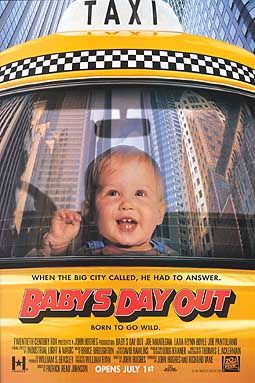
Baby’s Day Out
1994
Directed by Patrick Read Johnson
Welcome back to Movie Monday, where we continue the long and occasionally humbling march down the list of films that have consistently lost head-to-head battles in my Flickchart rankings. As always, the contents of this bad movie review are purely a reflection of my opinion. One man’s trash is another’s treasure, right? So just because I don’t care for this particular film should not negate your love for it.
Number 28 is Baby’s Day Out.
And unlike last week, I don’t find myself searching for diplomatic language. Even though this movie has the incomparable John Hughes’s name attached to it, I don’t feel the need to excavate hidden merit or make the case for misunderstood ambition. I just find myself staring at the screen and thinking: who thought this was a good idea, and why did so many people agree with them?
How It Ended Up Here
I have no specific memory of the first time I watched Baby’s Day Out, which is appropriate, because the film itself seems to have been made without any specific memory of what makes movies work. It exists in my brain the way certain things from the nineties exist — not as a vivid recollection but as a vague cultural residue, something I absorbed without choosing to, like a song that played too many times at a restaurant I didn’t like.
What I know is that when Baby’s Day Out appears in a Flickchart comparison, there is no hesitation. I have never looked at that title and thought, oh, wait, maybe this time. I click the other option. Whatever the other option is. I have almost certainly chosen Baby’s Day Out over films I genuinely dislike, because there is a category of cinematic failure that doesn’t produce strong emotion so much as it produces a kind of stunned blankness — a reaction that isn’t anger but isn’t forgiveness either.
That reaction is Baby’s Day Out.
To be clear about why: it’s not that the film is confusingly structured, or that it fails to deliver on an interesting premise, or that it can’t quite find the right tone. All of those were true of last week’s entry, Hero, which at least had the excuse of genuine ambition. Baby’s Day Out fails in a much more elemental way. It is aggressively stupid in a manner that I genuinely cannot forgive, and it is relentless about it — ninety-nine minutes of slapstick violence, infant peril, and grown men getting hit in the groin by a baby who cannot possibly understand what he’s doing, and yet apparently can, because the movie needs him to.
It’s not just bad. It’s stupid in a way that feels almost confrontational.
The John Hughes Problem
Here is where I have to stop and do something uncomfortable, which is acknowledge that Baby’s Day Out is a John Hughes film, or at least a John Hughes-adjacent film. Hughes wrote the screenplay and produced the picture. Patrick Read Johnson directed it, and I don’t want to hang too much on him — the screenplay is the problem here, not the direction, which is professional if unremarkable. But this was a John Hughes production, and that matters, because Hughes is someone who deserves better from his own legacy than Baby’s Day Out.
The Hughes comparison that will occur to everyone within the first ten minutes is Home Alone, and it’s not wrong. Both films involve criminals being subjected to increasingly elaborate and painful humiliations. Both films are comedies about adults failing spectacularly against a much smaller opponent. Both films were produced around the same era and aimed at the same audience. Home Alone came out in 1990. Baby’s Day Out came out in 1994. The parallels are not accidental.
What Home Alone understood, and Baby’s Day Out doesn’t, is that the comedy of a child outwitting criminals only works if the child is, in some meaningful sense, doing the outwitting. Kevin McCallister in Home Alone is a resourceful eight-year-old who makes plans, executes them, and faces genuine consequences when things go wrong. He’s a protagonist with agency. You root for him because he’s earned it.
Baby Bink is nine months old.
Baby Bink does not make plans. Baby Bink does not have strategies. Baby Bink crawls around Chicago following the illustrations in a picture book, and the three criminals chasing him are somehow unable to catch him, not because Bink outsmarts them, but because the movie requires them to fail. The physical comedy that results — men falling off cranes, getting set on fire, suffering injuries that would hospitalize an actual human being — doesn’t land because there’s no wit behind it. It’s not that Bink did something clever. It’s that the criminals are idiots, the universe hates them, and we’re supposed to find that funny.
Home Alone is a comedy. Baby’s Day Out is a series of accidents.
The cast does not help matters, though through no fault of their own. Joe Mantegna, Joe Pantoliano, and Brian Haley are all capable actors who have done genuinely impressive work elsewhere. Mantegna in particular, around this same period, was doing extraordinary things in other films. Here, they are asked to be human pinball bumpers — objects off which the plot bounces. Their characters have names and ostensible personalities, but what they actually have is a function: to be hurt, repeatedly, without sympathy.
Lara Flynn Boyle is essentially stranded as the mother, given almost nothing to do except look worried and then relieved. Cynthia Nixon appears as the nanny. Fred Thompson turns up as an FBI agent. They are all doing their jobs competently in a film that has no use for their competence.
The Box Office Math Is Genuinely Fascinating
Here’s a number for you: Baby’s Day Out cost $48 million to make.
Forty-eight million dollars. In 1994. For a movie about a baby crawling around Chicago.
It earned back roughly $30 million worldwide, which means it lost around $18 million even before you factor in marketing costs, which are typically at least as large as the production budget on a wide studio release. By any reasonable accounting, Baby’s Day Out was a significant financial disaster. 20th Century Fox, which distributed the picture, had to absorb a notable loss on a film that, from a pure concept standpoint, seemed reasonably safe — a family comedy from the writer of Home Alone, released in the summer, aimed at exactly the kind of broad audience that had made Hughes’s earlier productions into genuine cultural phenomena.
What went wrong is a question with an obvious answer, which is that the film simply isn’t very good, and audiences in the summer of 1994 had options. The Lion King was also in theaters. Forrest Gump opened the same month. Speed was still running. The competition alone would have been formidable for a well-reviewed film. Baby’s Day Out was not well-reviewed.
Roger Ebert, whose Chicago Sun-Times reviews I always find worth reading even when I disagree with them, gave the film one and a half stars, noting that the gags “might have worked in a Baby Herman cartoon, but in live action, with real people, taxis, buses, streets, and a real baby, they’re just not funny.” He was right. His partner Gene Siskel liked it, which tells you something about the gap between what this film was going for and what it actually achieved — the case for the defense seems to hinge on children specifically and babies especially enjoying it, which may well be true, and also is not a sufficient defense of a $48 million studio production.
The India Footnote, Which Is Extraordinary
This is the part of the post where I have to set aside my personal feelings about Baby’s Day Out and acknowledge something genuinely remarkable.
Baby’s Day Out was a massive hit in India.
Not a moderate success. Not a cult following. A phenomenon. It was remade in Telugu in 1995. Then in Hindi in 1997. Then in Malayalam in 1999. Then in Sinhalese in 2002. Roger Ebert — the same Roger Ebert who gave the film one and a half stars in the United States — recalled visiting Kolkata in 1999 and being told by the owner of a large theater that Baby’s Day Out was their most successful film ever, having run to full houses for more than seventeen consecutive weeks.
Seventeen weeks. The film that I am ranking at number 28 on my list of least favorite movies ran full houses for seventeen weeks in Kolkata, India.
I don’t know exactly what to do with this information, except to say that it usefully illustrates something about how contextual our experience of movies really is. A film is not a fixed object with fixed properties. It is a transaction between the film and its audience, and different audiences bring different things to that transaction. What registered as crass, aggressively stupid slapstick to American critics in 1994 apparently registered as something else entirely — something delightful, something worth seeing again and again and worth remaking in four different languages over seven years — to audiences in South Asia.
I still don’t like it. But I find something genuinely humbling in the reminder that my experience of a film, even a film I find aggressively stupid, is not the whole story.
The Verne Troyer Detail You Didn’t Know You Needed
Before we close, a footnote that I cannot skip, because it is one of those pieces of film trivia that sounds like it should be false and is not.
Verne Troyer — who went on to be considerably more famous as Mini-Me in the Austin Powers franchise — served as the stunt double for Baby Bink in Baby’s Day Out.
This was one of Troyer’s early professional credits. He performed the more physically demanding infant stunts, which is to say the ones where Bink appears to be in mortal danger on top of cranes or in traffic, which is quite a sentence. The Worton twins — Adam Robert Worton and Jacob Joseph Worton — played Bink in the close-up and reaction shots, but when Baby Bink was dangling from a skyscraper or crawling through a construction site, it was Verne Troyer in a baby costume.
The image of Verne Troyer, future international comedy star, dressed as a nine-month-old and doing stunt work for a film that was going to lose $18 million at the box office, is one of those details that makes you feel like you understand something essential about the movie industry without being able to articulate exactly what.
Why Number 28
Baby’s Day Out sits at number 28 because it is aggressively stupid in a way that I find difficult to forgive, and because that stupidity is not accidental or incidental but load-bearing. The film needs the criminals to be idiots. It needs the baby to be essentially magical. It needs the audience to find escalating physical violence funny without any comedic construction to support it. None of this is a flaw in execution. It’s a flaw in conception — a misunderstanding of why Home Alone worked that resulted in a film which has the shape of a family comedy without any of its substance.
It’s not the worst movie I’ve ever seen. It’s not even the worst movie I’ve ranked. But it is a film that consistently, reliably loses when matched against almost anything else, and not out of some close call or narrow defeat. It loses because when it appears on screen in comparison, some part of my brain says no thank you with a quiet firmness that doesn’t require much deliberation.
Forty-eight million dollars. Seventeen weeks in Kolkata. Verne Troyer in a baby costume.
Baby’s Day Out is a lot of things. A good movie is not among them.
Next Time on Movie Monday
I’ll be back next Monday to continue the countdown, and next week we’re moving up to number 27, which is a movie that is actually quite popular. Just not with me. In the meantime, if you’re one of the people who watched Baby’s Day Out in South Asia and want to make the case that I’ve been completely wrong about this film this entire time, I genuinely want to hear from you. I’m not being sarcastic. The seventeen-weeks-in-Kolkata detail has shaken my confidence in ways I’m still processing.
What do you think? Is Baby’s Day Out a misunderstood classic of nineties family comedy, or does it rank right where it belongs? Drop your thoughts in the comments below.

