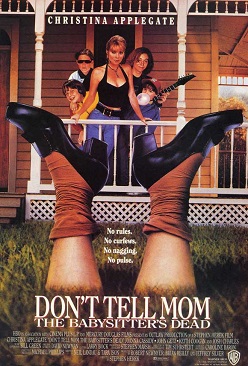
Don’t Tell Mom the Babysitter’s Dead
1991
Directed by Stephen Herek
Welcome back to Movie Monday, where we continue making our way down my personal list of cinematic disappointments, one ranking at a time. The usual disclaimers apply: this list is mine, it’s subjective, and it’s shaped by nothing more scientific than years of head-to-head comparisons on Flickchart. If Don’t Tell Mom the Babysitter’s Dead is a beloved part of your childhood, if you quote it regularly, if you’ve worn out a VHS copy or worn out the patience of anyone who hasn’t seen it by insisting they absolutely must — I mean this sincerely — I understand. I knew going in that this one was going to cost me something. The cult following around this film is real, it’s passionate, and it is not wrong to love a movie I happen to rank at number 30 on my worst list.
But here we are. Let’s talk about it.
How It Landed Here
I want to be upfront about something: unlike some entries on this list, I don’t have a dramatic story about my first encounter with Don’t Tell Mom the Babysitter’s Dead. There’s no classroom screening to look back on, no formative sleepover memory, no particular moment I can point to and say “that’s where it went wrong.” I caught it on HBO sometime in the early 1990s, the way you caught a lot of movies back then — channel surfing, landing on something already in progress, watching the rest because it was on and you were there.
And that, honestly, might be part of the problem. Some movies demand to be seen in a specific context, with a specific crowd, at a specific age. Don’t Tell Mom the Babysitter’s Dead feels like one of them. If you were a teenage girl in 1991, watching Christina Applegate navigate the adult world with borrowed confidence and a forged résumé, I can absolutely see how this film would have hit differently than it hit me. The cult following this movie has earned over the decades on VHS and cable isn’t an accident or a case of mass delusion. There is something genuinely resonant in the film’s central fantasy — the idea that a kid, thrust into impossible adult circumstances, can not only survive but actually thrive, and maybe discover something about herself in the process.
Applegate herself has talked about this. She’s pointed to the film’s message about second chances as the reason it still connects with people — the idea that you don’t have to be defined by where you started, that you can turn things around, that the burden teenagers feel isn’t permanent. That’s a real theme, and it’s a good one, and I don’t want to dismiss it.
I just wish the movie built around that theme were a little sharper.
The way this list works is straightforward, if a little unglamorous: years of Flickchart comparisons, movie against movie, until things sort themselves out. Don’t Tell Mom the Babysitter’s Dead ended up at number 30 not because of any single catastrophic failure, but because every time it went up against something else, something else won. That’s a telling verdict, even if it’s not a dramatic one.
The Promise of the Premise
Let’s give the film its due. On paper, Don’t Tell Mom the Babysitter’s Dead has a genuinely funny premise. The elderly babysitter hired to watch the Crandell kids for the summer dies — quietly, in her chair, with her hands wrapped around the family’s entire cash supply — and the kids, facing an empty house and an emptier bank account, have to figure out how to survive until Mom gets back from Australia. The oldest, seventeen-year-old Sue Ellen (Swell, to her friends), forges a résumé, lands an executive assistant job at a fashion company, and proceeds to run not just her household but, improbably, an entire clothing line.
The movie that premise promises is a sharp, slightly anarchic comedy about a teenager who discovers that adulthood is mostly improvisation and confidence, that the adults running things don’t necessarily know more than she does, and that the distance between “faking it” and “making it” is smaller than anyone wants to admit. That’s actually a subversive idea for a 1991 studio comedy aimed at teenagers. It’s the kind of premise that, in the right hands, could have been genuinely memorable.
The movie that premise delivers is considerably more comfortable than that.
Safe by Design
The comparison critics reached for in 1991 was Home Alone, which had been a massive hit the previous year and had apparently convinced Hollywood that kids-running-wild comedies were the next big thing. Peter Travers at Rolling Stone was not kind about the comparison. Roger Ebert, characteristically more generous, gave it two stars and called it “a consumerist, escapist fantasy for teenage girls” — which, depending on your angle, is either a dismissal or a reasonably accurate description.
What both of those reviews are circling around, I think, is that the film is relentlessly, almost strategically safe. The workplace satire that could have had real teeth is toothless. The romance is obligatory. The villain — Carolyn, the snooty receptionist who knows Swell is a fraud — never becomes a genuine threat because the movie isn’t really interested in stakes. Even Swell’s actual crimes — she forges credentials, she steals from petty cash, she lies to her boss repeatedly — are treated with such a light touch that nothing ever feels like it’s actually in danger of falling apart.
Part of this is genre. Coming-of-age comedies aimed at teenagers are not generally in the business of moral complexity. You know going in that things are going to work out, that the protagonist is going to triumph, that the love interest is going to come back around. Predictability isn’t inherently a flaw when predictability is what the audience came for.
But there’s a version of this story that lets the comedy be actually funny on the way to that inevitable happy ending, and Don’t Tell Mom the Babysitter’s Dead doesn’t quite find it. The jokes that should land with precision tend to land with a thud. The satirical moments — Gus the philandering VP, the office politics, the fashion industry absurdity — are painted in such broad strokes that they stop being satire and start being wallpaper. And a film built around a spectacular, high-concept premise ends up feeling, too often, like a pretty ordinary family comedy.
The Applegate Problem
Here’s where I want to be careful, because what I’m about to say is a criticism of the material, not of the performance.
Christina Applegate was, by 1991, genuinely famous. Married… with Children had made Kelly Bundy a cultural touchstone — a character defined by cheerful obliviousness and surprising depth underneath, played by an actress with impeccable comic timing and a natural screen presence that the camera loved. When Don’t Tell Mom the Babysitter’s Dead was put together, Applegate was exactly the kind of star a studio would want for a teenage coming-of-age comedy. She was recognizable, she was likable, and she had already proven she could carry scenes and land laughs.
The problem is that Swell Crandell is not Kelly Bundy, and the script doesn’t seem entirely sure what she is instead. The role asks Applegate to play someone capable and driven and ultimately competent, which is fine — but it doesn’t give her much to actually do with that competence except succeed. The edges that made Kelly Bundy interesting are smoothed away. Swell is likable from the first scene, sympathetic throughout, and triumphant at the end, and there’s almost nothing in between that complicates her.
Applegate does what she can. Her charm is genuine and it carries the film further than it probably deserves to go. In the scenes where she’s allowed to be funny — the early job interview sequence has a nice energy, and her growing confidence at GAW has moments of genuine wit — you can see exactly the kind of movie this could have been. She’s working with commitment even when the script isn’t meeting her halfway.
But she deserved better material for her first headlining feature. Coming off Married… with Children, with the goodwill of audiences who already loved her and the natural comedic gifts she had already demonstrated, she should have had a showcase. Instead, she has a vehicle — something functional, pleasant enough, ultimately forgettable. That might be the real disappointment at the center of Don’t Tell Mom the Babysitter’s Dead: not that the film is bad, exactly, but that it squanders a performer who was absolutely ready for something great.
What the Cult Gets Right
I said I wanted to engage sympathetically with the people who love this movie, and I mean it, so let me try to articulate what I think the cult around Don’t Tell Mom the Babysitter’s Dead is actually responding to.
The film works best as a kind of wish fulfillment for teenagers who feel the weight of expectations they didn’t ask for. Swell doesn’t want to be the responsible one. She wanted to go to Europe with her friends. Instead, she gets handed a situation that is objectively unfair — a dead babysitter, no money, four younger siblings, and a mother who has no idea any of it is happening — and she rises to it not because she’s perfect but because she has to. That arc, played without irony and with genuine warmth, connects. Of course it connects. The fantasy of being forced into a situation you weren’t prepared for and discovering you’re actually capable of handling it is one of the most enduring fantasies in coming-of-age storytelling.
And the film has real charm in its supporting performances. Keith Coogan’s Kenny is a genuinely funny slacker archetype. The GAW office scenes have moments of real life in them. The fact that David Duchovny is in this movie, several years before the world knew who David Duchovny was, is the kind of thing that makes rewatching old films worthwhile.
The people who love Don’t Tell Mom the Babysitter’s Dead are not wrong to love it. They’re responding to something real that’s in the film. I’m just also responding to what’s not in the film — the sharper jokes, the bolder choices, the more fully realized Christina Applegate performance — and finding the gap between the two a little too wide to climb.
Why Number 30
Don’t Tell Mom the Babysitter’s Dead sits at number 30 on this list for the same reason a lot of films end up on lists like this one: not because it’s a disaster, but because it’s a disappointment. A disaster is almost interesting. A disaster has the courage of its convictions, even when those convictions are wrong. Don’t Tell Mom the Babysitter’s Dead is a film that had real potential — a funny premise, a charming star, a perfectly good setting for sharp comedy — and decided, at every turn, to take the easier path.
It’s not as funny as it thinks it is. It’s not as sharp as its premise deserved. It’s a product of an era when studios believed that premise plus likable star plus broad comedy equaled a hit, and while that formula sometimes produces something genuinely entertaining, here it produces something more like pleasant background noise. The kind of film you watch on HBO on a Saturday afternoon in 1991 and forget about by Sunday.
I don’t hate this movie. I’m not sure I’m even particularly annoyed by it. I’m mostly just a little sad about what it could have been.
And to the passionate defenders of Swell Crandell and the summer that changed everything: I hear you. I genuinely do. You’re responding to something real. I just happen to be the person who kept picking other movies when Flickchart asked me to choose.
Next Time on Movie Monday
We’re taking a break from the worst list next week — and honestly, after spending a few weeks in the lower reaches of my Flickchart rankings, I’m ready for something a little more delightful. Join me the first Monday of April as we step into the Hundred Acre Wood for the latest installment of the Disney Animated Canon series: The Many Adventures of Winnie the Pooh. Consider it a palate cleanser.
Until then, may your summer jobs always lead to unexpected promotions, may you always stay “on top of that, Rose!” and may your family’s babysitter remain in excellent health.
What do you think? Is Don’t Tell Mom the Babysitter’s Dead a misunderstood gem, or do you understand where I’m coming from? Drop your thoughts in the comments below.
 The Confusing Middle
You nailed it. I like Applegate (she was positively sublime in Dead to Me), but this wasn’t . . . good.
LikeLiked by 1 person
Yes! Dead to Me was fantastic!
LikeLiked by 1 person