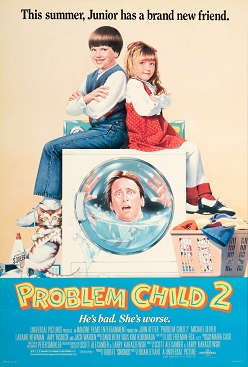
Problem Child 2
1991
Brian Levant
Welcome back to Movie Monday, where we continue our descent through my personal catalog of cinematic disappointments. Before we dive in, let me offer my standard disclaimer: this list represents my personal opinion and nothing more. What I consider unwatchable dreck might be your favorite comfort movie, the film you quote with friends, or the comedy that never fails to lift your spirits. Cinema is subjective, and my distaste for these films doesn’t invalidate your enjoyment of them. Take my criticisms with a grain of salt—or better yet, a whole shaker.
This week brings us to number 38: Problem Child 2, a 1991 sequel that achieved the seemingly impossible task of disappointing an 11-year-old boy who thought the original Problem Child was hilarious. Think about that for a moment. This film failed to entertain its exact target demographic—a child with already questionable taste who was physiologically primed to find bodily function jokes and cartoonish violence amusing. If that’s not a damning indictment of a comedy’s failure, I don’t know what is.
I was there opening weekend, fresh off my enjoyment of the original Problem Child, ready to laugh at whatever mayhem Junior would unleash this time. My young brain, still developing its critical faculties, had been thoroughly entertained by the first film’s anarchic spirit. This was the same kid who thought the Three Stooges represented sophisticated comedy. My bar wasn’t just low; it was subterranean. And yet, sitting in that darkened theater in July of 1991, even my pre-adolescent self recognized that something had gone horribly wrong.
The Sequel Nobody Asked For
The original Problem Child, released just a year earlier, had been a modest success, the kind of film that found its audience despite critical hatred. It was crude, mean-spirited, and built around the one-joke premise of “what if Dennis the Menace was actually sociopathic?” But it had a certain anarchic energy, a willingness to push boundaries that at least felt purposeful. Junior wasn’t just mischievous; he was a genuine terror, and the film didn’t entirely shy away from the darker implications of that premise.
Problem Child 2 arrived with the speed of a studio that knew its young star was rapidly aging out of his role. Michael Oliver, who played Junior, was already visibly older, that awkward phase where child actors stop being cute and start being gangly. Universal Pictures, displaying the kind of panic that leads to terrible decisions, rushed a sequel into production before their pint-sized psychopath could sprout his first pimple.
The result feels less like a sequel and more like a fever dream recreation of the first film by someone who had only heard it described secondhand. Where the original had at least committed to its mean-spirited premise, the sequel softens everything into pablum while simultaneously ramping up the gross-out humor, as if bodily fluids could substitute for actual comedy writing.
The Brian Levant Problem
This was Brian Levant’s directorial debut, and it shows in every frame. Levant would go on to direct such “classics” as The Flintstones and Jingle All the Way, establishing himself as Hollywood’s go-to guy for loud, colorful, and utterly soulless family entertainment. But here, in his first at-bat, you can see him learning all the wrong lessons in real-time.
The film has no sense of pacing, no understanding of comedy rhythm, and no ability to distinguish between a good take and a bad one. Scenes play out with the timing of someone learning to juggle while riding a unicycle—technically possible but painful to watch. Levant seems to believe that if actors deliver their lines loudly enough and the music cues hit hard enough, comedy will somehow materialize through sheer force of will.
The Wasted Talent of John Ritter
Perhaps the greatest tragedy of Problem Child 2—and I use the word “tragedy” with full awareness of its weight—is watching John Ritter struggle to find something, anything, to work with in this material. Ritter was a genuine comedic talent, a performer who could find humor in the smallest gesture or the simplest line reading. Three’s Company might not have been high art, but Ritter elevated it through sheer force of personality and impeccable timing.
Here, playing Ben Healy for the second time, Ritter seems lost. The script gives him nothing but reaction shots to Junior’s mayhem and a romance subplot so perfunctory it might as well have been written by predictive text. You can see him trying—God bless him, he never phoned it in—but it’s like watching a master chef try to make a gourmet meal out of gas station beef jerky. The ingredients simply aren’t there.
The film pairs him with Amy Yasbeck, his future wife and a talented comedian in her own right, but their chemistry is undermined by a script that treats their romance as an afterthought. She plays Annie Young, a school nurse with her own problem child, and the film’s big innovation is… what if there were TWO problem children? It’s the kind of creative bankruptcy that makes you wonder if anyone involved had ever actually seen a movie before, let alone tried to make one.
The Michael Oliver Situation
Let’s address the elephant in the room: Michael Oliver’s performance as Junior. Child actors exist on a spectrum from “uncannily naturalistic” to “visibly reading cue cards,” and Oliver, bless his heart, sits somewhere around “young Anakin Skywalker complaining about the cold of space.” It’s not entirely his fault—the script asks him to be simultaneously sympathetic and sadistic, charming and repulsive, without giving him any actual character to play.
Oliver delivers every line with the same flat affect, whether he’s supposedly being clever, mean, or vulnerable. His idea of being mischievous involves squinting his eyes and smirking in a way that suggests less “troubled youth” and more “mild constipation.” When the film needs him to show actual emotion during the wedding climax, he looks like someone trying to remember if they left the oven on.
The comparison to Jake Lloyd’s Anakin isn’t made lightly. Both are child performers asked to carry massive productions without the skills or direction to do so. But where Lloyd at least had the excuse of George Lucas’s notoriously wooden dialogue, Oliver is working with material that should be in his wheelhouse—a kid causing chaos. That he makes it look so laborious speaks to both his limitations as a performer and the film’s failure to understand its own protagonist.
The Candy Apple Catastrophe
If you need a single scene that encapsulates everything wrong with Problem Child 2, look no further than the carnival sequence. Trixie (played by Ivyann Schwan, who at least seems to understand she’s in a comedy) uses candy apples stuck to her shoes to appear tall enough for a ride. When Junior can’t follow, he retaliates by sabotaging the controls, causing everyone to vomit in technicolor glory.
This scene represents the film’s entire approach to comedy: take a mildly clever setup (the candy apple shoes), ignore its comedic potential (the visual gag of a tiny girl in platform candy apples), and instead default to the laziest possible punchline (mass vomiting). It’s as if the filmmakers had a checklist of “things kids find funny” and just worked through it mechanically. Vomit? Check. Destruction? Check. Adults getting humiliated? Check. Actual humor? Notably absent.
The sequence also highlights the film’s uncomfortable mean-spiritedness. The original Problem Child at least had the courage of its convictions—Junior was genuinely disturbing, and the film didn’t entirely shy away from that. Here, we’re supposed to find him charming while he causes innocent bystanders to lose their lunches. It’s not dark comedy; it’s just unpleasant.
The Romantic Subplot That Wasn’t
The addition of LaWanda DuMore (Laraine Newman) as Ben’s potential bride adds nothing but runtime. Her characterization consists entirely of “rich,” “mean,” and “hates children.” The film treats her eventual comeuppance—being given a giant nose through surgical mix-up—as hilarious justice, but it’s really just cruel and lazy.
Meanwhile, the real romance between Ben and Annie develops with all the passion of a DMV transaction. They meet, they like each other, their kids cause chaos, they somehow end up together. The film seems to believe that simply putting two attractive adults in proximity will generate chemistry, like romance works through osmosis.
The Comedy Landscape of 1991
To understand how Problem Child 2 could exist, we need to consider the comedy landscape of 1991. This was a weird transitional period for family comedies. The John Hughes teen comedy era was ending, but the Jim Carrey rubber-faced revolution hadn’t begun. Studios were throwing everything at the wall to see what stuck, and apparently, “problem children causing chaos” stuck just enough to warrant a sequel.
But compare Problem Child 2 to other comedies released that same year. City Slickers showed that family-friendly comedy could be smart and heartfelt. What About Bob? proved that you could mine mental health for laughs without being mean-spirited. Even Don’t Tell Mom the Babysitter’s Dead managed to find genuine humor in its ridiculous premise. Problem Child 2, by contrast, feels like it was made by aliens who had comedy described to them but had never actually experienced laughter.
The Bad Kid Comedy Paradox
Here’s the fundamental problem with “bad kid” comedies, at least when they’re not willing to go full horror: they want to have their cake and eat it too. They want the transgressive thrill of a child behaving badly, but they also want that child to be sympathetic and likeable. They want consequences for everyone except the protagonist. They want to critique adult hypocrisy while ultimately reinforcing traditional values.
The only films that successfully explore the “bad kid” trope are those that commit to the horror of it. The Good Son, released just two years later, understood that a truly problematic child isn’t funny—he’s terrifying. The Omen knew that evil children work as horror, not comedy. Even Dennis the Menace, released the same year as Problem Child 2, understood that true mischief needs innocence behind it, not malice.
Problem Child 2 exists in an uncomfortable middle ground where Junior is too mean to be sympathetic but too sanitized to be genuinely transgressive. He’s not a problem child; he’s a plot device in a striped shirt.
The Box Office Confusion
Despite its creative failures, Problem Child 2 made money. Not as much as the original, but enough to justify its existence in Hollywood’s ledger books. It earned $32.7 million against an $11-15 million budget, proving once again that financial success and artistic merit operate in entirely different universes.
But unlike Big Momma’s House, which at least found its intended audience, Problem Child 2‘s success feels more like inertia. Parents who had survived the first film figured the second couldn’t be worse (they were wrong). Kids who enjoyed the original assumed the sequel would deliver more of the same (it didn’t). The film succeeded through brand recognition and summer vacation desperation, not because anyone actually enjoyed it.
The Lasting Damage
Problem Child 2 didn’t kill the franchise—that honor goes to the direct-to-TV Problem Child 3: Junior in Love—but it did kill something more important: John Ritter’s big-screen potential. After this and Stay Tuned, Ritter retreated to television where he belonged, eventually finding success again with 8 Simple Rules before his untimely death in 2003. That Problem Child 2 represents one of his few starring film roles feels like a cosmic injustice.
The film also helped cement the “bad kid” comedy as a creative dead end. After Problem Child 2‘s diminishing returns, studios largely abandoned the format, occasionally returning to it with diminishing results (see Dennis the Menace, which at least had Walter Matthau to salvage something from the wreckage).
Why Problem Child 2 Earns Its Spot at Number 38
Problem Child 2 sits at number 38 not because it’s the most incompetent film ever made, but because it represents a special kind of failure: the sequel that misunderstands everything that made its predecessor work while simultaneously amplifying everything that didn’t. It’s a film that disappointed its target demographic—11-year-old boys with questionable taste—which takes a special kind of anti-talent.
This is a comedy that fundamentally doesn’t understand comedy, a family film that offers nothing for families, a star vehicle that makes its stars look worse. It wastes John Ritter, squanders Amy Yasbeck, and proves that Michael Oliver’s performance in the first film might have been a fluke. It’s mean without being dark, gross without being funny, chaotic without being energetic.
The Bottom Line
Problem Child 2 stands as proof that sometimes Hollywood’s fastest reflex—the rushed sequel—produces exactly what you’d expect: a hollow echo of something that wasn’t that great to begin with. It’s a film that failed to entertain even those of us young enough and dumb enough to be its ideal audience, a special achievement in failure that earns its place on this list.
For those who found genuine entertainment in Junior’s second round of mayhem, I can only express bewilderment tinged with concern. Were we watching the same movie? Or has Stockholm syndrome extended to terrible sequels, where familiarity breeds not contempt but acceptance?
Next week on Movie Monday, we’ll continue our journey through cinematic disasters with another film that proves sometimes Hollywood’s recycling program produces nothing but garbage. Until then, remember: not every modest success deserves a sequel, and sometimes the real problem children are the executives who greenlight these films.
What are your thoughts on Problem Child 2? Did it fail to meet even your 11-year-old standards, or did you somehow find humor in its desperate attempts at comedy? Share your experiences in the comments below—I’m particularly curious to hear from anyone who preferred this to the original, mainly because I need to understand how that’s possible.


Luckily, I haven’t seen any of the Problem Child movies. I heard they were some of the worst, so I avoided them, but who knows? I might do a troublesome child marathon one of these days.
LikeLiked by 1 person
hi I watch the original problem child like it I was 8 years old and when problem child 2 came out I was so excited thought I might like it just like the original but I did not like problem child 2 the fell it did not feel good to me when I watching it but I watch it all the way through though to go out
LikeLiked by 1 person