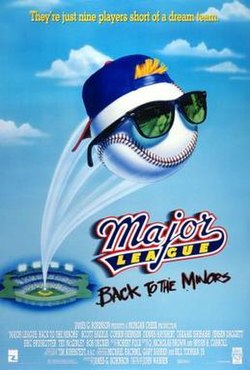
Major League: Back to the Minors
1998
Directed by John Warren
Welcome back to Movie Monday, where we’re continuing our relentless journey through my personal list of the 100 worst movies I’ve ever endured. This week we’re stepping up to the plate for number 46: Major League: Back to the Minors, the 1998 sports comedy that took everything beloved about the original Major League franchise and struck out so spectacularly that it makes you wonder if anyone involved had ever actually seen a baseball movie before. And yes, before we go any further – this represents my personal opinion. If you somehow found joy in watching Scott Bakula try to manage his way through what feels like a made-for-TV movie that accidentally got a theatrical release, more power to you. We can still grab a beer and argue about baseball. But if you think this movie deserves to share shelf space with the original Major League, we might need to have a serious conversation about your relationship with quality entertainment.
I’ll be honest – this one hits particularly hard because I went in with genuine hope. The original Major League from 1989 was a near-perfect sports comedy, striking that delicate balance between heart and humor that made you actually care about the ragtag Cleveland Indians. Major League II, while not quite matching the original’s magic, still had enough charm and returning cast chemistry to work as a worthy sequel. So when Major League: Back to the Minors was announced with Scott Bakula – the eternally likable Sam Beckett from Quantum Leap – taking the lead, I thought we might be getting something special. Instead, we got a movie that feels like it was written by someone who had heard about baseball secondhand and thought the sport needed more interpretive dance.
From Diamond Dreams to Direct-to-Video Nightmares
To understand how spectacularly Back to the Minors fails, you need to appreciate what made the original Major League work so brilliantly. That film understood that great sports movies aren’t really about the sport – they’re about character, heart, and the universal appeal of underdogs fighting against impossible odds. Charlie Sheen’s Rick “Wild Thing” Vaughn wasn’t just a pitcher with control problems; he was every person who’d ever been given one last chance to prove themselves. Tom Berenger’s Jake Taylor wasn’t just an aging catcher; he was everyone who’d ever wondered if their best days were behind them.
The original film also understood that comedy in sports movies works best when it comes from character and situation, not from broad slapstick or forced quirkiness. The humor emerged naturally from the personalities clashing, from the desperation of their situation, and from the genuine love these characters had for a game that had often been cruel to them. It was smart, it was heartfelt, and it respected both its characters and its audience.
Major League: Back to the Minors took one look at this formula and apparently decided what it really needed was ballet dancers, psychologist pitchers, and a plot so convoluted that even the characters seem confused about what movie they’re in. It’s like watching someone take a perfectly crafted watch apart and reassemble it with a sledgehammer and some chewing gum.
The Title That Says Everything
Before we even get to the actual content of the film, can we talk about that title for a moment? Major League: Back to the Minors. Read that again. Major League… Back to the Minors. It’s right there in black and white – a movie called Major League that takes place entirely in the minor leagues. It’s like calling a movie Star Wars: Return to Earth or Fast & Furious: Slow & Cautious. The title is a contradiction that perfectly encapsulates the fundamental confusion at the heart of this entire enterprise.
The original Major League worked because it was about major league players fighting to win in the major leagues. The title meant something – it represented aspiration, achievement, the pinnacle of professional baseball. Back to the Minors suggests the exact opposite – failure, demotion, settling for less. And while there’s nothing inherently wrong with a story about minor league baseball (some of the best sports movies ever made have been set in the minors–looking at you Bull Durham), calling it Major League creates expectations that the film has no intention of meeting.
It’s as if the filmmakers were banking entirely on brand recognition, hoping that slapping the Major League name on any baseball movie would automatically generate audience interest. It’s the cinematic equivalent of putting “New and Improved!” on a product that’s demonstrably worse than the original.
Scott Bakula: Wrong Place, Wrong Time, Wrong Script
Poor Scott Bakula. Here’s an actor who had spent five years charming television audiences as the time-traveling Sam Beckett, proving he could handle both comedy and drama with equal skill. Bakula has always possessed that rare quality of being instantly likable without being cloying – the kind of performer who can make you believe in the impossible while keeping everything grounded in genuine humanity. He should have been perfect for a baseball comedy.
Instead, he’s saddled with playing Gus Cantrell, a character so thinly written that Bakula seems to be making up his personality as he goes along. Gus is supposed to be a grizzled minor league veteran who can transform a group of misfits into a championship team, but the script never gives us any reason to believe he has the wisdom, experience, or leadership skills necessary for the job. Bakula does his best to inject some charm into the proceedings, but he’s working with dialogue that sounds like it was generated by a computer program that had only seen sports movies through brief summaries.
The tragedy is that Bakula could have been great in this role with better material. He has the everyman appeal that made the original Major League cast so effective, and he’s certainly capable of the kind of wry humor that defined the franchise. But the script gives him nothing to work with beyond generic inspirational speeches and forced romantic subplot with Jensen Daggett’s Maggie Reynolds that feels like it was imported from a completely different movie.
Watching Bakula try to make this material work is like watching a master chef trying to prepare a gourmet meal with ingredients from a gas station. The skill is there, but the raw materials are so fundamentally inadequate that failure is inevitable from the start.
An Ensemble Cast of Missed Opportunities
The supporting cast reads like a collection of “hey, it’s that guy!” character actors who deserved so much better than what they got. Corbin Bernsen returns as Roger Dorn from the original films, but he’s reduced to a plot device whose main function is to set up the central conflict and then disappear for most of the movie. Bernsen had great chemistry with the original cast, but here he’s isolated from everything that made his character work.
Dennis Haysbert reprises his role as Pedro Cerrano, the mysticism-obsessed slugger from the first two films, but without the context of the original team dynamic, the character feels like a pale imitation of himself. Haysbert is a naturally compelling performer (as anyone who’s seen 24 can attest), but he’s given nothing to do except repeat familiar character beats without any of the development that made them meaningful in the first place.
The new cast members fare even worse. Walton Goggins shows up as Billy “Downtown” Anderson, the power hitter whose ego threatens to tear the team apart, but the script never makes him interesting enough to care about his redemption arc. Ted McGinley plays Leonard Huff, the arrogant major league manager who serves as the film’s primary antagonist, but he’s such a one-dimensional villain that McGinley can’t do anything except sneer and deliver exposition.
Perhaps most painfully, the film wastes Kenny Johnson as Lance “The Dance” Pere, a ballet dancer turned ballplayer whose story could have been genuinely interesting with better writing. Instead, the character exists purely for fish-out-of-water comedy that never rises above the level of “look, the ballet dancer is playing baseball!” It’s the kind of lazy writing that suggests the filmmakers thought the concept was inherently funny without bothering to develop any actual jokes.
A Plot That Actively Resists Entertainment
The story, such as it is, involves Gus being recruited to manage a AAA team called the Buzz (a name that sounds like it was chosen by a marketing committee that had never seen a baseball game). His mission is to turn a collection of misfits into a real team, which leads to the inevitable showdown with the major league club that’s designed to prove that heart matters more than talent.
It’s the same basic structure as the original Major League, but without any of the elements that made that formula work. The original film gave us distinct, memorable characters with clear motivations and personal stakes in the outcome. Back to the Minors gives us a collection of quirky character traits masquerading as actual people. The original film built genuine tension around whether this group of misfits could actually come together as a team. Back to the Minors assumes we’ll automatically care about the outcome without bothering to make us care about the characters.
The film’s biggest structural problem is that it can’t decide what story it wants to tell. Is it about Gus proving himself as a manager? Is it about the team learning to work together? Is it about the conflict between major and minor league baseball? Is it about the romance between Gus and Maggie? The script tries to juggle all these elements simultaneously and drops every single one of them.
Even the baseball scenes, which should be the film’s strongest element, feel perfunctory and unconvincing. The original Major League understood that great sports movie moments come from character development paying off in athletic achievement. Back to the Minors treats the baseball as an afterthought, rushing through game sequences that have no emotional weight because we don’t care about the people playing.
Technical Mediocrity in Service of Nothing
One of the film’s most frustrating aspects is how technically competent it is in service of such poor material. The cinematography is perfectly adequate, the baseball scenes are filmed with basic competence, and the production values suggest a legitimate theatrical release rather than a made-for-TV movie. This isn’t a case where you can blame the failures on lack of resources or technical incompetence.
Instead, we have a film that looks like it should work but fails at the most fundamental level of storytelling. It’s like watching someone use professional-grade equipment to record a karaoke performance – technically proficient but completely missing the point of what makes entertainment entertaining.
The direction by John Warren (who also wrote the script) feels anonymous and uninspired. There’s no visual flair, no distinctive voice, no sense that anyone behind the camera had any particular passion for this story or these characters. It’s competent in the most damning possible way – professional enough to not be obviously bad, but lacking any spark of creativity or inspiration that might have elevated the material.
Box Office Reality: When Even Baseball Fans Stay Away
Major League: Back to the Minors was released in April 1998, right in the heart of baseball season when sports fans should have been primed for this kind of entertainment. Instead, the film managed only $3.6 million in the domestic box office against an $18 million budget – numbers so dismal that they suggest audiences could smell the mediocrity from the theater parking lot.
For context, this was the same year that gave us Saving Private Ryan, There’s Something About Mary, and The Truman Show – movies that understood how to entertain audiences. Back to the Minors opened against films that had actual stories to tell and characters worth caring about, making its failures even more apparent by comparison.
The film’s financial performance was so poor that it effectively killed any possibility of future Major League sequels for nearly two decades. When your movie performs so badly that it murders an entire franchise, you’ve achieved a special level of failure that goes beyond mere incompetence into active destruction of beloved intellectual property.
Critical Consensus: Even Kindness Has Limits
The critical reception was about as brutal as you’d expect for a film this fundamentally broken. The movie currently holds a 22% rating on Rotten Tomatoes, and even that seems generous given the complete lack of anything resembling entertainment value. Critics noted that the film felt like a cheap imitation of the original films, lacking both the heart and the humor that made the franchise worth following in the first place.
What’s particularly telling is that many reviews mentioned feeling sorry for the cast, particularly Scott Bakula, who clearly deserved better material. When critics are focusing more on their sympathy for the actors than on anything happening in the actual movie, you’ve created something that inspires pity rather than engagement.
The film also drew unfavorable comparisons to other sports comedies of the era, with critics noting that even bad sports movies usually manage to generate some excitement during the game sequences. Back to the Minors somehow made baseball – America’s pastime – feel boring and inconsequential.
Why Major League: Back to the Minors Earns Its Place at Number 46
So why does Major League: Back to the Minors land at number 46 on my personal worst movies list? It’s not just because it’s incompetent – though it absolutely is. It’s because the film represents the worst kind of creative laziness: taking a beloved franchise and producing something so generic and uninspired that it actively damages the memory of what came before.
The original Major League films understood that great sports movies are about more than just the sport – they’re about character, determination, and the universal appeal of underdogs fighting against impossible odds. Back to the Minors took one look at that formula and decided what it really needed was less character development and more quirky character traits.
What makes this particularly maddening is that all the pieces were there for a genuinely good movie. Scott Bakula is a naturally charismatic lead who could have anchored a great sports comedy with better material. The concept of minor league baseball provides plenty of opportunities for both humor and heart. The returning cast members from the original films could have provided continuity and fan service.
Instead, we got a movie that fails at every level – as a sequel, as a sports movie, and as basic entertainment. It’s a film that seems designed to waste everyone’s time and talent as efficiently as possible, including the audience’s. When your movie makes people nostalgic for bad sports comedies, you’ve achieved something truly special in its mediocrity.
The film also represents everything wrong with franchise filmmaking at its most cynical. Rather than building on what made the original films work, Back to the Minors treats the Major League name as a brand to be exploited rather than a legacy to be honored. It’s the kind of cash-grab sequel that gives sequels a bad name.
The Long-Term Damage: Franchise Killer
Perhaps the most frustrating thing about Major League: Back to the Minors is how thoroughly it damaged the Major League brand. The original film was a genuine classic that deserved a better legacy than this generic, uninspired follow-up. By the time this movie hit theaters, it had been four years since Major League II, and fans were ready for a return to form. Instead, they got something that felt like it had been assembled in a boardroom by executives who had never seen a baseball game.
The film’s failure effectively ended the Major League franchise for nearly two decades. When David S. Ward, the writer of the original film, announced plans for a “proper” Major League 3 in 2010, part of the appeal was the promise that it would ignore Back to the Minors entirely. That’s how thoroughly this film failed – even the franchise creator wanted to pretend it never happened.
The Silver Lining: What Not to Do
If there’s one positive thing to say about Major League: Back to the Minors, it’s that it serves as a perfect example of how not to continue a beloved franchise. The film’s failures helped establish some basic rules for future sports movie sequels: respect your source material, understand what made the original work, and don’t assume that familiar character names automatically equal entertainment value.
The movie also provided valuable lessons for everyone involved. Scott Bakula went on to have a successful television career with Star Trek: Enterprise and NCIS: New Orleans, showing that one bad movie doesn’t have to define an actor’s career. The film industry learned (hopefully) that franchise recognition alone isn’t enough to guarantee audience interest.
And for baseball movie fans, Back to the Minors made us appreciate just how difficult it is to create a great sports film. The original Major League made it look easy, but this sequel proved that combining sports, comedy, and heart requires genuine skill and inspiration, not just familiar elements thrown together without thought or care.
The Bottom Line
Major League: Back to the Minors stands as a monument to wasted potential and creative laziness. It’s a film that had every advantage – a beloved franchise to build on, a charismatic lead actor, and a sport that provides natural drama and excitement – and still managed to create something actively boring. Watching it is like observing a master class in how to turn gold into lead through sheer determination and bad decision-making.
The movie fails because it confuses familiar elements with actual entertainment, quirky character traits with genuine personality, and franchise recognition with audience affection. It’s a film that seems to have been made by people who understood the surface elements of what made the original Major League work but completely missed the heart and soul that made it special.
In the end, Major League: Back to the Minors is like a beautifully wrapped present that contains nothing but disappointment. It looks like it should work – legitimate cast, professional production values, beloved franchise – but the moment you start watching, you realize someone has played a very expensive practical joke on you. It’s a movie that makes you appreciate just how rare it is to create something genuinely entertaining, and how easy it is to destroy something good through laziness and lack of inspiration.
Next week on Movie Monday, we’ll continue our descent through cinematic mediocrity with number 45: Mortal Kombat: Annihilation, a film that took everything people loved about the original Mortal Kombat movie and decided what it really needed was less coherent plotting and more nonsensical fight scenes. Until then, remember: just because you can make a sequel doesn’t mean you should, and sometimes the most disappointing movies are the ones that had every reason to be good.
What are your thoughts on Major League: Back to the Minors? Did you manage to find any entertainment value in this franchise-killer, or do you think it deserves its place among the worst sports movies ever made? Share your thoughts in the comments below – I’d love to hear if anyone out there has a defense for this diamond disaster.
 The Confusing Middle
I didn’t even know this movie existed! Haha. Reading a good blog post about a bad movie is way better than watching the bad movie.
LikeLiked by 1 person
Haven’t even seen the original. So I’ll take your word about the sequel.
LikeLiked by 1 person