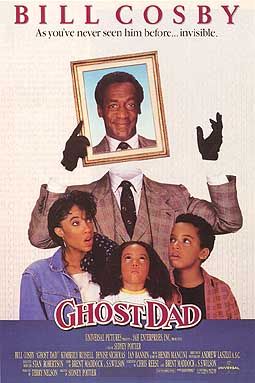
1990
Directed by Sidney Poitier
Welcome back to Movie Monday, where I’m slowly working my way down my personal list of the worst movies I’ve ever seen. This week, we’ve reached number 65: the 1990 fantasy comedy Ghost Dad, starring Bill Cosby and directed by Sidney Poitier. Before we dive in, I should remind you that this list is based solely on my opinion, so something I hate may be something you love. That said, I have a feeling there aren’t many passionate defenders of this particular cinematic misfire.
My History with Ghost Dad
Even as a child watching this movie in the early 1990s, I thought it was stupid. That’s saying something, because kids are generally pretty forgiving when it comes to movie quality. But even with my undeveloped critical faculties, I could tell this wasn’t good. The acting was bad across the board, and despite being marketed as a comedy, it really wasn’t funny.
The Disaster on Paper
Ghost Dad was directed by Sidney Poitier – yes, that Sidney Poitier, the groundbreaking actor who became the first Black performer to win an Academy Award for Best Actor. This was Poitier’s final directorial effort, and one has to wonder if the experience was so traumatic that he swore off directing forever. The film starred Bill Cosby, who at the time was riding high as “America’s Dad” thanks to the phenomenal success of The Cosby Show, which had been dominating television ratings since its debut in 1984.
On paper, this pairing of two African American entertainment pioneers should have been promising. In reality, it resulted in a film that critics panned and audiences largely ignored, resulting in a box office disaster that earned only $25.4 million against a $30 million budget.
The “Plot”
I put “plot” in quotation marks because what unfolds in Ghost Dad barely qualifies as a coherent narrative. Bill Cosby plays Elliot Hopper, a workaholic widower with three children who’s trying to secure a big promotion at work. After forgetting his daughter Diane’s birthday, he tries to make it up to her by promising her his car once he secures a big deal at work.
On his way home one night, Elliot takes a taxi driven by a Satanist named Curtis Burch (Raynor Scheine). The cab ride turns terrifying as Burch drives erratically. In a panic, Elliot pretends to be Satan to scare the driver into stopping. Instead, the shocked cabbie drives off a bridge, seemingly killing them both.
Elliot emerges from the accident as a ghost who can only be seen by his children in a completely dark room. Even then, they can’t always hear him. He learns from paranormal researcher Sir Edith Moser (Ian Bannen) – yes, Sir Edith, a man with a woman’s name because apparently that’s hilarious – that his soul will remain earthbound until Thursday. This gives Elliot just a few days to complete his company’s merger and renew his life insurance policy to provide for his children after he “crosses over.”
The rest of the film is a series of increasingly contrived and unfunny scenarios as Elliot attempts to maintain his work responsibilities while being, you know, mostly dead. Eventually, it’s revealed that Elliot isn’t actually dead – his spirit just jumped out of his body in fright, which is apparently a hereditary condition since it happened to his father too. There’s a hospital mix-up (Burch had switched wallets with Elliot), Elliot’s daughter Diane has a serious accident that causes her spirit to also leave her body, and eventually everyone gets back to normal. Elliot even finds time to start a romantic relationship with Joan (Denise Nicholas), because why not?
The Execution (Or Lack Thereof)
The fundamental problem with Ghost Dad is that it can’t decide what kind of movie it wants to be. Is it a heartwarming family comedy about a father learning to prioritize his children? A supernatural fantasy? A romantic comedy? A slapstick farce? It tries to be all these things and succeeds at none of them.
The visual effects are terrible, even by 1990 standards. The ghost effects primarily consist of Cosby being filmed with a slightly blurry filter or simply having him stand behind semi-transparent material. It looks cheap and unconvincing, which is surprising given the $30 million budget (equivalent to about $65 million today).
The tone is all over the place. One minute, we’re supposed to be concerned about children potentially being orphaned; the next, we’re watching Cosby’s ghost pretend to be an invisible butler at a dinner party. Scene to scene, the film veers wildly between sentimental family drama and broad, unfunny comedy.
The Performances
Bill Cosby is, to put it mildly, not good in this movie. He mugs for the camera, delivers his lines with weird emphases, and generally seems to be in a completely different film than everyone else. There’s no subtlety or nuance to his performance – just a lot of eye-bulging, shouting, and his trademark “Cosby face.” It’s less acting and more a series of comedy routines awkwardly stitched together into the semblance of a character.
The supporting cast doesn’t fare much better, though they aren’t given much to work with. Kimberly Russell as Elliot’s oldest daughter Diane and Denise Nicholas as his love interest Joan try their best to ground their scenes in some kind of emotional reality, but they’re fighting a losing battle against both the script and Cosby’s scene-chewing performance.
Critical Reception
Critics were not kind to Ghost Dad. Roger Ebert gave it half a star out of four, calling it “a desperately unfunny film—a strained, contrived construction that left me shaking my head in amazement […] How could Sidney Poitier, a skilled filmmaker with an actor’s sense of timing, have been the director of this mess? How did a production executive go for it? Who ever thought this was a good idea?”
Vincent Canby of The New York Times was equally unimpressed, describing it as “unctuous, flat and phony, a farce that has the pace of a Broadway bus at rush hour.”
On Rotten Tomatoes, the film holds an approval rating of just 6% based on 31 reviews, with the critics consensus stating: “A startlingly misconceived effort from director Sidney Poitier and star Bill Cosby, Ghost Dad is a listless, glacially-paced comedy that’s alternately schmaltzy and incomprehensible.” Interestingly, audiences were more forgiving, giving the film an average grade of “A-” on CinemaScore, suggesting there was some disconnect between critical and audience reception.
The Poitier-Cosby Connection
What makes this film particularly disappointing is the talent involved. Sidney Poitier and Bill Cosby were longtime friends who had previously collaborated on more successful films, including Uptown Saturday Night (1974), Let’s Do It Again (1975), and A Piece of the Action (1977). These films, while not critically acclaimed masterpieces, were at least competently made and commercially successful.
Ghost Dad was a far cry from those earlier collaborations. Interestingly, the film wasn’t originally intended to star Cosby at all. Early in development, John Badham was slated to direct with Steve Martin as Elliot Hopper. For reasons unknown, Badham and Martin left the project, and Universal hired Poitier and Cosby as their replacements. One can only wonder how different – and possibly better – the film might have been with Martin in the lead role.
Cosby’s Career Low Points
Ghost Dad wasn’t Cosby’s only cinematic disaster. Just three years earlier, he had starred in Leonard Part 6 (1987), a spy comedy so bad that Cosby himself publicly denounced it before its release, warning audiences to stay away. It seems Cosby had a knack for appearing in truly terrible films when he ventured onto the big screen.
This is particularly striking given his success in television and stand-up comedy. The Cosby Show was a cultural phenomenon that dominated ratings throughout the late 1980s. His stand-up comedy albums won numerous Grammy Awards, and his 1983 concert film Bill Cosby: Himself is still regarded as one of the greatest stand-up comedy films ever made.
But when it came to narrative feature films, Cosby seemed unable to translate his comedic talent to the big screen. Ghost Dad represents perhaps the nadir of this disconnect between his television/stand-up success and his film career failures.
The Complicated Legacy
It’s impossible to discuss anything Bill Cosby-related today without acknowledging the serious sexual assault allegations against him. Since 2014, more than 60 women have accused Cosby of rape, drug-facilitated sexual assault, sexual battery, and other sexual misconduct, with alleged incidents spanning from 1965 to 2008.
In 2018, Cosby was convicted of aggravated indecent assault against Andrea Constand and sentenced to prison, though his conviction was later overturned by the Pennsylvania Supreme Court in 2021 due to a violation of his due process rights related to a non-prosecution agreement. In 2022, a jury found Cosby civilly liable for sexually assaulting Judy Huth when she was 16 years old.
These allegations and convictions have fundamentally altered how we view Cosby’s work. Television networks have pulled reruns of The Cosby Show from syndication, and his once-stellar reputation as “America’s Dad” has been irrevocably tarnished. The man once known for his family-friendly comedy and moral pronouncements now has a legacy defined by serious criminal allegations.
This complex reality adds another layer of discomfort to watching Ghost Dad today. The film’s premise of a father trying to look after his children from beyond the grave takes on a disturbing irony in light of what we now know about the star.
Any Redeeming Qualities?
Is there anything good about Ghost Dad? I’m struggling to come up with much. I suppose one could argue that the film’s core message about the importance of family over career is laudable, if ham-fistedly delivered. Some of the child actors give decent performances considering the material they’re working with. The film is mercifully short at 84 minutes, so at least the suffering doesn’t last too long.
But honestly, these are faint praises for a film that fails on almost every level – script, direction, acting, special effects, and basic entertainment value.
Cultural Impact (Or Lack Thereof)
Ghost Dad has had minimal cultural impact beyond being remembered as a terrible film. It occasionally appears in “worst movies ever” lists and has been parodied a few times in other media:
- In the Simpsons‘ “Treehouse of Horror XI,” Homer dies after consuming broccoli and must perform one good deed within 24 hours to avoid Hell, a plot somewhat reminiscent of Elliot’s situation in Ghost Dad.
- In a Family Guy episode, Stewie appears on Kids Say the Darndest Things (Cosby’s show) and says “Ghost Dad was the best movie I’ve seen since Leonard Part 6,” referencing two of Cosby’s biggest film flops.
- The video game “Barkley, Shut Up and Jam: Gaiden” features Ghost Dad as a boss character with Bill Cosby’s face superimposed on a ghost’s body.
But these references are less about the film itself and more about using Ghost Dad as shorthand for “terrible movie starring Bill Cosby.”
Conclusion
Ghost Dad earns its place at number 65 on my worst movies list through its baffling script, poor direction, awful special effects, and Bill Cosby’s cringe-inducing performance. What makes it particularly disappointing is that it represents a waste of talent – Sidney Poitier’s last directorial effort deserved to be something better than this supernatural comedy misfire.
As a cultural artifact, Ghost Dad is now doubly uncomfortable to revisit – first because it’s a genuinely bad movie, and second because of the serious allegations against its star. It stands as a reminder that even the most successful entertainers can produce spectacular failures, and that the people we elevate as cultural icons may have deeply troubling private lives that eventually come to light.
Next week on Movie Monday, we’ll move on to number 64 on my worst movies list. I promise it won’t involve any spectral parents, but it might be equally haunting for entirely different reasons.
Have you seen Ghost Dad? Do you think it deserves its spot on my worst movies list, or am I being too harsh? Let me know in the comments below!
 The Confusing Middle
I have known about Ghost Dad for awhile, but I stayed away due to its bad reputation. Had no idea Sidney Poitier was the director. I’m shocked that he made something so bad. Although I loved The Cosby Show, trying to watch the movie now will definitely make me see Bill Cosby a different way.
LikeLiked by 1 person
you guys dont gotta clue. the bad effects or w.e were typical of the time i mean this 1990 even ghostbusters 2 dont really hold up that great on that end. regardless though I dont know too many inner city kids that didnt grow up at the time loving them this movie. He was a big public figure at the time and i rather not get into all the extra shyt with him nowadays because lets be honest we have yet to truly scratch the surface of what be going on in Hollywood. not gonna say its the greatest but its a nostalgic classic.
LikeLiked by 1 person
That’s cool… Like I said, just because I didn’t like something doesn’t meant there aren’t folks out there who love it. Thanks for sharing your love for the movie!
LikeLike