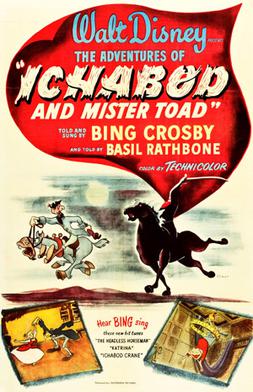
The Adventures of Ichabod and Mr. Toad
1949
Directed by Ben Sharpsteen, Jack Kinney, Clyde Geronimi, James Algar
Welcome back to Movie Monday, dear readers! Since it’s the first Monday of the month, we’re taking our regular break from my ongoing countdown of the 100 worst movies I’ve ever seen to cleanse our palates with some classic Disney animation. Don’t worry – we’ll return to our regularly scheduled cinematic disasters next week. Today, we’re diving into one of Disney’s most peculiar offerings: The Adventures of Ichabod and Mr. Toad.
If you’re wondering why Disney decided to pair a manic British amphibian with a gangly American schoolteacher in a single film, well… grab a cup of tea (or perhaps some hard cider, in Mr. Toad’s honor), and let’s explore one of the most wonderfully weird entries in the Disney canon.
The Package Deal
To understand how we ended up with this oddball pairing, we need to talk about Disney’s “package film” era of the 1940s. During and immediately after World War II, the Disney studio found itself in a bit of a pickle. With international markets disrupted by the war and budgets tighter than Ichabod Crane’s wallet, Walt Disney couldn’t afford to produce the kind of full-length animated features that had made the studio famous. The solution? Combine shorter segments into “package films” – essentially the animated equivalent of a variety show.
The Adventures of Ichabod and Mr. Toad was actually the last of these package films, coming after such mixed bags as Make Mine Music, Fun and Fancy Free, and Melody Time. What makes this one particularly interesting is that both segments were originally planned as full-length features. That’s right – both The Wind in the Willows and The Legend of Sleepy Hollow were supposed to be their own movies before Disney’s accountants presumably had simultaneous heart attacks.
A Tale of Two Tales
The film gives us two completely unrelated stories, linked only by the fact that they’re both literary adaptations narrated by distinguished actors who probably wondered how they ended up describing the antics of anthropomorphic animals and headless horsemen.
Mr. Toad’s Wild Ride (Before It Was a Theme Park Attraction)
The first segment, narrated by Basil Rathbone (who probably needed a stiff drink after recording some of these lines), introduces us to J. Thaddeus Toad, Esq., quite possibly the worst estate manager in British history. Imagine if your wealthiest friend had the impulse control of a toddler in a candy store and the attention span of a caffeinated squirrel. That’s Mr. Toad.
This segment is essentially a cautionary tale about property management and the dangers of vehicular obsession, told through the lens of a wealthy amphibian who treats his ancestral estate like a piggy bank for funding his latest manias. Toad goes from horse-cart racing to motor car theft faster than you can say “poop poop!” (which he does, frequently and with concerning enthusiasm).
The beauty of this segment lies in its absolutely bonkers plot progression. Toad goes from respected estate owner to convicted car thief, escapes prison disguised as a washerwoman (a disguise that somehow works despite him being, you know, a TOAD), and eventually proves his innocence through a chaotic battle for the deed to Toad Hall. And just when you think he’s learned his lesson, he immediately develops an obsession with airplanes. It’s like watching a Victorian-era episode of “Intervention” where nobody successfully intervenes.
Ichabod’s Not-So-Romantic Comedy
The second segment gives us Disney’s take on Washington Irving’s “The Legend of Sleepy Hollow,” narrated by Bing Crosby, who brings his signature easy-going charm to a story that ends with a man either being murdered by a ghost or running away in abject terror (the film leaves it delightfully ambiguous).
Ichabod Crane is introduced as our protagonist, though “hero” might be stretching it. He’s a lanky schoolteacher who’s basically a colonial gold-digger, more interested in Katrina Van Tassel’s future inheritance than her personality. The film doesn’t even try to hide this – there’s literally a sequence where he imagines her father’s farm as various food items he’ll get to enjoy after marriage. Real romantic stuff there, Ichabod.
The rivalry between Ichabod and Brom Bones is less “love triangle” and more “battle of questionable motivations.” Brom is a bully who can’t stand being upstaged, while Ichabod is essentially trying to execute a long-term heist via marriage. It’s like a Jane Austen novel where nobody is particularly likable, but everyone is entertaining.
Animation That Influenced Generations
What’s particularly fascinating about this film is how it showcases two distinct animation styles that would influence Disney for decades to come. The Wind in the Willows segment features the kind of detailed character animation and expressive personalities that would become a hallmark of Disney’s character work in films like 101 Dalmatians and Robin Hood. You can see echoes of Mr. Toad’s manic energy in later Disney characters like The Emperor’s New Groove‘s Kuzco.
The Sleepy Hollow segment, meanwhile, demonstrates Disney’s mastery of atmosphere and horror-tinged animation, following in the footsteps of the “Night on Bald Mountain” sequence in Fantasia while setting a standard for spooky-yet-family-friendly sequences that would influence later films like The Black Cauldron and The Great Mouse Detective. The climactic chase with the Headless Horseman remains one of Disney’s most effectively creepy sequences, managing to be genuinely suspenseful while still being appropriate for (most) children.
A Lasting Legacy
While The Adventures of Ichabod and Mr. Toad might seem like an odd footnote in Disney’s history, its influence extends far beyond its initial release. Mr. Toad’s Wild Ride became one of Disneyland’s opening day attractions (and still operates in Disneyland, though sadly not in Walt Disney World anymore). The Headless Horseman leads off Mickey’s Not-So-Scary Halloween Party at Magic Kingdom. And the film’s approach to adapting classic literature – taking beloved stories and infusing them with Disney’s particular brand of humor and heart – became a template for countless Disney adaptations to follow.
The film also marks an important transition point in Disney animation. As the studio’s last package film before returning to full-length features with Cinderella in 1950, it represents both the end of one era and the beginning of another. The animation techniques developed during this period – particularly in creating distinctive character personalities and atmospheric settings – would serve the studio well in its upcoming Golden Age.
Final Thoughts
The Adventures of Ichabod and Mr. Toad is a unique entry in the Disney canon, representing both the creative compromises of the package film era and the studio’s continuing artistic ambition. It’s a film that gave us both a manic toad’s obsession with transportation and one of animation’s most memorable ghost stories. The fact that these two completely different tales work together at all is a testament to Disney’s storytelling abilities.
Is it a perfect film? No. Is it a coherent film? Debatable. But it’s a fascinating glimpse into a transitional period of Disney animation, and both segments are entertaining enough to stand on their own merits. Whether you’re in it for the British humor of The Wind in the Willows or the American gothic of Sleepy Hollow, there’s something here for everyone.
Just maybe don’t take financial advice from Mr. Toad or relationship advice from Ichabod Crane.
Next week, we’ll return to our regularly scheduled programming of cinematic disasters with number 66 on our list of the 100 worst movies I’ve ever seen, See Spot Run. Until then, stay clear of any horsemen you meet, and try not to trade your ancestral estate for a motor car!


The Adventures of Ichabod and Mr. Toad is my favorite Disney movie from the Package era. If only because it’s simply 2 separate stories not tied together by a framing device. I remember watching it when I was a kid, but the Sleepy Hollow segment stuck with me more than the Wind in the Willows segment. The latter is jolly old fun, but the former terrified me back then. I’ll never forget the Headless Horsemen’s evil cackle.
LikeLiked by 1 person