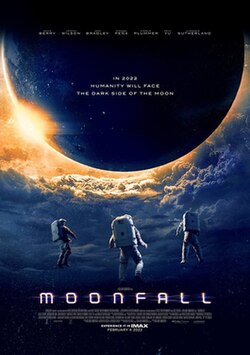
Moonfall
2022
Directed by Roland Emmerich
Same disclaimer as always before we get started: this list is based entirely on my personal Flickchart rankings, which have been built over years of head-to-head matchups between movies I’ve actually seen. This is not an objective declaration that Moonfall is the fifth-worst movie ever made, nor is it meant to offend anyone who watched it and had an absolute blast. If this movie scratches some particular itch for you, I’m genuinely glad it does. Movies are subjective. Sometimes ridiculous spectacle is exactly what somebody wants, and there are plenty of movies I enjoy that other people would probably describe using words considerably less polite than “ridiculous.”
Normally, I don’t think I would have bothered seeing Moonfall when it arrived in theaters in February 2022. The premise alone sounded like something I could probably wait to catch at home someday, assuming I remembered it existed by then. But I was a Regal Unlimited subscriber at the time. For roughly twenty bucks a month, plus a 53-cent convenience fee when I reserved through the app, I could basically see whatever I wanted. More importantly, I had friends with the same subscription, which created a dangerous environment in which the question stopped being, “Is this movie worth paying to see?” and became, “We’re already paying for this thing. What else are we going to do tonight?”
And that, ladies and gentlemen, is how Moonfall gets you. I knew almost immediately that I had made a terrible mistake.
Roland Emmerich Has Destroyed the World Before
I should probably establish that I am not philosophically opposed to Roland Emmerich blowing up the planet. I love Independence Day. I am fully prepared to accept that aliens have crossed interstellar space only to discover that their highly advanced technology is susceptible to a computer virus uploaded by Jeff Goldblum. I have seen The Day After Tomorrow. I have seen 2012. Emmerich has built a large part of his career around discovering increasingly creative ways to make humanity regret constructing famous landmarks.
At a certain point, though, the returns started diminishing for me. Independence Day had enormous spectacle, but it also had characters I liked. The movie knew exactly what kind of entertainment it was delivering, and there was a wonderful simplicity to the basic proposition: aliens show up, aliens blow things up, humanity fights back. Nobody needed to reveal halfway through the movie that the White House was secretly constructed by ancient humans around a miniature neutron star.
Moonfall apparently looked at that kind of restraint and decided it was for cowards. The film was directed by Roland Emmerich from a screenplay he wrote with Harald Kloser and Spenser Cohen. Halle Berry plays NASA executive and former astronaut Jocinda Fowler, Patrick Wilson plays disgraced astronaut Brian Harper, and John Bradley plays conspiracy theorist K.C. Houseman. The setup is that some mysterious force has knocked the Moon out of its orbit, sending it progressively closer to Earth and threatening the destruction of civilization.
Already, we have quite a bit to work with. Unfortunately, the movie was only warming up.
Oscar Winner Halle Berry Is Here
One of my earliest thoughts while watching Moonfall was that Halle Berry must have received one heck of a paycheck. That probably isn’t fair. Actors take roles for all kinds of reasons. Maybe she loved the screenplay. Maybe she really wanted to work with Emmerich. Maybe she had always dreamed of being in a movie where the Moon attempts to murder Colorado.
But I kept thinking about the words Academy Award winner Halle Berry appearing in the marketing. Because that is absolutely true. Berry won the Best Actress Oscar for Monster’s Ball at the 74th Academy Awards. Of course, movie history also gives us another amusing honorific: Golden Raspberry winner Halle Berry, thanks to Catwoman.
I’m not pointing that out because Berry is a bad actress. She obviously isn’t. Great actors appear in terrible movies all the time. Patrick Wilson is talented. John Bradley is talented. Michael Peña is talented. Donald Sutherland shows up in this thing, and nobody was ever going to convince me that Donald Sutherland suddenly forgot how acting works.
The problem is that I spent most of Moonfall thinking about the people playing the characters instead of caring about the characters themselves. When your movie is asking me to worry about the literal destruction of Earth and I’m wondering how attractive the catering must have been to convince everyone to sign their contracts, something has gone wrong. There are movies where a good performance can elevate weak material. This was not one of those movies for me.
The Moon Is Falling, Because Sure
Brian Harper begins the movie as an astronaut whose career is destroyed after a mysterious technological swarm attacks his Space Shuttle mission. Nobody believes his account of what happened. Years later, K.C. Houseman discovers that the Moon’s orbit is changing and attempts to convince anyone who will listen that something catastrophic is happening. Jo Fowler eventually joins Harper and Houseman on a mission to save Earth.
That description makes the story sound almost restrained. It leaves out the NASA conspiracy. It leaves out the hollow Moon. It leaves out the artificial intelligence. It leaves out the ancient civilization. It leaves out the fact that the Moon is actually a gigantic technological megastructure built by humanity’s ancestors around an enormous power source. By the time the characters actually enter the Moon and begin learning what is really happening, Moonfall has departed our reality so thoroughly that I’m not sure light from our universe could still reach it.
And look, I can handle nonsense. Back to the Future is my favorite movie of all time. I am not sitting there with a physics textbook objecting because a stainless-steel automobile cannot actually travel through time after reaching 88 miles per hour. The rules don’t have to be real. They have to feel real within the movie. That distinction matters.
When a movie is entertaining me, I’m willing to help it. Suspension of disbelief is a partnership between the filmmakers and the audience. You give me characters and a story that I care about, and I will happily ignore enormous violations of reality. But Moonfall kept asking me to increase my contribution.
“Okay, Aaron, the Moon is falling.” Fine.
“The Moon is hollow.” All right.
“It’s actually a megastructure.” Uh-huh.
“Built by an ancient advanced civilization.” Sure.
“And rogue artificial intelligence destroyed them.” Are we almost done?
“And the Moon was sent across space to create Earth and seed it with life.” Movie, I am tired.
Apparently Physics Also Had Regal Unlimited
Several years after the movie’s release, astrophysicist Neil deGrasse Tyson singled out Moonfall for exactly the kind of scientific insanity I had already accepted while watching it. He said the film had taken the unofficial crown from Armageddon for violating the most laws of physics per minute. That is hilarious. It is also not really why I dislike the movie.
I like a dash of realism in science fiction. If somebody can explain the science in a way that makes me think, “Yeah, I can buy that,” wonderful. But I am absolutely willing to let filmmakers bend reality into a pretzel if doing so gives me a good story. The trouble is that my suspension of disbelief has a union contract. It gets breaks. It has working hours. It is not pulling overtime because Moonfall refuses to meet it halfway.
Scientific nonsense can be part of the fun. Jurassic Park isn’t a paleontology lecture. Star Wars doesn’t worry about whether sound should travel through space. Back to the Future asks me to accept a flux capacitor and then rewards me with Marty McFly desperately trying to make sure his parents fall in love. Those movies give me reasons not to care. Moonfall gave me two hours and ten minutes to notice.
Maybe If We Throw Another Plot at It
The movie’s problem isn’t merely that its central premise is ridiculous. It is that Moonfall seems terrified that one ridiculous premise might not be enough. While Jo, Brian, and K.C. are dealing with the Moon, the film continually returns to Earth for a collection of family subplots involving Brian’s son Sonny, Jo’s son Jimmy, Jimmy’s caretaker Michelle, Brian’s former wife Brenda, and Brenda’s husband Tom. Michael Peña plays Tom, which feels like another entry in my ongoing mental ledger titled Talented Actors Whose Agents Owe Me an Explanation.
I understand why the Earthbound material exists. Global destruction is an abstract concept. Filmmakers need individual people whose survival matters to us so that the stakes have a human face. The problem was that I didn’t care. I didn’t care enough about the people going into the Moon. I didn’t care enough about the people running around beneath it. Mostly, I cared about when the movie would end.
That sounds harsher than I usually like to be. I know nobody sets out to make a terrible movie. Hundreds of people worked on Moonfall. Set builders, visual-effects artists, costume designers, camera operators, editors and countless other crew members spent months of their lives bringing the thing to the screen. I genuinely hate dismissing all that work with a simple, “This sucks.” But appreciating the effort required to make a movie is different from enjoying the movie that effort produced. I can respect the construction crew while still wanting to leave the building.
Yes, the Effects Look Expensive
Visually, Moonfall certainly looks like a modern effects-heavy blockbuster. It had better. This was an enormously expensive production. Reported budget figures vary somewhat depending on the source, with estimates generally landing around the $140 million range and some box-office databases listing the production budget at $150 million.
And yes, there are enormous destruction sequences. Gravity goes haywire. Water surges across landscapes. Debris gets pulled upward as the Moon looms impossibly close to Earth. The filmmakers clearly wanted spectacle, and spectacle is what they delivered. But we are deep into the twenty-first century. “Look, the CGI is impressive” is no longer enough to get me excited about a movie.
Hollywood has spent decades showing us impossible things. Dinosaurs can look real. Spaceships can fly through enormous alien cities. Entire planets can explode. Actors can battle creatures that didn’t exist anywhere except inside a computer until months after filming ended. Technical competence is impressive, but at this level it is also part of the admission price. The visual effects can convince me the Moon is falling. The screenplay still has to convince me to care.
Please Stop Encouraging the Conspiracy Theorists
K.C. Houseman also creates another problem for me. He begins as the conspiracy theorist everybody dismisses. Then the movie proves him right. The Moon really is artificial. NASA really has concealed information. There really is an enormous conspiracy involving discoveries connected to the Apollo program.
As pure B-movie storytelling, I understand the appeal. There is something inherently fun about taking the guy everyone thinks is crazy and revealing that he was the only person paying attention. But we also live in a world where people will believe practically anything provided somebody places dramatic music behind a YouTube video.
I don’t need Moonfall to be a responsible educational documentary. Still, there is something unintentionally silly about building your blockbuster around the premise that the guy ranting about the secret artificial Moon is actually the smartest person in the room. At least make him wrong about something. Maybe the Moon is artificial but the Apollo program was still real. Give society a win.
This Is Not a “Bad Movie That Rules”
There is an important distinction I’ve become more conscious of thanks to the podcast and YouTube channel Bad Movies Rule. Their discussions often arrive at one of three verdicts: good movie, bad movie that rules, or just a bad movie. I love that distinction because there absolutely are bad movies that rule.
Superman IV: The Quest for Peace is terrible. I know it’s terrible. You know it’s terrible. Christopher Reeve probably knew portions of it were terrible while standing in front of the camera. And yet I have affection for it. The 1987 Masters of the Universe movie is another one. Is it the He-Man adaptation anybody would have designed if given unlimited freedom? Absolutely not. Does Skeletor eventually look like somebody gave Frank Langella access to the world’s most aggressive Halloween store? Sure. I’ll still watch it.
That kind of bad movie possesses some strange quality that survives its deficiencies. Nostalgia may help. Sincerity helps. Sometimes a movie is so spectacularly misguided that watching it becomes enjoyable on an entirely different level. Moonfall never reached that place for me. I wasn’t laughing with it. I wasn’t even laughing affectionately at it. I was just waiting.
Critics Were Kinder Than I Was
The critical response was bad, although perhaps not quite as merciless as my own reaction. Rotten Tomatoes currently lists Moonfall at 35 percent among critics, while Metacritic gives it a score of 41, indicating mixed or average reviews. Interestingly, some positive reviews embraced exactly the qualities that drove me crazy, treating the movie’s unapologetic absurdity as part of its charm. Fair enough. That audience exists. I am not in it.
Commercially, the situation was rougher. Moonfall earned about $19 million in the United States and Canada, with Box Office Mojo reporting roughly $67.3 million worldwide. Against a production budget somewhere around $140 to $150 million before marketing costs, that is not the kind of result that generally encourages studios to start preparing the next installment.
And the filmmakers apparently did have larger ambitions. Before the movie’s release, Emmerich discussed the possibility of continuing the story if Moonfall succeeded, and he spoke publicly about envisioning a second and third installment. Which explains that ending.
Wait, You Thought There Would Be Another One?
K.C. sacrifices himself during the climactic battle. Then the Moon’s operating system reconstructs his consciousness and essentially announces that there is more work to be done. The movie ends by dangling another chapter. I laughed. Not because the scene was particularly funny. I laughed at the optimism.
Moonfall had just spent more than two hours hurling every idea it possessed at me, and then it looked me directly in the eye and essentially said: “See you next time.” No. Roland. We need to talk. Emmerich later explained more specifically that a sequel could have brought K.C. back with a newly constructed body as additional AI swarms converged on Earth.
I suppose I should admire the confidence. There is something almost beautiful about ending your movie with the assumption that audiences will naturally demand to know what happens next. The box office apparently responded, “We’re good.”
Why It Lands at Number Five
The deeper we get into this countdown, the harder it becomes to explain why one movie is number five instead of number seven or number three. Flickchart created these rankings through years of head-to-head choices. Moonfall did not undergo a tribunal where I carefully assigned deductions for artificial Moons and violations of orbital mechanics. It just kept losing. And based on the one time I saw it, I understand why.
I don’t dislike Moonfall because it is unrealistic. I dislike it because I found it exhausting. It kept escalating without becoming more interesting. It gave me characters without making me care about them. It delivered enormous spectacle without giving that spectacle enough emotional weight.
Worst of all, it crossed that invisible line between ridiculous and entertainingly ridiculous. There are movies that can show me something completely absurd and persuade me to grin. Moonfall made me shake my head. Maybe someday I’ll stumble across it again and discover that time has transformed it into one of those gloriously terrible movies I can enjoy for all the wrong reasons. But I’m not volunteering for the experiment. I already paid my 53 cents.
Next Time on Movie Monday
Next week, we leave the falling Moon behind and head for the mountains. Surely a movie involving skiing, friendship, ambition, and the Colorado slopes will provide a calm, grounded change of pace after ancient artificial megastructures and rogue interstellar AI. Unfortunately, this is still my list of least favorite movies. Grab your skis and lower your expectations. Number four takes us to Aspen Extreme, where apparently the greatest danger waiting on the mountain isn’t an avalanche. It’s the screenplay.
What did you think of Moonfall? Is it the kind of gloriously ridiculous disaster movie you can enjoy, or did you spend two hours wondering how much more nonsense the Moon could possibly contain? And are there any movies you would classify as “bad movies that rule” even though you know they aren’t actually good? Drop a comment below and let me know.


I’m not sure that I’d watch it again anytime soon, but I did watch the entire movie, so that’s saying something. Laughably ridiculous, sure, but entertaining.
LikeLiked by 1 person