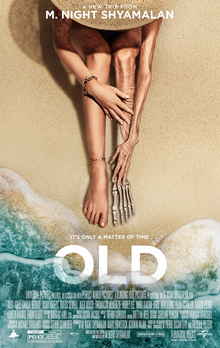
Old
2021
Directed by M. Night Shyamalan
Same disclaimer as always before we get started: this list is based entirely on my personal Flickchart rankings, which have been built over years of head-to-head matchups between movies I’ve actually seen. This is not an objective declaration that Old is the sixth-worst movie ever made, nor is it meant to insult anyone who loves it. If this movie worked for you, I am genuinely glad it did. Movies are subjective, and sometimes the thing that completely loses one person is exactly what hooks somebody else.
That distinction feels particularly important when talking about M. Night Shyamalan. There may not be another filmmaker whose movies have produced such wildly different reactions from me over the years. When Shyamalan is on, he is really on. The Sixth Sense is a great movie. I loved Unbreakable and Signs. I really enjoyed Split right up until the moment it decided to announce that it existed in the Unbreakable universe, and then Glass came along and made me wonder whether I had actually wanted that universe expanded in the first place.
On the other side, Lady in the Water left almost no impression on me at all. The Village was interesting even if I found its big reveal somewhat predictable. And then there is The Happening.
We don’t need to talk about The Happening.
The strange thing is that none of those disappointments have ever completely killed my interest in Shyamalan’s next movie. Maybe The Sixth Sense bought him an unlimited supply of cinematic grace with me. Put his name on a trailer, give me an intriguing premise, and I’m probably going to wonder what he’s up to this time.
That was exactly what happened with Old.
Such a Good Idea
I saw Old in the theater during its opening weekend in July 2021, and I went in legitimately intrigued. The trailer had presented one of those beautifully simple movie premises that immediately makes you start imagining possibilities: a group of strangers visits a secluded beach and discovers that something there is causing them to age at an impossibly accelerated rate.
That’s a great hook.
The movie follows Guy and Prisca Cappa, played by Gael García Bernal and Vicky Krieps, who have brought their children Maddox and Trent to a tropical resort for what amounts to one final family vacation before the couple separates. The resort manager offers them access to an exclusive beach, where they are joined by several other guests. Before long, Trent discovers a dead body, the children begin aging rapidly, and everyone realizes that time on the beach is moving very differently from time everywhere else.
The rough calculation the characters eventually arrive at is that they are aging about one year for every thirty minutes they spend there. Suddenly every medical condition becomes exponentially more dangerous. Children become teenagers before their parents have processed what is happening. Wounds heal almost immediately. A corpse decomposes with terrifying speed. And if the group cannot find a way off the beach, an entire lifetime will pass before the next morning.
Old was written and directed by Shyamalan and was inspired by Sandcastle, a graphic novel by Pierre Oscar Lévy and Frederik Peeters. Shyamalan received the book from his daughters as a Father’s Day gift and became fascinated enough by its premise to develop his own version of the story. The film ultimately opened in the United States on July 23, 2021, with Universal Pictures distributing.
Everything about that setup should work for me.
And yet I walked out of the theater disappointed.
A Movie That Never Finds Its Rhythm
My biggest problem with Old is difficult to isolate because it isn’t one catastrophic failure. It’s a collection of things that keep working against one another.
The pacing feels strange. The dialogue often sounds unnatural. The internal logic raises questions the movie never satisfactorily answers. And whenever the story begins building toward something genuinely unsettling, it seems to make a tonal decision that releases the tension instead of tightening it.
There is a horror movie buried inside Old that I would probably love.
Imagine staying almost completely within that genre. You arrive at a beautiful beach. Your children begin changing in front of you. A small cut heals in seconds. Someone dies and their body decomposes before your eyes. Nobody knows why this is happening, and every attempt to leave somehow deposits you right back where you started.
Don’t explain it.
Don’t reassure me that there’s a reason.
Just trap these people there and let the horror come from the fact that nature itself appears to have stopped obeying the rules.
Instead, Old keeps drifting between horror and family tragedy. That isn’t inherently a problem. Horror can absolutely be emotional, and the premise naturally invites questions about mortality and how quickly our lives disappear. Shyamalan himself has described the film as being concerned with our relationship to time, including the ways people confront aging and eventually find some peace with it.
The trouble is that I rarely felt those two movies working together.
One minute we’re dealing with a grotesque medical emergency. The next we’re being asked to contemplate a marriage falling apart. Then somebody is behaving irrationally because a preexisting condition is accelerating. Then we’re back to another horrific consequence of the beach.
Rather than making the emotional material more frightening, the tonal shifts kept pulling me out of the horror.
Human Beings Don’t Talk Like This
And then there’s the dialogue.
Shyamalan has always had a somewhat peculiar rhythm to the way his characters speak. Sometimes it works because the performances and atmosphere make that heightened quality feel like part of the world. There are conversations in The Sixth Sense and Unbreakable that don’t necessarily sound like everyday speech, but they feel intentional within those movies.
In Old, the dialogue frequently just sounds awkward.
Characters explain information with a bluntness that makes them feel less like frightened human beings and more like people making sure the audience has received the necessary plot details. They announce professions and medical conditions with suspicious convenience. Emotional reactions occasionally seem one step removed from how an actual person might respond to discovering that their six-year-old has become a teenager over the course of lunch.
And yes, there’s a rapper named Mid-Sized Sedan.
I know that particular name is probably intended to be funny. Maybe I’m supposed to accept that this is a world where somebody looked at the rich history of stage names and decided, “You know what conveys musical charisma? A moderately practical four-door automobile.”
But the movie already has such a delicate balancing act between absurdity and genuine terror that details like that make it harder for me to stay inside the story.
This was hardly a complaint unique to me. Several critics singled out Shyamalan’s dialogue and characterization even when they admired the premise. Metacritic ultimately landed at 55 out of 100 from 53 critic reviews, squarely in its “mixed or average” category. Rotten Tomatoes sits at 50 percent positive from critics, with its consensus specifically describing the execution as something likely to intrigue or annoy viewers with relatively little middle ground.
That sounds about right.
I was annoyed.
The Horror Movie That Keeps Escaping
There are individual concepts in Old that sound horrifying when you describe them outside the movie.
Prisca has what was previously a slow-growing tumor. On the beach, it begins expanding at a terrifying rate, forcing the group to perform emergency surgery. Kara, who was a little girl when she arrived, becomes a teenager and gets pregnant after having sex with the rapidly aging Trent. Her pregnancy runs its entire course in minutes. Later, Chrystal’s calcium deficiency leads to a particularly gruesome sequence in which broken bones heal almost immediately in the wrong positions.
Those ideas should be nightmare fuel.
But because the movie keeps racing from one consequence of accelerated aging to another, I never had enough time to sit with most of them. That’s a strange criticism to make about a movie whose entire premise is that there isn’t enough time, but perhaps that’s part of the problem. The characters barely have time to process something before the screenplay has to demonstrate the next terrible implication of the beach.
The result, at least for me, was emotional distance.
Instead of thinking, Oh God, imagine experiencing this, I found myself thinking, Okay, what weird thing is the beach going to do next?
Once I’m watching the mechanics instead of the people, the horror is already losing me.
That becomes particularly unfortunate because the movie is dealing with something genuinely universal. Everybody ages. Everybody loses people. Parents watch children grow faster than they would like, while children eventually watch their parents grow old. You don’t need a supernatural beach to make the passage of time scary.
Old takes that universal anxiety and turns the dial all the way up. Conceptually, I understand exactly what Shyamalan is trying to do.
Emotionally, the movie never quite got me there.
At Least It’s a Nice Place to Rapidly Decompose
I will absolutely give the movie this: that beach is gorgeous.
If you’re going to spend your workday filming a movie about people rapidly aging toward death, there are worse offices.
Much of Old was shot at Playa El Valle in the Dominican Republic, and the setting does some significant work for the film. It creates a visual contradiction that I wish the movie had exploited even more. Everything around these characters looks like paradise. The ocean is beautiful. The cliffs create a secluded little world. The sun is shining.
And everyone is dying.
The production itself was unusual for Shyamalan because it marked the first time he had made a movie entirely outside the Philadelphia area, where so much of his work had previously been filmed. Principal photography took place in the Dominican Republic during 2020, amid the first year of the COVID-19 pandemic.
Michael Gioulakis’ cinematography is one of the stronger elements. Even reviews that weren’t enthusiastic about the film frequently acknowledged the setting and visual approach, and I understand why. There are moments when the camera avoids showing exactly what you expect it to show, letting reactions or sounds carry the scene instead.
Sometimes that creates tension.
Other times I found myself wondering why the camera seemed determined not to look directly at the movie.
Still, visually, Old certainly isn’t boring.
Which makes it unfortunate that I found so much of the storytelling frustrating.
Please Stop Explaining the Monster
Eventually, we get to the part of the movie that bothered me most.
The explanation.
By the final act, we discover that the resort is essentially a front for a pharmaceutical research operation. Guests with particular medical conditions are deliberately selected and given experimental drugs before being sent to the beach. Because their lives progress at such an accelerated rate once they’re there, researchers can observe what would ordinarily amount to years of medical results within a single day.
So now we know why these particular people were brought together.
We know who’s watching them.
We know what the larger conspiracy is.
And I immediately wished I knew less.
This is where Old runs into one of my recurring problems with horror stories. Sometimes an explanation makes the scary thing less scary.
Michael Myers is the easiest example for me. The original Halloween is frightening in large part because Michael is practically a force of nature. Dr. Loomis can tell us that something is deeply wrong with him, but the movie doesn’t need an elaborate mythology explaining why he kills. He simply comes.
Every time later installments have tried to explain Michael through curses, family mythology, or increasingly complicated backstory, I’ve found him a little less frightening.
Mystery leaves room for your imagination. Explanation closes the door.
Interestingly, Sandcastle, the graphic novel that inspired Old, does not provide the movie’s pharmaceutical-company explanation for the beach. Contemporary criticism of the film specifically noted that difference, with some reviewers arguing that the unexplained version was ultimately more effective.
I’m with them. Maybe the beach is supernatural. Maybe it’s some impossible geological phenomenon. Maybe God looked down and decided these particular vacationers had gotten entirely too comfortable. I don’t need to know.
The fact that there is a beach where time inexplicably accelerates is far more interesting to me than learning that a pharmaceutical company has discovered it and created the world’s most unethical clinical trial.
The Shyamalan Problem
This brings me to the twist. I knew there was going to be one. You knew there was going to be one. The people sitting three theaters over probably knew there was going to be one. That’s part of the baggage Shyamalan has carried since The Sixth Sense. That movie’s revelation worked so spectacularly that audiences began entering every subsequent Shyamalan film looking for the trapdoor.
Sometimes he’s handled that expectation well. Sometimes the twist has become the least interesting part of an otherwise interesting movie. And I think Old would have been stronger if it hadn’t felt obligated to reveal one last layer.
To be fair, the pharmaceutical conspiracy isn’t exactly a Sixth Sense-style revelation that completely recontextualizes everything we’ve watched. But the structure still feels familiar: we’ve spent most of the movie asking what is happening, and now Shyamalan pulls back the curtain and shows us the machinery.
I didn’t want to see the machinery. I wanted to be afraid of the beach. That is ultimately the frustrating thing about Old. I don’t dislike it because the central idea is stupid. I dislike it because the central idea is good. I can see the movie I wanted somewhere inside the movie I got. I just can’t tell you exactly how to get it out.
Apparently Plenty of People Had a Better Vacation Than I Did
Critically, Old produced the sort of divided reaction that has become almost a Shyamalan tradition. Rotten Tomatoes currently lists half of its critic reviews as positive, while Metacritic’s score of 55 reflects a similarly mixed response. Some critics admired the movie’s audacity and existential themes, while others objected to the dialogue and the way the premise was ultimately handled.
Commercially, though, the film did reasonably well, especially considering its relatively modest scale and pandemic-era release. It opened domestically with about $16.9 million and eventually earned roughly $48.3 million in the United States and Canada. Worldwide, it finished at about $90.1 million.
So this wasn’t some catastrophic failure that audiences universally rejected. Plenty of people found something compelling in it.
That’s worth emphasizing because we’re now deep enough into my least favorite films that the rankings can start sounding more definitive than they really are.
Old is number six because that’s where years of random Flickchart matchups have deposited it. I’ve only watched the movie once, during its original theatrical run. Every placement represents a collection of choices I’ve made since then, usually when Flickchart asked me whether I preferred Old or some completely unrelated movie.
At this end of the list, I’m not sure there is much value in arguing that number six is objectively worse than number eight or number four. They’re all down here for a reason.
Why It Lands at Number Six
When I think back on Old, disappointment is the word that keeps coming up. I went into the theater wanting to like it. Shyamalan’s name still had that pull for me, and the trailer had sold me on a wonderfully creepy idea. A beach that steals your entire life in a matter of hours sounds like exactly the kind of strange high-concept thriller I should enjoy.
Instead, I got a movie where the pacing never settled into a rhythm that worked for me, the dialogue repeatedly pushed me outside the story, and the final explanation made the central mystery less interesting.
There are things here I appreciate. The setting is beautiful. The underlying meditation on aging has real potential. Shyamalan is still willing to make original movies that don’t feel assembled by committee, and I genuinely respect that even when the result doesn’t connect with me.
I’d rather filmmakers take weird swings than make nothing but safe choices. Sometimes those swings give us The Sixth Sense. Sometimes they give us Old. And sometimes they give us The Happening.
Sorry. We almost made it through the whole article without talking about it.
Next Time on Movie Monday
Next week, we continue the countdown with a movie that looked at the Moon and apparently thought, “You know what? That thing isn’t causing nearly enough problems.”
Number five brings us Moonfall, where gravity takes the day off, physics files for unemployment, and the Moon decides that peacefully orbiting the Earth has gotten boring.
I’m sure everything will be fine.
What did you think of Old? Did the mystery of the beach work for you, or did the eventual explanation take some of the air out of it? And where does it fall in your personal ranking of M. Night Shyamalan’s movies? Drop a comment below and let me know.

