I have spent entirely too much of my life thinking about time travel. Not actually attempting it, mind you. If I had figured that part out, I probably wouldn’t be sitting here writing a blog post. Although I suppose it’s possible that Future Me already came back, told Present Me exactly what to write, and then swore me to secrecy so I wouldn’t destroy the space-time continuum.
Which is exactly the sort of thing that happens when you’ve watched Back to the Future as many times as I have. It’s my favorite movie. Not my favorite science-fiction movie. Not my favorite movie from the 1980s. My favorite movie, period.
And while I’ve never pretended the Back to the Future trilogy holds up to rigorous scientific scrutiny, I will absolutely defend the original movie as a masterclass in screenwriting. I’m apparently not alone there. Robert Zemeckis and Bob Gale received an Academy Award nomination for their original screenplay.
Nearly everything introduced in the first act matters later. Setups become payoffs. Throwaway jokes become plot points. Even the story’s time-travel rules are explained primarily by watching Marty experience them rather than listening to Doc Brown deliver twenty minutes of exposition.
But Back to the Future is hardly the only movie to ask what would happen if we could move through time. Cinema has been playing with the idea for generations. Sometimes the past can be changed. Sometimes it can’t. Sometimes changing history creates an entirely new timeline. And sometimes the Avengers spend an entire scene explaining why time travel doesn’t work like Back to the Future, only to leave me wondering whether their own ending works like Back to the Future.
So let’s fire up the DeLorean and look at a few different ways Hollywood has dealt with the fourth dimension.
First, We Need Some Rules
Here’s the thing about time travel… As far as our current understanding of physics goes, traveling forward through time isn’t particularly controversial. Relativity tells us that time passes at different rates depending on velocity and gravity.
Backward time travel is where things get weird. Really weird.
But for a movie, I don’t particularly care whether Doc Brown could actually send a DeLorean back to November 5, 1955. I care whether the movie convinces me he can. Science fiction gets to invent the rules. That’s part of the fun. What frustrates me is when a story establishes those rules and then breaks them whenever the plot needs something different.
Back to the Future establishes a fairly simple idea. History is malleable. Marty accidentally interferes with his parents’ first meeting in 1955, and the consequences begin creeping into his photograph. His siblings disappear first. Eventually, Marty starts disappearing too. If George and Lorraine don’t fall in love, Marty will never be born.
Fix the past, save the future.
Except Marty doesn’t exactly fix it. He changes it.
When Marty returns to 1985, his family is different. George is confident and successful. Lorraine seems happier. Biff is no longer George’s tormentor. Marty remembers the original version because he’s the one who changed it. That’s the model. And it’s wonderfully easy to understand. It is also, if you think about it long enough, completely bonkers.
Back to the Future: Change the Past, Rewrite the Present
One reason Back to the Future works so well is that Zemeckis and Gale don’t let temporal mechanics become more important than Marty. The movie isn’t really about time travel. It’s about a teenager discovering that his parents were once teenagers too.
That was baked into the concept from the beginning. In the original production notes, Zemeckis and Gale discussed the idea of looking through your parents’ high school yearbooks and wondering what they were actually like at that age. Time travel is the mechanism that lets Marty find out. That’s important because the movie doesn’t stop every ten minutes to explain temporal physics. The Rules reveal themselves as Marty makes mistakes.
Push George out of the path of Lorraine’s father’s car? Congratulations. You’ve just prevented your parents’ meet-cute. Introduce Chuck Berry’s cousin to rock and roll? Let’s not think about that one too hard.
Then the sequels complicate things.
In Back to the Future Part II, old Biff steals the DeLorean in 2015, travels to 1955 and gives his younger self the sports almanac. When Marty and Doc return to 1985, Hill Valley has become a nightmare. Doc even draws the explanation on a chalkboard. History has been altered, creating a skewed version of 1985.
This is where fans start asking uncomfortable questions. If Biff changed history in 1955, how did he return to the same 2015 from which he stole the DeLorean? Should he have arrived in an alternate 2015?
There are explanations fans have offered over the years, and deleted footage showing old Biff disappearing suggests the filmmakers considered the consequences. But the larger point is that the trilogy’s rules become harder to defend once the story gets more complicated. And I’m okay with that.
Because the rules still serve the characters and the story. For me, that’s the standard. Which brings us to another movie where a time traveler accidentally helps create the very future he was trying to prevent.
The Terminator: What If It Was Always Supposed to Happen?
The original Terminator offers a model of time travel I actually find more compelling from a philosophical standpoint. Skynet sends a Terminator into the past to kill Sarah Connor before she can give birth to John Connor. John sends Kyle Reese back to protect her. Kyle and Sarah fall in love. Kyle becomes John’s father.
Think about what that means.
John Connor exists because John Connor sends his own father into the past. There isn’t necessarily an original version of events where John had some other father and history subsequently changed. The time travel is already part of history. That’s a causal loop. And if backward time travel were somehow possible, that’s closer to how I imagine it would work.
You couldn’t go back and kill Hitler because history already tells us Hitler wasn’t killed by a time traveler before World War II. If you traveled back intending to do it, something would stop you. Or, more interestingly, whatever you did in your attempt would turn out to have been part of history all along.
Maybe that sounds less exciting than rewriting reality. I find it fascinating.
It’s similar to the time travel in Harry Potter and the Prisoner of Azkaban. Harry doesn’t go back and change what happened earlier that evening. We eventually discover that the mysterious figure Harry saw casting the Patronus was Harry himself. He was always there because his future trip into the past had already happened.
The past doesn’t change. Our understanding of it does.
Then James Cameron complicated things with Terminator 2. The characters reject the idea that Judgment Day must happen. The entire movie builds toward the possibility that the future isn’t fixed, culminating in Sarah’s hope that human beings can learn the value of life.
Suddenly the franchise moves from history fulfills itself toward history can be changed. And you know what? I don’t mind. Because T2 earns the shift thematically. The question of whether we’re prisoners of fate is part of the story. The rules aren’t changing because the screenwriters need to get out of a corner. The possibility of changing fate is the point.
The Time Machine: Forget Yesterday. Let’s See Tomorrow.
Then there’s H.G. Wells. The 1960 film adaptation of The Time Machine, directed by George Pal and starring Rod Taylor, approaches the subject differently. George doesn’t spend much time trying to fix yesterday. He wants to see tomorrow. And the day after that. And roughly eight hundred thousand years after that.
The film sends him all the way to A.D. 802,701, where humanity has evolved into the Eloi and Morlocks. That’s one of the things I love about the classic time-machine concept. The machine itself becomes almost like a vehicle traveling down a highway. George can stop wherever he wants, look around and then keep going. There’s something wonderfully straightforward about that.
But it also asks a different question from Back to the Future. Marty travels through time and changes history. George travels through time primarily to witness history. He’s watching civilization rise, fall and transform around him.
That’s an important distinction because time-travel stories don’t necessarily have to be about paradoxes. Sometimes the appeal is simply imagining what we would see if the barriers of time disappeared.
Would you go backward? Forward? How far? And would you be brave enough to pull the lever if you didn’t know what would be waiting when you stopped?
Somewhere in Time: Who Needs a DeLorean?
Then there’s Somewhere in Time, which takes one look at Doc Brown’s flux capacitor and George’s elaborate Victorian contraption and says: What if you just thought really hard?
Richard Collier, played by Christopher Reeve, becomes fascinated by a photograph of actress Elise McKenna, played by Jane Seymour. He eventually uses self-hypnosis to convince himself that he’s in 1912. And it works. Because apparently I’ve been approaching this whole time-travel thing incorrectly.
No plutonium. No lightning bolt. No 88 miles per hour. Just really aggressive method acting.
The movie was adapted by Richard Matheson from his own 1975 novel Bid Time Return, and its time travel is deliberately more romantic fantasy than technological science fiction. But it also contains one of my favorite kinds of temporal weirdness.
The pocket watch.
At the beginning of Richard’s story, an elderly Elise gives him a watch. Richard later travels into the past and gives that same watch to the younger Elise. So where did the watch originally come from? Elise gets it from Richard. Richard gets it from Elise. Nobody actually buys the thing. It simply exists inside the loop.
That’s the bootstrap paradox, and it’s the kind of thing that can keep a time-travel fan awake much later than necessary.
Then Richard makes one devastating mistake. He discovers a penny from 1979 in his pocket, breaking his psychological connection to 1912 and snapping him back to his own time. Marty needs a DeLorean. Richard Collier is defeated by pocket change.
I love time-travel movies.
Avengers: Endgame: Please Explain This Again, Professor Hulk
And now we arrive at the one that irritates me.
I like Avengers: Endgame. Quite a bit, actually. But its time travel makes my head hurt, and not necessarily for the fun reasons. The movie goes out of its way to tell us that Back to the Future is wrong.When Rhodey suggests killing baby Thanos, Professor Hulk explains that changing your past doesn’t change your present. Traveling into the past makes that past part of your future. Fair enough.
Later, the Ancient One helps explain the danger of creating branched realities, particularly when an Infinity Stone is removed from its proper place in history. So the movie seems to establish that altering events creates a branch rather than rewriting the reality the Avengers came from. I can work with that.
Then Steve Rogers happens.
At the end of the movie, Steve returns the Infinity Stones to their proper places and decides to remain in the past, where he finally gets his dance with Peggy Carter. It’s a beautiful ending for Steve. Emotionally? No notes. Temporally? I HAVE QUESTIONS.
If Steve traveled into the past and stayed with Peggy, wouldn’t that create another branch? And if he’s living in another branch, how does elderly Steve simply appear sitting on a bench in the primary timeline? Apparently I’m not the only one asking.
Even the filmmakers have offered conflicting explanations. Co-writer Christopher Markus has argued that Steve could have lived quietly with Peggy in the existing MCU history. Joe Russo, meanwhile, said Steve’s decision would create a branched reality, meaning he would eventually have to find a way back to the primary timeline.
When the writers and directors can’t agree on how the ending follows the movie’s time-travel rules, I feel slightly better about being confused. This is where Endgame loses me. Not because its model is complicated. Because I’m not convinced the movie follows its own model.
Why Back to the Future Still Wins
So after all that, which movie handles time travel best?
Come on.
Did you really think I was going to say Avengers: Endgame?
The Terminator probably offers the model closest to what I find philosophically satisfying. The Time Machine captures the pure wonder of moving through the fourth dimension. Somewhere in Time uses time travel to tell a tragic love story.
But Back to the Future does something none of them quite matches. It makes time travel incredibly easy to understand without making the story itself simple. We understand Marty’s problem almost immediately. He changed the past. His future is disappearing. He has to fix what he broke and somehow get home. Everything else grows from there.
And yes, if you scrutinize the trilogy closely enough, you’ll find inconsistencies. I’ve scrutinized it. Trust me. But I never get the sense that Zemeckis and Gale are making up new rules because they’ve lost control of the story. The time travel exists to serve the characters. That’s why it works.
And maybe that’s ultimately the most important rule any time-travel movie can follow. You can give me one timeline or fifty. You can tell me history is immutable or let Marty McFly accidentally invent rock and roll. You can build a machine out of a DeLorean or send Christopher Reeve backward through sheer force of concentration. Just establish the rules. Then play fair.
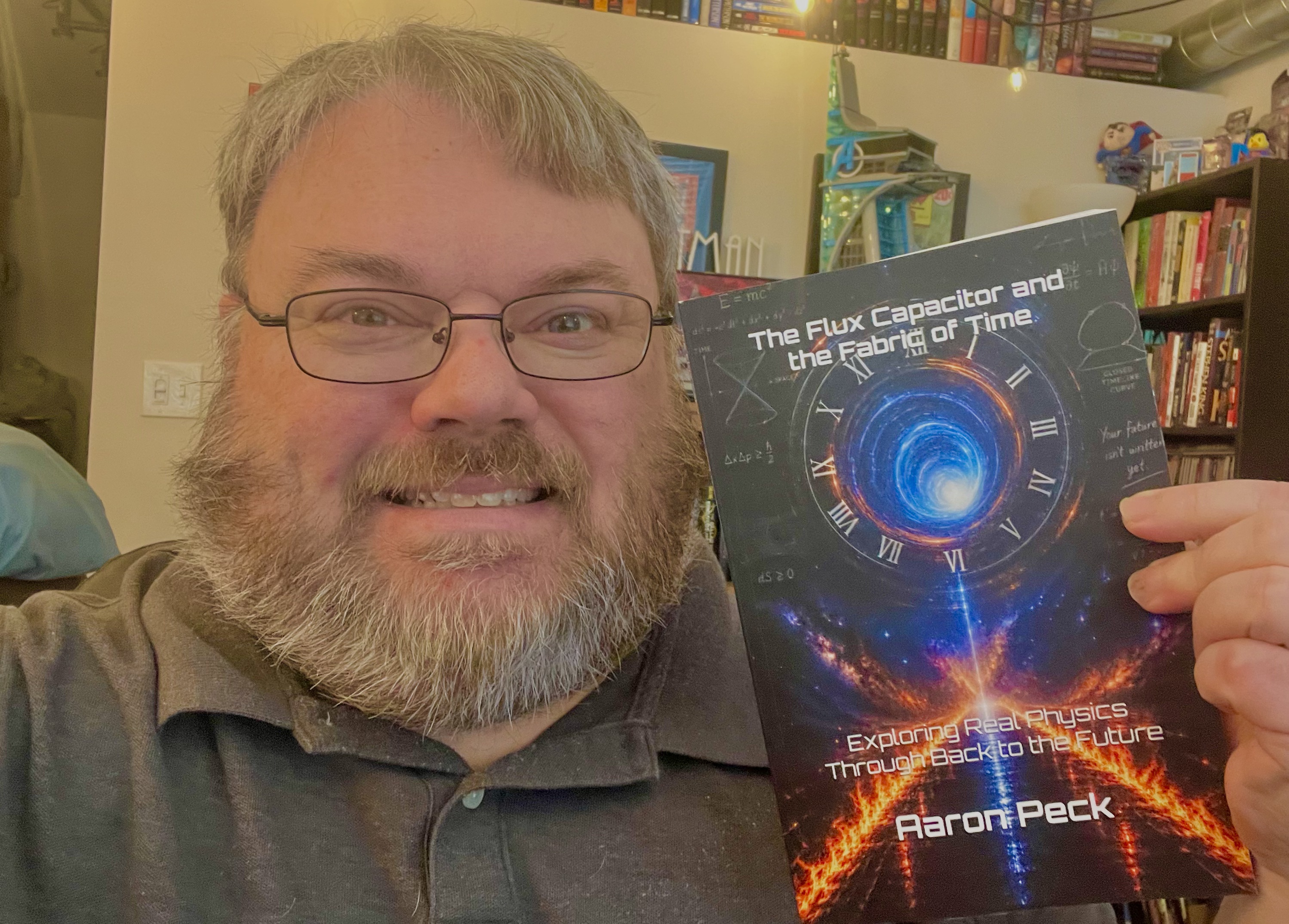
And if you want to spend even more time arguing about whether any of this could actually happen, I’ve already done a lot of the homework for you. My book, The Flux Capacitor and the Fabric of Time, is available now and takes a much deeper look at the real physics behind the science of Back to the Future. I promise you don’t need an advanced degree in theoretical physics to follow along. You just need a little curiosity about the fourth dimension and, preferably, an appreciation for stainless steel automobiles traveling at exactly 88 miles per hour.
Because when it comes to cinematic time travel, plenty of movies have taken us backward and forward through history. But for me, Bob Gale and Robert Zemeckis still got there first. Or maybe they got there later.
Time travel makes these things complicated.

