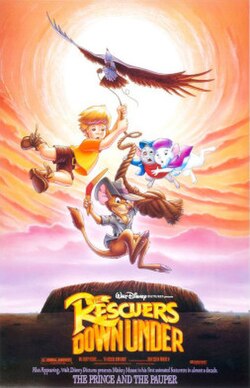
The Rescuers Down Under
1990
Directed by Hendel Butoy & Mike Gabriel
Welcome back to Movie Monday. First Monday of the month, which means my hundred least favorite movies get a week off while I spend some time with a Disney film that isn’t one of them. Last month it was The Little Mermaid, the movie that woke the whole studio up. This month we land on the film that came right after it, and got absolutely nowhere near the same credit for showing up: The Rescuers Down Under.
I want to be upfront about where I’m starting from here, because it colors everything that follows. I saw this one. It wasn’t a big favorite. I always thought the original Rescuers was the better film, and honestly, watching this one again for this post hasn’t fully talked me out of that. But going back into how this movie actually got made turned out to be a lot more interesting than the nostalgia I didn’t have for it. Sometimes the story behind the movie is the better story.
The First Sequel Disney Actually Committed To
Here’s a fact that surprised me when I started digging: this was the first animated sequel Walt Disney Feature Animation ever released in theaters. Not the first sequel Disney ever made in any format, but the first one the studio trusted enough to put on the big screen with the full theatrical rollout.
The original Rescuers had become one of Disney’s biggest hits by the mid-1980s, and once Michael Eisner and Jeffrey Katzenberg took over studio management, they green-lit a proper sequel. Writing started in 1986, and the decision to set the story in Australia wasn’t random. Crocodile Dundee had just turned the Outback into something every American audience member had opinions about, and Disney wanted a piece of that cultural moment. It’s the kind of decision that makes total sense in a pitch meeting and looks a little dated four years later, which is more or less what happened.
Mike Gabriel almost didn’t take the director’s chair at all. When he was first approached about the project, watching the process on Oliver & Company had left him unconvinced it would be much fun. He turned it down. A few months later he got called back into the office and said yes the second time around, and Hendel Butoy joined him as co-director after his work animating Tito on Oliver & Company impressed the right people. Producer Thomas Schumacher, who’d been brought over from the Mark Taper Forum, rounded out the leadership team, and storyboard artist Joe Ranft came on as story supervisor, valued for his ability to reshape a rough idea into something that actually worked on screen.
One decision from that early story period is worth sitting with for a second, because it’s not a flattering one. The story team advocated for casting an Aboriginal Australian child actor to voice Cody. Katzenberg overrode that idea. According to storyboard artist Brenda Chapman, the studio went instead with what she described as “a little white blonde kid,” and the character design was built to match. It’s a small decision in the scope of the whole production, but it’s the kind of small decision that tells you something about who was making the calls and what they were prioritizing. I don’t think you can talk honestly about this movie’s Australian setting without acknowledging that the one clearly Australian voice the story could have used got talked out of the room.
The film also made a real departure from formula by dropping songs entirely, only the second Disney animated feature to do that after The Black Cauldron. The filmmakers wanted to market it as the studio’s first real action-adventure picture, pulling inspiration from Hitchcock, Welles, and David Lean rather than the Broadway-adjacent structure that had just worked so well for The Little Mermaid. It’s an interesting swing. Whether it paid off is something critics and audiences disagreed about then and still disagree about now.
There’s also a quieter, sadder piece of continuity here. Jim Jordan, who voiced Orville the albatross in the original film, died in early 1988 after a fall at his home. Rather than recast Orville, Roy E. Disney suggested giving him a brother named Wilbur, a nod to the Wright brothers that let the studio honor Jordan’s character without asking someone else to step into his voice. John Candy took the role, and it ended up being one of the more purely enjoyable pieces of comic relief in the whole picture.
Drawing the Outback, One Feather at a Time
If the story side of the production had some real growing pains, the animation side is where this movie earns its stripes, even for someone like me who’s never fully warmed to the finished film.
Art director Maurice Hunt and a group of his animators actually traveled to Australia, spending days moving through Uluru, Katherine Gorge, and Kakadu National Park to sketch and photograph the landscape firsthand. That research shows up on screen constantly, in the way the movie handles scale. The Outback in this film feels genuinely enormous, and the characters feel appropriately small inside it, which is exactly the effect Hunt was going for.
Marahute the golden eagle got the most obsessive treatment of any character in the film. Supervising animator Glen Keane studied live eagles at the Peregrine Fund in Boise, plus a stuffed specimen borrowed from the Los Angeles Museum of Natural History and an actual eagle skeleton. To make her read as a character rather than just an accurate bird, Keane’s team enlarged her, shrank her head, stretched her neck and wings, and slowed her wingbeats down to roughly a quarter of real eagle speed so the human eye could actually track her in flight. She’s built from around 200 individually animated feathers, and because of how labor-intensive that made her, she only appears on screen for about seven minutes total, bookending the film at the start and the end. Every one of those minutes looks like it earned its budget.
The studio also brought in outside help to hit the release date, pulling in 70 artists from Disney-MGM Studios who ended up contributing about ten minutes of finished screen time, including work from supervising animator Mark Henn. Henn handled several key scenes with Bernard, Bianca, and McLeach, and he leaned on George C. Scott’s performance in Dr. Strangelove as a reference point while animating the villain. For the Australian wildlife beyond Marahute, animators made trips to the San Diego Zoo to study kangaroos, kookaburras, and snakes, and an iguana from Walt Disney World’s Discovery Island got brought into the studio specifically so the team drawing Joanna the goanna had a live model to work from.
And then there’s the technical milestone that actually makes this film historically significant, even if most audiences at the time had no idea it was happening. The Rescuers Down Under was the first feature film ever completed entirely through digital means. The Computer Animation Production System, developed with a young company called Pixar, let artists scan in hand-drawn cels and backgrounds and then ink, paint, and composite everything digitally instead of by hand. It’s the reason the film could pull off camera moves and multiplane-style effects that would have been brutally difficult with traditional cel painting, and it’s why McLeach’s truck and that opening field of flowers have a texture that feels just slightly different from anything Disney had done before. Disney’s marketing barely mentioned any of this at the time, which in hindsight feels like a real missed opportunity. They’d just quietly built the future of animation production and decided not to talk about it.
Buried Under Home Alone
So if the craft was this ambitious, why isn’t this movie remembered the way The Little Mermaid is? Mostly because of one very unlucky release date.
The Rescuers Down Under opened on November 16, 1990, the exact same day as Home Alone, which also happened to star John Candy. It opened in fourth place that weekend, behind Home Alone, Rocky V, and Child’s Play 2, with just $3.5 million. Katzenberg was reportedly so unhappy with that number that he pulled the film’s television advertising almost immediately, which is about the fastest way possible to make sure a movie doesn’t recover from a slow start. It finished its run with $27.9 million domestically and $47.4 million worldwide, a genuinely disappointing result for a film that had cost real money and real research trips to make.
Here’s the part that stings a little more in hindsight: reviews were good. Roger Ebert gave it three out of four stars and singled out the flight sequences for the sense of freedom they created. Gene Siskel, also at three stars, called it a “bold, rousing” picture. Rita Kempley at The Washington Post described it as a gorgeously drawn myth made for brave mice and plucky children, and Charles Solomon at the Los Angeles Times put it in the same conversation as Spielberg and Lucas for its adventure filmmaking. Not everyone was won over. Janet Maslin at The New York Times found the story a little dark and uninvolving for very small children, and TV Guide flatly noted that the Australian fascination the film was built around had already faded by the time it reached theaters. But on the whole, critics liked this movie more than audiences showed up for it, and that gap between critical reception and box office performance is really the whole story of why this film gets remembered as a footnote instead of a landmark.
It’s worth noting where it landed with critics over time, too. Rotten Tomatoes currently has it at 85 percent positive from 66 reviews, with a consensus that credits it for adding real Outback flavor to a charmingly modest story and calls it a sequel that actually outdoes the original. I’ll be honest, I don’t fully agree with that last part. But I understand why people who love this movie love it, and the craftsmanship on display makes a much stronger case for the film than my personal nostalgia ever will.
What It Left Behind
The commercial disappointment didn’t stop The Rescuers Down Under from being folded into the Disney Renaissance as a real, if smaller, part of that era’s story. It picked up the Los Angeles Film Critics Association award for Best Animated Film, along with a matching award from the Dallas-Fort Worth Film Critics Association, and it won a Golden Reel Award for its sound editing work.
The technology it pioneered mattered more than the film’s box office numbers ever suggested it would. That fully digital production pipeline built with Pixar became the foundation for how Disney made animated films for years afterward, and it’s a much bigger part of animation history than the movie’s reputation as an underperformer gives it credit for. There’s something almost poetic about a film best remembered for a rescue story also quietly rescuing the studio’s production process for the next decade.
Watching it again for this post, I keep landing in the same place I started. This is a well-made, ambitious, technically important movie that I still don’t love as much as the original. Bernard and Bianca are fine here, Marahute is genuinely stunning every time she’s on screen, and Wilbur gets some real laughs. But something about the first film’s warmth got traded out for scale and spectacle, and scale and spectacle were never really what pulled me into The Rescuers in the first place. I respect this movie more than I enjoy it, which might be the most honest thing I can say about it.
What about you? Did this one work better for you than it did for me, or are you in the “the original was better” camp too? Let me know in the comments.
Next Monday, we’re back to the countdown, and this next entry might get some pushback. Up next on my least favorites list is Old, M. Night Shyamalan’s 2021 mystery thriller about a beach that ages you decades in a single afternoon. I have thoughts. See you next week.


I grew to love this movie as a little one
LikeLiked by 1 person