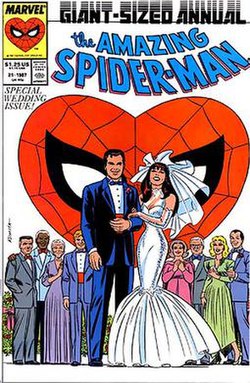
There are certain images that live rent free in the collective memory of anyone who ever picked up a comic book, even casually. Superman lifting a car over his head. Wolverine popping his claws for the first time. And somewhere near the top of that list, in a tuxedo he clearly didn’t own before this issue, Peter Parker standing at the altar next to Mary Jane Watson, both of them terrified and thrilled in equal measure.
That moment happened in June of 1987, inside the pages of The Amazing Spider-Man Annual #21, plainly titled “The Wedding!” It wasn’t just a story. It was a publishing event, a marketing campaign, and, depending on who you ask, either the best or worst thing that ever happened to Peter Parker. Nearly forty years later, it’s still one of the most talked about moments in the character’s history, and it’s worth digging into why.
Setting the Stage
By the mid 1980s, Peter and Mary Jane had been circling each other for over two decades. She debuted all the way back in the Silver Age as Aunt May’s idea of the perfect girl next door, a role Mary Jane immediately subverted the moment she stepped through Peter’s doorway with that famous line about how she’d been living right in the neighborhood. What started as comic relief slowly deepened into one of the most genuine will they/won’t they relationships in superhero comics, right alongside Peter’s more tortured history with Gwen Stacy.
Once Gwen was killed off in the 1970s, the door opened for Mary Jane to become something more than a party girl in Peter’s orbit. Writers spent years building her into a fully formed person: an actress trying to make it, someone who understood loss in her own complicated way, and eventually, someone who knew Peter’s secret and chose to stick around anyway. By the time editorial started talking seriously about marrying the two characters off, the emotional groundwork had been laid for a long time.
A Marketing Stunt With Heart
Let’s be honest about what “The Wedding!” actually was. It was, by design, a gimmick. Marvel’s then editor-in-chief Jim Shooter was closing out his tenure at the company, and pairing off two of its most recognizable characters was a guaranteed headline grabber. Critics at the time and since have pointed out that the annual itself is a fairly thin read, more concerned with hitting the beats of a big event than with earning the emotional payoff on the page.
And yet, the stunt worked, largely because of the scale Marvel built around it. Stan Lee, who co-created Spider-Man and was still writing the syndicated newspaper strip at the time, pushed to have the wedding happen simultaneously in both the comic book and the daily strip. That meant coordinating two separate creative teams working on entirely different production schedules, something Lee later described as one of the most difficult logistical puzzles of his career. Comic books are written months ahead of publication, and the newspaper strip runs on its own separate lead time, so lining up two completely different ongoing storylines to land on the exact same beat required real behind the scenes engineering.
Marvel also brought in outside glamour. Promotion director Steve Saffel had the idea to have a real fashion designer create Mary Jane’s wedding gown, and the assignment went to Willi Smith, a prominent American designer known for his streetwear influenced style. Smith died not long after finishing the design, and the newspaper strip version of the wedding was dedicated to his memory.
Then there was the live event. In 1987, Marvel staged an actual live action wedding ceremony at Shea Stadium in New York, complete with an introduction from Stan Lee himself. It’s the kind of promotional stunt that feels almost unthinkable now, a comic book company throwing a live wedding for two fictional characters at a Major League Baseball stadium, but that was the scale of ambition Marvel brought to this moment.
What Actually Happens in the Comic
Strip away the marketing machine for a second and look at the actual story. Peter is juggling his usual chaos, defeating Electro one morning before heading home to find Mary Jane in the middle of moving her things in. He’s got the standard Peter Parker anxiety spiral going, wondering how he’s supposed to support a wife on a freelance photographer’s income while also saving the city on a nightly basis.
The Daily Bugle staff throws him a surprise engagement party, which predictably irritates J. Jonah Jameson, who grumbles about lost productivity and quietly plots to dock the pay of anyone who attended. It’s a small beat, but it’s the kind of character detail that makes Jameson so enduring. The man cannot help himself.
From there, the story moves through a series of quiet, human moments rather than big action set pieces. Peter proposes again, this time from the ceiling, and gets teased for the mess of footprints he leaves behind. Mary Jane’s ex-boyfriend tries to tempt her away from the wedding entirely with plane tickets to Paris. Peter visits Aunt May and flips through an old scrapbook, replaying the history of his relationship with MJ in his head. Both of them spend the night before the wedding wrestling with doubt, Peter dreaming that his rogues gallery shows up to ruin everything he’s built, MJ wondering the same thing out loud to her friend Liz Allan.
It all resolves at City Hall, where both Peter and MJ show up late, visibly nervous, and get married by MJ’s uncle, Judge Spencer Watson. In a nice callback, Mary Jane hands Peter the Paris tickets her ex tried to bribe her with, and the two head off on their honeymoon as husband and wife. It’s a modest, low key ending for a story that generated an enormous amount of hype, and that contrast is part of why opinions on the issue itself remain so mixed even among longtime fans.
The Ripple Effects
Once the marriage was locked into continuity, it reshaped how writers approached Peter Parker for the next two decades. A married Spider-Man wasn’t just a status update, it was a fundamental shift in how stories could be told. Writers had a built-in emotional stake any time Peter went out on patrol, a spouse who understood exactly what he was risking every night and chose to stay anyway. Mary Jane stopped being a supporting love interest and became a genuine co-lead in Peter’s ongoing story, someone with her own career struggles and her own perspective on what it meant to love a superhero.
It also changed how other corners of the Marvel universe treated the relationship. The MC2 alternate future built an entire mythology around Peter and Mary Jane’s marriage, including their daughter Mayday Parker growing up to become Spider-Girl. The UK based Spectacular Spider-Man comic ran with a similar concept in its own continuity. Even the What If line got in on it, imagining alternate versions where Peter married Gwen Stacy or Black Cat instead, each one built specifically around the assumption that the “real” marriage to Mary Jane was the baseline worth deviating from. That’s a good measure of how central the wedding had become to the character’s identity. You can’t have a meaningful “what if” story without a clearly understood “what actually happened” to push against.
The Retcon Nobody Asked For
No honest look at this story can skip over what happened twenty years later. In 2007, under then editor-in-chief Joe Quesada, Marvel published “One More Day,” a four part crossover written primarily by J. Michael Straczynski with Quesada contributing to the final chapter. The plot found Peter making a deal with the demon Mephisto to save a dying Aunt May, with the price being his marriage. Mephisto didn’t just end the marriage, he erased it from history entirely, leaving Peter and Mary Jane as two people who had simply never taken that step.
The backlash was immediate and it has never really faded. Quesada defended the decision publicly, arguing that a married Peter Parker felt less relatable to younger readers and that Marvel needed to get back to a more grounded, single version of the character. Fans and critics disagreed loudly, and “One More Day” is still routinely cited as one of the most controversial stories in Spider-Man’s history, frequently landing on lists of the character’s worst moments rather than his best. Even some of the creators involved have acknowledged over the years how divisive the whole thing became.
What’s interesting is that the wedding has never fully gone away, even in a timeline where it officially didn’t happen. Writers keep circling back to it. Nick Spencer’s run on Amazing Spider-Man spent real energy rebuilding the emotional connection between Peter and MJ and hinted at the original timeline bleeding through. The newspaper strip, notably, never adopted the retcon at all. It quietly rebooted its own continuity and then folded the marriage back in, eventually revealing that an entire storyline had simply been a bad dream, in a twist that borrowed its structure from a famous soap opera cliffhanger. Nearly forty years later, that version of Peter and MJ has apparently been married for decades in the strip’s own internal timeline, which is a strange but fitting bit of trivia. Somewhere out there, in the pages of your local newspaper, Spider-Man never got divorced.
A Wedding That Keeps Getting Left at the Altar
It’s also worth noting how carefully other versions of Spider-Man have tiptoed around this exact question since. The Sam Raimi film trilogy ended with Peter and MJ finally together but unmarried. The Andrew Garfield era never got the chance to address it at all. And the current Tom Holland era of the Marvel Cinematic Universe has kept Peter defiantly single, young, and unattached, which tracks with the exact philosophy Quesada was pushing back in 2007. Studios seem to agree with him on this one, even as comic readers continue to argue the opposite. A teenage or twenty something Spider-Man swinging between rooftops reads as more universally relatable to a mass film audience than a Peter Parker juggling a mortgage and a spouse who worries every time he leaves for work.
That tension between “relatable young hero” and “character allowed to actually grow up” is really the whole debate in miniature. The 1987 wedding argued that Peter had earned the right to move forward. “One More Day” argued that moving forward was the wrong direction for the franchise to take. Nearly every adaptation made since 2007, on screen at least, has sided with Quesada’s read on the character, whether or not that was a conscious choice by the people writing those films.
Meanwhile, back in the comics, the wedding refuses to disappear entirely. It gets referenced in flashbacks. It gets alluded to in dream sequences. Writers who grew up reading “The Wedding!” as kids keep finding ways to wink at it even while operating under the constraints Quesada put in place. There’s something almost poetic about a story engineered specifically to be erased from continuity that has proven so stubbornly difficult to actually erase from readers’ memories.
Why It Still Matters
Comic book continuity is famously elastic. Characters die and come back, timelines get rebooted, and status quos shift with the editorial winds. But the wedding endures as a genuine cultural touchstone in a way most single issues never manage. It got referenced and parodied everywhere from Marvel Zombies to The Simpsons. It got collected into multiple trade paperbacks over the years, including one that bundled it with other famous Marvel weddings. It’s the kind of story people bring up in casual conversation even if they’ve never read a single issue of Amazing Spider-Man.
Part of that staying power comes from what the story represents rather than how well it was executed on the page. It’s a superhero choosing, in the middle of all his chaos and danger, to build something stable and permanent. That’s a fundamentally different kind of heroism than punching a villain through a building, and it’s one that resonated with readers who had been following Peter Parker since he was an awkward teenager with a chip on his shoulder. Watching him grow into someone capable of standing at an altar and meaning it mattered, even if Marvel later decided otherwise.
Whether you think “One More Day” was a necessary course correction or an act of creative vandalism probably says a lot about how you feel about long form serialized storytelling in general. Should characters be allowed to grow and change permanently, or does a shared universe need an eternal status quo to keep working for new readers coming in decades later? There’s no clean answer, and Marvel has spent the better part of twenty years unable to fully commit to one either.
What isn’t up for debate is that for one week in the summer of 1987, two fictional characters got married across a comic book, a daily newspaper strip, and a live event at a baseball stadium, and it became one of the defining moments in the history of the medium. That’s a legacy worth remembering, retcon or no retcon.
What do you think? Should Marvel have left well enough alone, or was “One More Day” the right call for keeping Spider-Man relatable? Let me know in the comments.

