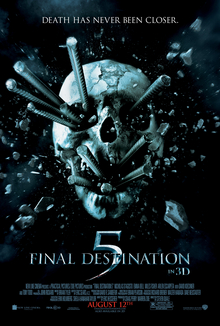
Final Destination 5
2011
Directed by Steven Quale
Same disclaimer as always, because a franchise this durable deserves it more than most: this list comes straight from my Flickchart rankings, built from thousands of head to head matchups between films I’ve actually watched. It isn’t a verdict on quality, and it definitely isn’t a judgment on anyone who counts these movies among their favorite guilty pleasures. If you’ve spent a decade defending Death as the franchise’s best recurring villain, I’m glad these movies give you that. I’m only explaining why, on my own personal scoreboard, this one landed at number eight.
A Franchise That Forgot Why the First One Worked
Here’s the thing about the original Final Destination that I don’t think gets said enough: it worked because it slowed down. Alex Browning’s premonition, the ripple of dread that followed him through the rest of the movie, the sense that Death was patient and methodical rather than showy. The sequels chased something different almost immediately, and by the time Final Destination 5 rolled around in 2011, the franchise had fully committed to being a highlight reel of elaborate accidents strung together by the thinnest possible connective tissue of character work.
Final Destination 5 is, structurally, a clever entry. It’s a prequel that ends by folding directly into the opening minutes of the first film, and I’ll give the writers credit for pulling that trick off cleanly. But cleverness in structure doesn’t make up for a cast of characters I couldn’t tell apart twenty minutes after the credits rolled, or for a movie that treats each death less like a horror set piece and more like a special effects demo reel with dialogue stapled on for pacing.
What’s Actually Going On Here
The plot, for anyone who needs the refresher: office worker Sam Lawton is heading to a company retreat with his coworkers when he has a premonition of the bridge they’re crossing collapsing. He panics, gets a handful of people off the bridge before it goes down, and the group spends the rest of the movie discovering that surviving Death’s plan just means Death starts picking them off one at a time, in the order they were originally supposed to die.
An FBI agent suspects Sam of causing the collapse before getting cleared. A returning mortician character warns everyone that cheating death has consequences. Characters start dying in accidents involving gymnastics equipment, a falling statue, a malfunctioning laser eye surgery machine, and a runaway wrench, and along the way the survivors figure out they can steal someone else’s remaining lifespan by killing them directly, which gives the back half of the film an ugly little morality wrinkle it never fully commits to exploring. The whole thing closes the loop by revealing the bridge collapse survivors eventually board Volée Airlines Flight 180, the doomed flight from the very first movie, which is a genuinely satisfying piece of franchise plumbing even if getting there is a slog.
Character Names as a Cause of Death
My biggest problem with Final Destination 5 isn’t any individual death sequence. Several of them are staged with real craft, and the opening bridge collapse in particular earns its reputation as one of the better set pieces in the whole franchise. My problem is that I finished the movie and genuinely struggled to remember which coworker was dating which coworker, or why I was supposed to care that the office manager was next on the list rather than just curious about how he’d go.
This is a franchise-wide issue by 2011, but Final Destination 5 leans into it harder than its predecessors because it’s working with a full ensemble of interchangeable young professionals whose entire characterization amounts to a job title and a single personality trait. There’s the womanizer, and there’s the loyal best friend, and neither one gets more than a scene or two to feel like an actual person before the movie starts working out how to kill them. Once the mechanism of death becomes the whole point, the human beings attached to it start to feel like set dressing.
I don’t think every horror franchise needs Shakespeare. But even the original Final Destination understood that dread requires investment, and investment requires characters you’d genuinely miss. This entry swapped that investment out for spectacle, and the spectacle, however well constructed, can’t carry a full ninety minutes on its own.
It doesn’t help that the film’s central twist, the idea that surviving characters can steal a dying victim’s remaining lifespan by killing them outright, gets introduced with real weight and then mostly abandoned as a plot mechanic rather than explored as the moral crisis it should be. One character does use it, and the movie treats the aftermath as a shrug rather than a turning point. That’s a version of the exact same problem running underneath everything else here. Final Destination 5 keeps finding interesting threads and then declining to pull on them, because pulling on them would mean slowing down long enough to let a character actually sit with a decision instead of just reacting to whatever elaborate contraption Death has rigged up next.
The Story Behind the Camera
A few production details are worth knowing, because they explain some of the choices on screen better than the finished film does on its own.
Final Destination 5 exists at all because The Final Destination, the fourth movie, had been marketed as the franchise’s ending and then made enough money that Warner Bros. reversed course almost immediately. Development on a fifth film started in 2010, with the studio’s Alan Horn confirming the project was moving forward and producer Craig Perry announcing early on that it would be shot natively in 3D rather than converted afterward. Writer Eric Heisserer has said that the prequel structure was the studio’s idea from the start, and that inventing new ways to kill characters within the established rules of the franchise was one of the hardest parts of the job. He’s also mentioned that the inspiration for the film’s laser eye surgery death came from his own wife’s experience with the procedure, which is either a charming bit of writerly observation or deeply unsettling depending on how you look at it.
Casting came together over the course of a few weeks in August 2010, with Miles Fisher landing the role of Peter first, followed quickly by Arlen Escarpeta, Nicholas D’Agosto, Ellen Wroe, Tony Todd returning as the franchise’s recurring mortician, and finally David Koechner, P. J. Byrne, Emma Bell, Courtney B. Vance, and Jacqueline MacInnes Wood rounding out the ensemble. Filming took place in Vancouver between September and December of 2010, using the newly released Arri Alexa digital camera, and the production shot the bridge collapse sequence on the real Lions Gate Bridge along with scale models built specifically for the effect.
There’s also a stranger footnote involving the film’s marketing. The original UK poster campaign drew enough complaints from parents that the country’s Advertising Standards Authority ruled it likely to cause fear and distress in young children who encountered it on buses and trains, and ordered it pulled from that particular ad placement. Warner Bros. pushed back, arguing the image was too abstract and colorless to register as frightening to kids, but the ruling stuck.
One more piece of trivia I genuinely enjoyed digging into: Miles Fisher, who plays Peter, released a tie in music video ahead of the film’s release for his original song “New Romance.” The video reimagines the main cast as a parody of the 1990s sitcom Saved by the Bell, complete with Fisher playing a Zack Morris type character, only with the show’s cast getting picked off in Final Destination style accidents throughout. It’s a strange, funny little artifact that has almost nothing to do with the movie’s tone and everything to do with a cast that clearly had fun making something on the side. Brian Tyler, who scored the film, also composed the music for The Final Destination before this one, and the soundtrack was released commercially a few days after the movie hit theaters.
Where It Landed With Everyone Else
Critics were more forgiving of this one than I expected going in. Review aggregators put it in the mixed to positive range, and it was, for a while, the highest rated entry in the entire franchise on both major review sites before being overtaken years later by the 2025 follow-up. Several reviewers singled out the bridge collapse as one of the better disaster sequences of the year, and there was a recurring thread of praise for how well the movie used 3D, at a time when plenty of horror films were still treating the format as an afterthought rather than a storytelling tool. Roger Ebert, never a franchise apologist, still found something to appreciate in how competently the effects work landed each individual gag.
The film also performed solidly at the box office, opening at number three behind Rise of the Planet of the Apes and The Help, and eventually grossing just under 158 million dollars worldwide against a 40 million dollar budget. That made it, for over a decade, the third highest grossing entry in the franchise, a ranking it still holds even after the 2025 sequel arrived and shuffled the leaderboard around it.
Audiences responded well too. CinemaScore polling gave the film a B+, a solid grade for a horror release, and the movie kept enough goodwill in the years after its release to get a proper home media rollout, including a Blu-ray 3D edition and an UltraViolet digital copy bundled into most physical releases. It’s the kind of reception that tells you the formula was still working for a lot of viewers in 2011, even as I sat here fifteen years later wishing the formula had left a little more room for the people trapped inside it.
None of that critical goodwill changes how the movie sits with me on a rewatch, though. I think there’s a real difference between a movie that executes its individual moments well and a movie that adds up to something worth sitting through in full, and Final Destination 5 is a clear example of the former without quite managing the latter.
Why It Lands at Number Eight
When I think about why this one ranks where it does for me, it isn’t a lack of craft. The effects work is genuinely strong for its era, the bridge collapse is a legitimately well built set piece, and the franchise plumbing connecting this film back to the original is more satisfying than it had any right to be. What keeps it low on my list is simpler than any of that: I don’t care about a single person on screen, and a movie built entirely around the anticipation of who dies next needs me to care at least a little about who’s currently alive.
Take away the impressive kill sequences and what’s left is a script running through the motions of a formula it clearly understands better than it understands its own cast. I don’t need every character in a horror movie to have a rich inner life. I do need enough of one that the gap where a person used to be actually registers as a loss and not just a checkmark on a list. Final Destination 5 never quite gets there, and no amount of clever bridge engineering or laser surgery mishaps can fully make up the difference.
Next Time on Movie Monday
Next Monday we’re trading collapsing bridges and stolen lifespans for a Segway, a mall, and a security guard with something to prove. No premonitions required this time, just a man, his cart, and a level of dedication to loss prevention that the script mistakes for a personality. We’re looking at Paul Blart: Mall Cop. See you Monday.
What’s your take on Final Destination 5? Does the bridge collapse alone earn it a pass, or does the thin cast wear you down the same way it wore me down? Drop a comment and let me know.

