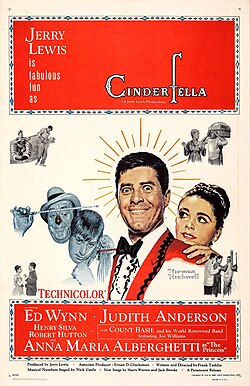
Cinderfella
1960
Directed by Frank Tashlin
Same disclaimer as always, because a movie this beloved by a certain generation of viewers deserves it more than most: this list comes straight from my Flickchart rankings, built from thousands of head-to-head matchups between films I’ve actually watched. It isn’t a verdict on quality, and it definitely isn’t a judgment on anyone who grew up loving this one. If Cinderfella was a Christmas tradition in your house, or the movie that introduced you to Jerry Lewis in the first place, I’m glad it gave you that. I’m only explaining why, on my own personal scoreboard, it landed at number nine.
Last week’s entry, Haunted Honeymoon, disappointed me because I could see exactly what it was trying to be and watched it miss anyway. This week’s disappointment comes from a different direction entirely. I don’t dislike Jerry Lewis. I don’t dislike the old dark house genre’s cousin, the fractured fairy tale. What I dislike is watching a clever premise get buried under forty extra minutes of mugging that the premise never asked for.
A Fairy Tale With the Genders Flipped
The pitch for Cinderfella is genuinely fun to say out loud. Take Cinderella, keep the wicked stepmother, keep the fairy godfather, keep the glass slipper, and swap the genders on almost everyone so the put-upon servant waiting for his life to change is a grown man named Fella instead of a girl named Ella. It’s the kind of high concept that writes its own poster tagline, and on paper it gives a physical comedian like Lewis a built-in reason to be graceful in one scene and a klutz in the next.
The problem is that a premise this thin needs real discipline to sustain itself for ninety minutes, and discipline was never really Lewis’s brand. Frank Tashlin wrote and directed the film, and Tashlin understood cartoon logic in live action about as well as anyone working at the time. But he also lets Lewis run a joke well past the point where it’s still funny, circling back to the same bit of physical shtick until the laugh has completely drained out of it. I kept waiting for someone behind the camera to call cut a few seconds earlier, and that call never came.
What’s Actually Going On Here
For anyone who hasn’t seen it, Cinderfella follows Fella, whose father has died and left him at the mercy of his wicked stepmother Emily and her two sons, Maximilian and Rupert. The stepfamily has taken over the family mansion, and Fella has been shuffled off to an unfinished room at the end of a hallway, where he functions as an unpaid butler catering to everyone’s whims.
Fella keeps having the same recurring dream, one where his late father is trying to tell him where he hid the family fortune, except Fella always wakes up before he learns the location. His stepfamily knows the money exists somewhere on the property, and different members go to different lengths to find it first, some digging around behind his back and others pretending at friendship in hopes he’ll lead them to it.
Enter Princess Charming, visiting town on behalf of her home country, and a wicked stepmother who decides a lavish ball is exactly what’s needed to marry her off to Rupert and save the family’s dwindling finances. Fella isn’t invited, naturally, until his fairy godfather shows up with a promise that Fella won’t remain a “people” for much longer, he’ll blossom into a “person.” From there it’s the story you already know, transformation, grand entrance, dancing with the princess, and a race against midnight, with Count Basie’s orchestra providing the ball’s music.
Where the movie splits from familiar territory is the ending. One of Fella’s stepbrothers finally puts together that Fella was the mystery guest at the ball, and the two end up in a physical struggle under a tree on the property, which is exactly where the buried fortune turns out to be. Fella, who apparently knew the hiding spot the entire time, hands the money over to his stepfamily without hesitation, telling them he never needed the fortune, only a family that actually wanted him around. Shamed, the stepmother orders her sons to give the money back. The princess shows up with Fella’s lost shoe, he tries to talk her out of a future together because she’s a “person” and he’s a “people,” and she tells him that underneath the gown, she’s a “people” too.
It’s a sweet enough resolution, and I’ll give the film credit for landing on sincerity instead of a cynical wink at its own premise. The trouble is getting there. The romance between Fella and the princess barely has room to breathe once you subtract all the screen time spent on stepbrothers scheming and Lewis working through an extended physical routine, and by the time the emotional payoff arrives, it’s landing on an audience that’s been worn down rather than won over.
The Story Behind the Camera
The production history here is stranger and more interesting than anything that ends up on screen, starting with the poster. Cinderfella‘s promotional art was painted by Norman Rockwell, commissioned directly by Lewis, and it’s one of only a handful of films Rockwell ever agreed to illustrate in his career, a list that also includes The Song of Bernadette and the 1966 remake of Stagecoach. Rockwell’s artwork wasn’t limited to the poster either. It ran across magazine ads, lobby cards, and even the sheet music cover for “Let Me Be a People,” one of the songs Lewis performs in the film. Lewis kept the original painting in his personal collection for decades afterward.
Then there’s the staircase. Fella’s grand entrance to the ball required Lewis to descend a long staircase in one take and, in a separate take, sprint back up the same sixty-three steps in under ten seconds. By most accounts, including Lewis’s own, that sprint put enough strain on his heart to land him in the hospital, where he reportedly spent four days in an oxygen tent. Filming was delayed for roughly two weeks as a result. It’s worth noting that not every account agrees on how serious the incident actually was. At least one biography of Lewis describes the hospital visit as a precaution after exhaustion rather than a confirmed cardiac event, so the full story sits somewhere between legend and medical record. Either way, Lewis apparently insisted on doing the stunt himself rather than handing it to a stand-in, which tracks with everything else I’ve read about how much creative control he wanted over his own films.
A few other details round out the production. The mansion exteriors were shot at Chartwell in Bel Air, the same estate that would later serve as the Clampett mansion on The Beverly Hillbillies. Lewis produced the film himself and insisted it debut as a Christmas release rather than the summer date Paramount originally wanted, a scheduling fight significant enough that Lewis agreed to write, produce, and direct an entirely separate film, The Bellboy, just to give the studio something to release in the meantime. Filming on Cinderfella itself ran from October through December of 1959, well over a year before the movie actually reached theaters.
There’s also a smaller wardrobe detail I appreciated once I read about it. While rehearsing his entrance to the ball, Lewis decided the natural movement of his pant legs was throwing off the line of the whole shot, so he had the wardrobe department sew elastic stirrups into the hems that looped under his shoes to keep the fabric taut while he moved. He referred to it later, on the film’s DVD commentary, as an old dancer’s trick. It’s a small thing, but it tells you how much attention Lewis was paying to his own physical presentation even in scenes that only last a few seconds on screen.
The dream car that shows up during the film is worth a mention too. It’s the Golden Sahara, a heavily customized 1953 Lincoln Capri built by George Barris, the same customizer who would go on to design the Batmobile and the Munster Koach later in the decade. And a fair amount of the film’s uncredited gag writing reportedly came from Joe Besser, better known to most people as one of the Three Stooges, which is a strange little intersection of comedy history buried in the credits nobody reads.
The songs were originally meant to carry more weight in the finished film than they ultimately do. A studio cast recording was released around the same time, featuring Lewis alongside a different supporting cast performing songs written for the movie, several of which never made it into the theatrical cut at all. Listening to that soundtrack now is a strange experience, since it tells a slightly different, more condensed version of the story than the one that actually reached theaters.
Where It Landed With Everyone Else
Critical reaction at the time was mixed rather than uniformly hostile, which surprised me a little going in. Some reviewers found real charm in the premise and in Lewis’s physical comedy, while others felt the same routines that charmed one critic simply overstayed their welcome for another. The New York Times was firmly in the second camp, calling it one of the dullest comedies of the year. Decades later, DVD Talk’s retrospective take landed somewhere in the middle, describing it as harmless weekend entertainment for the family while still preferring Lewis’s smaller-scale comedies over this more ambitious production.
Modern aggregator scores reflect that same split. Cinderfella sits in mixed territory on Rotten Tomatoes, hovering around the halfway mark depending on which page you check, which feels about right for a movie that clearly has defenders and detractors in roughly equal number.
The box office numbers are a little harder to pin down with confidence, since different sources report the figures differently, but the film performed well for Paramount regardless of which set of numbers you trust. It opened strong that December, becoming one of the week’s top-grossing films nationally, and it got a theatrical rerelease in 1967 paired with another Lewis vehicle, The Errand Boy. Whatever critics thought of the jokes, audiences showed up.
Why It Lands at Number Nine
When I sit with why this one ranks so low for me, it isn’t the premise. A gender-flipped Cinderella story is a genuinely clever hook, and I mean that. It’s the execution, specifically the way Tashlin and Lewis seem to trust the audience’s patience far more than the material earns. Scenes that should run two minutes stretch to five. Gags that land the first time get repeated a third and fourth time as though repetition alone will make them funnier.
I keep coming back to that staircase sequence, actually, because it’s the one moment where the ambition and the payoff genuinely match up. Lewis wanted a real, unbroken display of physical grace, he got it, and it cost him a hospital stay to make it happen. Some film historians have pointed out that Fella’s suave, transformed persona at the ball reads like an early sketch of Buddy Love, the smoother alter ego Lewis would fully develop a few years later in The Nutty Professor. If that’s true, there’s something almost fitting about it. The best moment in a movie about a man magically becoming someone more polished turned out to be a rough draft for one of Lewis’s more enduring characters.
I wish the rest of the film shared that staircase scene’s discipline, that same willingness to commit fully to one clean idea instead of padding out every scene with an extra beat of shtick. The bones of a genuinely charming movie are visible here. The premise is strong, the supporting cast is stacked with people who clearly know what they’re doing, and Ed Wynn in particular brings exactly the right kind of gentle, otherworldly energy to the fairy godfather role. But the finished film keeps getting in its own way, trusting a joke to land a second and third time when it already used up its welcome on the first pass. That’s the difference between a movie I’d defend and a movie that lands at number nine on a list like this one.
Next Time on Movie Monday
Next Monday we’re trading fairy godmothers for something considerably less forgiving. No glass slippers, no midnight deadlines you can talk your way around, just a countdown you can’t outrun and a franchise that’s made an entire identity out of proving that point many times over. We’re looking at Final Destination 5. See you Monday.
What’s your take on Cinderfella? Does the Rockwell poster alone earn it a pass, or does the runtime wear you down the same way it wore me down? Drop a comment and let me know.

