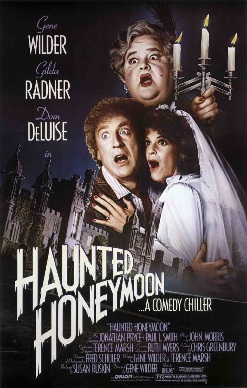
Haunted Honeymoon
1986
Directed by Gene Wilder
Same disclaimer as always, because it matters more this week than most: this list comes straight from my Flickchart rankings, the result of thousands of head-to-head matchups between movies I’ve actually sat down and watched. It isn’t a review of quality or a verdict on cultural worth, and it definitely isn’t a judgment on your taste if this one holds a place in your heart. If Haunted Honeymoon is a movie you grew up loving, or one that reminds you of a rainy afternoon with your family gathered around the TV, I’m genuinely glad it gave you that. I’m not trying to take it away. I’m only explaining why, on my own personal scoreboard, it ended up at number ten.
Last week’s entry, Left Behind, disappointed me because I went in rooting for it and watched that hope curdle in real time. This week is a different flavor of letdown entirely. I didn’t walk into Haunted Honeymoon carrying decades of personal investment in the source material. I walked in as a fan of a whole genre, and watched that genre get fumbled by people who clearly understood it better than the finished product suggests.
A Genre I Genuinely Love
I need to say this up front, because it’s the whole reason this movie stings the way it does: I love the comedy-horror mashup. The old dark house mystery where somebody’s cackling behind a secret panel, the spooky mansion full of suspicious relatives who all seem to be hiding something, the fog machine working overtime while a lovable idiot stumbles into a suit of armor, and the family lawyer who obviously knows more than he’s letting on. Done well, that genre is one of my favorite things a movie can be. It threads a needle that shouldn’t work and somehow does, letting you feel a little unsettled and a little delighted in the same scene.
So when I sat down with Haunted Honeymoon, I wasn’t approaching it with suspicion. I wanted this to be a good one. Gene Wilder loved this kind of film too, by his own account, going back to being a kid scared out of his seat by movies he couldn’t stop watching. That’s the same impulse that makes me seek these movies out. And that’s exactly why it’s frustrating to watch a film made by someone who clearly gets the assignment on paper still land as flat as this one does. The ingredients are all there. The execution just never comes together, and a lot of the jokes sit on screen a beat too long, waiting for a laugh that doesn’t show up.
What’s Actually Going On Here
For anyone who hasn’t stumbled across this one, Haunted Honeymoon is set in the 1930s and follows Larry Abbot and Vickie Pearle, radio performers on a hit mystery show who are about to get married. Larry has started stammering and blanking on his lines mid-broadcast, gripped by a fear he can’t explain, and it’s tanking the show’s ratings. His uncle, a psychologist, decides the cure is to scare Larry even harder, on the theory that a bigger fright will knock the smaller one loose.
That decision sends Larry and Vickie to his family’s castle-like mansion for the wedding weekend, where a house full of relatives, an old family rumor about a werewolf, and an actual hired killer disguised in a werewolf costume all collide. Bodies keep turning up in the wrong places, Larry starts questioning his own sanity, and the whole thing eventually gets explained away as one of the couple’s own radio plays, a twist that undercuts most of the tension the movie spent an hour building.
It’s a clever premise on paper. A movie about people who perform scary stories for a living getting caught inside one is a good hook, and I wanted it to pay off. The trouble is the jokes rarely land with the timing they need, and the mystery elements feel more like obligatory plot furniture than genuine intrigue.
And then there’s the ending, which is its own separate problem. After an hour spent on buried bodies, a hitman disguised as a werewolf, a family lawyer with his own secrets, and Larry getting sealed inside a glass coffin, the movie reveals the entire ordeal was actually one of the couple’s own radio broadcasts all along. I understand the appeal of that kind of wink. It ties back to the “Manhattan Mystery Theater” framing device and lets the film comment on its own genre. But it also quietly tells the audience that none of what they just sat through actually mattered, which is a rough note to end on when the whole point of a comedy-chiller is convincing you the danger felt real even while you were laughing at it.
The Love Story Behind the Camera
The part of this movie’s history I find more compelling than anything in the finished film is how it came to exist at all. Wilder had been carrying the idea since the 1970s, wanting to make what he called a “comedy-chiller” in the tradition of old dark house pictures. He didn’t revisit it seriously until he and Gilda Radner fell for each other while making Hanky Panky, and he built this project as something they could do together.
There’s a detail from production that I keep coming back to. Wilder has said the emotional center of the film clicked for him while he and Radner were watching an old movie in bed and a song from it moved her to tears. He looked over, saw how genuinely affected she was, and decided that tenderness was what the whole project needed to be about. Radner, for her part, later joked that she practically insisted on playing the fiancée herself after that moment, unwilling to picture the scene belonging to anyone else.
That’s a sweet story, and it’s easy to see the affection between them all over the finished film even when the jokes aren’t working. Wilder wanted Dom DeLuise to play his role of the family matriarch completely straight rather than mugging for the camera, which is the right instinct, and DeLuise commits to it well enough that he still walked away with a Golden Raspberry for Worst Supporting Actress. That’s one of those honors that says more about the era’s comfort with actors in drag than it does about the performance itself.
The production itself sounds like it might have been more fun than the finished movie. Filming took place at Elstree Studios outside London across eleven weeks, and Jonathan Pryce, who plays the murderous cousin Charles, has recalled that the cast rarely bothered retreating to their dressing rooms between setups. Instead they’d stay clustered together, entertained by DeLuise holding court in character and out of it. That’s the kind of set anecdote that makes me wish more of that loose, easy chemistry had made it onto the screen instead of getting flattened by a script that keeps stopping to explain its own plot mechanics.
Where It Landed With Everyone Else
Critics were not kind when the film opened in July of 1986, and Orion actually chose not to screen it for reviewers in advance, a decision the producer publicly framed as a stand against a press she felt had gotten needlessly vicious rather than as a lack of confidence in the movie. Reviews that did run afterward mostly agreed the film had a handful of chuckles buried in it but nowhere near enough to sustain a full comedy. The consensus criticism, echoed across several outlets at the time, was that the plotting felt more tangled than entertaining and the jokes leaned on the kind of gags that had already gone stale decades earlier. Not every critic piled on. Some found real charm in how the film played with the old dark house formula and the corny radio mystery shows it was clearly paying tribute to.
The numbers back up that split reaction. The film sits at just 18 percent on Rotten Tomatoes based on eleven reviews and lands in similarly unfavorable territory on Metacritic, while audiences polled at the time gave it a lukewarm C-minus grade. Kevin Thomas at the Los Angeles Times was one of the film’s few genuine defenders, describing it as a bouncy horror comedy that had real fun with both the old dark house genre and the corny radio mystery shows it was riffing on. I wish I’d walked away agreeing with him, because I can see exactly what he’s responding to. I just don’t think the finished film sustains that fun much past the opening stretch.
The box office told a rougher story than even the reviews did. The film’s budget sat around nine million dollars, and it barely scraped together eight million domestically, a discouraging outcome for any studio picture, let alone one carrying two beloved comedic stars. It’s the kind of number that ends a directing career less through any single bad decision and more through the accumulated math of a film that simply didn’t connect the way everyone involved clearly hoped it would.
The Ending Nobody Wanted
Here’s the part of this movie’s story that actually gets to me, more than any joke that didn’t land or any plot thread that went nowhere. Haunted Honeymoon was Gilda Radner’s final feature film appearance. She would be diagnosed with ovarian cancer later that same decade and passed away in May of 1989 at just 42 years old, only a few years after this movie wrapped.
I don’t say that to guilt anyone into liking the film more than it earns. The movie stands or falls on its own jokes regardless of what came after it, and I still think it falls short more often than it should. But there’s something genuinely bittersweet about watching Radner in a wedding gown for most of the runtime, performing opposite the man she was actually married to, in a story built around the two of them getting married inside the fiction as well. Wilder has talked about how personal that framing felt to him, and knowing what was coming for both of them makes certain scenes land with a weight the filmmakers couldn’t have intended.
It’s a strange thing to sit with. A movie I find pretty clumsy as a piece of comedy also happens to be a genuine time capsule of two people who loved each other, captured on film not long before one of them ran out of time. I don’t think that fact fixes the movie’s pacing problems or makes the mystery plot any less of a shrug. But it does mean I can’t be as flip about ranking it low as I was with some other movies on this list. There’s a real tenderness sitting underneath the fog machine and the werewolf costume, even if the comedy around it never quite justifies the tenderness.
Why It Lands at Number Ten
If I’m being fully honest, the ranking here isn’t really about any single failed scene. It’s that a movie built by someone who clearly loves this genre, married to someone he clearly loved just as much, still couldn’t find the rhythm that makes old dark house comedy work. The premise is strong. The pedigree behind the camera and in front of it is stronger still. And yet the jokes mostly just sit there, waiting for a punch line that Wilder’s own affection for the material never quite delivers.
I keep thinking about what a tighter cut of this movie could have looked like, one willing to trust its cast a little more and lean less on familiar gags borrowed from films Wilder admired growing up. That version exists somewhere in the gap between what this movie is and what it clearly wanted to be. This one just never finds it, and that gap is exactly why it sits where it does on my list.
Next Time on Movie Monday
Next week we’re giving the fog machines and the werewolf costumes a rest. It’s the first Monday of the month, which means we’re taking our usual break from the least-favorites list for a palate cleanser, and this one comes with fins, a voice worth bargaining away, and a crab who really should stick to singing instead of giving relationship advice. We’re heading under the sea with Disney’s The Little Mermaid. See you Monday.
What’s your take on Haunted Honeymoon? Did it work better for you than it did for me, or does it deserve its spot near the bottom of the pile? Drop a comment and let me know.

