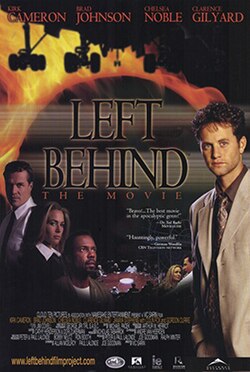
Left Behind: The Movie
2000
Directed by Vic Sarin
Same disclaimer as always, and I mean it more than usual this week: this list is built entirely off my Flickchart rankings, which means it reflects nothing but my own head-to-head preferences played out over thousands of matchups. It is not a measure of quality, cultural impact, or how much a movie deserves your love. If Left Behind is a film that introduced you to the Rapture, gave you your first real jolt of end-times anxiety as a kid, or just holds a soft spot because it was one of the few movies your youth group ever agreed to watch together, I’m not here to take that away from you. I’m just explaining why, on my own personal ledger, it lands at number eleven.
Last week I wrote about Matilda and the way its craft kept me admiring the construction from a slight remove instead of getting swept up in it. This week is a different kind of remove entirely. Matilda earns nearly everything critics and audiences have given it. Left Behind does not, and I say that as someone who wanted very badly to love it.
A Confession Before We Start
I read the Left Behind books. Not just the first one out of curiosity, but a real chunk of the series, back when it was the book everyone at church seemed to be passing around. I was genuinely excited when I heard a movie was coming. This felt like our version of a blockbuster, something built from a story I already cared about, headed for an audience that didn’t usually get to see its own beliefs treated like the premise of a thriller. I remember the letdown clearly. It wasn’t a small disappointment either. It was the specific feeling of watching something you’d been looking forward to for a long time and slowly realizing, scene by scene, that it wasn’t going to get better.
I went back and reread the first book a few years ago, curious whether my teenage self had simply been an easy audience. What I found wasn’t that the book was poorly constructed or beyond my ability to follow. It was that so much of it is, for lack of a better word, cheesy. The dialogue leans hard into exposition, the characters announce their feelings instead of having them, and the prose has a made-for-TV quality even on the page. Knowing that now makes the film’s failures feel almost inevitable rather than surprising. You can only elevate source material so far, and this film mostly just filmed the material as written.
What the Movie Is Actually About
For anyone who hasn’t encountered the story, Left Behind follows GNN journalist Cameron “Buck” Williams and airline pilot Rayford Steele in the hours surrounding a global event where millions of people vanish without warning. Believers call it the Rapture. Rayford’s wife and young son are gone. His daughter Chloe is left to piece together what happened to her family while Buck chases a conspiracy involving the United Nations and a mysterious new Secretary-General named Nicolae Carpathia, who the story slowly reveals to be the Antichrist. Along the way, a disgraced pastor named Bruce Barnes becomes a reluctant guide for the people who missed their chance at salvation the first time and are now trying to hold onto their faith through what the film promises will be seven years of tribulation.
It’s a big premise, and to the film’s credit, it doesn’t shy away from the scale of it. The trouble is almost everything in the execution feels smaller than the idea deserves. The performances lean stiff, the pacing drags through long stretches of characters explaining plot to each other, and the visual effects (particularly in the opening air raid over Israel) look exactly as dated as you’d expect from a movie with this kind of budget trying to depict a war.
How This Thing Actually Got Made
The path to the screen involved more turnover than you’d guess from the finished product. Namesake Entertainment, a production company known for adapting Christian authors, optioned the film rights to Tim LaHaye and Jerry B. Jenkins’ novel in 1999. Producer Ralph Winter came aboard and brought in Alan B. McElroy to write a screenplay. When the studios weren’t interested in financing it, Winter licensed his stake to Peter and Paul Lalonde’s Toronto-based Cloud Ten Pictures, who had already built a name making similarly themed direct-to-video apocalypse films. Winter and McElroy stepped away from the project after that, though Namesake kept a co-producer credit on the sequel.
The casting has its own oddities worth knowing. Televangelists Jack Van Impe and John Hagee show up in cameo roles as raptured airline passengers, and evangelist T.D. Jakes plays Pastor Vernon Billings, the man whose videotaped sermon becomes the film’s clumsiest but most sincere attempt at explaining its own theology. Contemporary Christian artists Bob Carlisle and Rebecca St. James pop up as news anchors, which is the kind of casting choice that only makes sense if you already knew the soundtrack was going to be stacked with Christian music talent, which it is.
Filming happened around Toronto over 31 days in the spring of 2000, on a budget reported at $17.4 million, which the filmmakers marketed at the time as the most ambitious Christian film ever made. An Ontario quarry stood in for Israel, and the production leaned on camels to sell the desert illusion. There’s a quote from the Bowmanville Zoo’s animal trainer about camels being the single most useful prop a movie like this can have, and having watched the finished film, I believe him. The camels are doing more convincing work than some of the human cast.
There’s also a soundtrack angle worth mentioning, because this movie treated its music almost like a second marketing campaign. Two separate CDs came out around the release, one a collection of contemporary Christian songs inspired by the film’s characters and themes, and a second featuring the orchestral score performed by the London Symphony Orchestra. It’s a strange amount of musical ambition for a film that couldn’t be bothered to make its dialogue sound like something a real person would say, and it tells you a little about where the priorities sat during production. The music wanted to be prestige. The screenplay settled for functional.
Getting There First, Then Getting There Slowly
One of the stranger release strategies here is that Left Behind hit home video before it ever played in a theater. It came out on VHS and DVD on October 31, 2000, months ahead of its February 2001 theatrical run, reportedly as a way to build word of mouth before asking people to pay for a ticket. Roughly three and a half million copies sold on home video, which suggests the strategy worked in raw numbers even if the theatrical release itself barely broke even. The film opened in 17th place its first weekend, pulling in a little over two million dollars, and finished its run with just over four million total against that seventeen million dollar budget.
Critics were not kind, and this is one of the rare cases where I don’t think the critical consensus is being unfair. The film sits at a dismal 16 percent on Rotten Tomatoes across 45 reviews, with the site’s own summary landing on the idea that poor production values and an implausible story make this one strictly for the already-converted. Metacritic isn’t any warmer, placing it firmly in “generally unfavorable” territory. One review I came across put it about as bluntly as I would myself: the sincerity of the project ends up working against it, turning what should have been a heartfelt cautionary tale into something that’s easier to laugh at than sit with.
The Kirk Cameron of It All
I’d be lying if I said Kirk Cameron’s casting doesn’t color how a lot of people approach this film now, myself included to some degree. By the time he made this movie, Cameron was several years removed from Growing Pains and beginning the transition into the more overtly evangelical public figure he’d become known as afterward. That later reputation makes it tempting to watch Left Behind as some kind of origin story for that persona, but I’d rather judge the performance on its own terms than lean on who he became. On its own terms, it’s a stiff, over-earnest performance in a role that needed someone capable of selling skepticism turning into belief, and that transformation never quite lands.
A Legal Mess to Match the Onscreen One
Even the people who made this movie weren’t happy with how it turned out. Tim LaHaye actually sued Namesake Entertainment and Cloud Ten Pictures over his dissatisfaction with the finished product, a dispute that dragged on for years before finally settling in 2008. Part of that settlement gave LaHaye a path toward remaking the story the way he’d originally envisioned it, which eventually led to the 2014 reboot starring Nicolas Cage, a film that somehow found a way to be received even worse than this one.
Despite all of that, this film still spawned two direct sequels, Left Behind II: Tribulation Force in 2002 and Left Behind: World at War in 2005, both continuing the story from the second novel in the series. I haven’t ranked either of those on my Flickchart list, mostly because by the time World at War came out, I’d already stopped watching. The first film had used up whatever goodwill I’d carried in from the books.
Why This One Lands Where It Does
Here’s the honest shape of my problem with Left Behind, and it isn’t really about the theology, which I still find compelling as a story premise even if I’ve moved away from some of the specific beliefs that shaped it. My issue is that the film had a genuinely interesting hook, a global mystery unfolding in real time with a ticking-clock structure that should have worked as a thriller regardless of anyone’s faith background, and it consistently chooses the flattest possible version of every scene built on top of that hook. Characters state their arcs out loud instead of living them. The villain’s plan gets explained in a monologue rather than revealed through action. Even the moment where Buck finally accepts what’s happening around him, which should be the emotional center of the whole story, plays more like a plot checkpoint than a genuine turn.
I keep coming back to how much I wanted this one to work. That’s different from most of the movies on this list, where my expectations going in were already modest or nonexistent. I went into Left Behind rooting for it, carrying real affection for the source material, and watched that affection curdle into frustration in real time. Revisiting the book years later and finding it cheesier than I remembered didn’t exactly soften my feelings toward the film either. If anything, it clarified something for me: the movie isn’t a betrayal of great source material. It’s a faithful adaptation of material that was already straining under its own sincerity, filmed by people who didn’t have the resources or the instincts to paper over that strain.
I don’t think this is a movie only “haters of Christianity” could dislike, to borrow a phrase from one of its more defensive fans online. I think it’s a movie that even a sympathetic audience, one that wanted to see this story land, has every right to find clumsy. That’s a harder kind of disappointment than simply disliking something that was never for you, and it’s the reason this one has stuck with me enough to land in my bottom dozen.
What makes it worse in hindsight is knowing the story had another shot decades later and still couldn’t find its footing. The 2014 remake had a bigger budget and a recognizable star in Nicolas Cage, and it somehow landed even lower with critics than this one did. At some point you have to wonder whether the problem was ever really the budget or the cast at all. Two very different production teams, working more than a decade apart, both ran into the same wall. That tells me the difficulty was baked into the source material from the start, in the same cheesiness I ran into rereading the book, and no amount of money or better casting was ever going to fully fix it. I still think there’s a great, tense thriller buried somewhere in this premise. Nobody has made that version yet.
Next Time on Movie Monday
Next week we’re trading the Rapture for a much smaller kind of apocalypse: a marriage. We’re headed into a creaky old mansion, a body count that keeps climbing, and a bride who’s starting to suspect her new husband might be the actual problem. Haunted Honeymoon is next on the list, and I promise this one earns its spot for reasons that have nothing to do with prophecy and everything to do with comedic timing gone wrong. See you Monday.
 The Confusing Middle