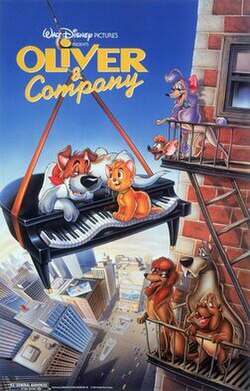
Oliver & Company
1988
Directed by George Scribner
Welcome back to Movie Monday. First Monday of the month means we set aside the countdown of my hundred least favorite movies and spend some time with a Disney film I actually love. Last month it was The Great Mouse Detective, a movie that arrived at a moment of genuine crisis for Disney animation and, against long odds, kept the department alive. This month we jump forward two years to a very different Disney, one that was starting to believe in itself again, and land on a movie about a homeless kitten, a gang of New York street dogs, and a Charles Dickens novel that got put through a blender.
I loved this movie as a kid. I still do. Let’s talk about why.
Where I Come From on This One
I have real, uncomplicated affection for Oliver & Company. There’s no revisionist angle here, no adult reappraisal that talked me into liking something I was lukewarm on as a kid. I watched this one on VHS more times than I can count, and a lot of it is baked into my memory in a way that has nothing to do with critical consensus and everything to do with how it felt to be a kid in front of a television with this movie playing.
Dodger was the draw. I didn’t know who Billy Joel was when I first saw this movie. I had no context for “Piano Man” or “Uptown Girl” or any of it. All I knew was that this dog was cool in a way that felt aspirational to a kid who was decidedly not cool. The swagger, the New York attitude, the way he moved through the world like he owned every inch of it. That’s a hard thing for animation to pull off convincingly, and this movie pulls it off in its first ten minutes.
And then there’s “Why Should I Worry?” I would not have been able to tell you at the time why that song worked on me the way it did. I just know that it did, and still does.
A Different Kind of Crisis Moment
Last month’s post was about a film that saved Disney animation from institutional collapse. This month’s film comes from a different chapter of that same recovery story, one that’s less about crisis and more about a studio figuring out what it wanted to become.
Michael Eisner and Jeffrey Katzenberg had joined Disney in 1984, arriving from Paramount Pictures where Eisner had been chairman and Katzenberg had run production. Not long after they took over, the two held a meeting with the animation staff to solicit ideas for future projects, a meeting that became known internally as the “Gong Show.” Story artist Pete Young pitched a simple concept during that meeting: Oliver Twist, but with dogs. Katzenberg, who had previously overseen a live-action adaptation of the musical Oliver! during his time at Paramount, approved the idea almost immediately, alongside another pitch from that same period of development that would eventually become The Little Mermaid.
That’s worth sitting with for a second. The same round of pitch meetings that greenlit Oliver & Company also greenlit the film that would kick off the Disney Renaissance in earnest. These two movies were, for a while, traveling companions through the same studio at the same moment, even though history remembers one of them far more fondly than the other.
The production itself was not smooth. George Scribner and Richard Rich were originally announced as co-directors, with Young serving as story supervisor, but Young died unexpectedly in late 1985, and Rich left the production around six months in, leaving Scribner as the sole director for the rest of the process. The film went through years of story revisions. Characters swapped species and roles more than once before the final version settled into place. Oliver and Dodger were originally conceived as two kittens, then flipped to two dogs, before the filmmakers landed on the mismatched pairing that made it into the finished film. Rita, the streetwise Saluki, had a much larger role in early drafts, including a subplot in which she was nearly killed off entirely, a beat the writers debated and ultimately abandoned. There was even a discarded subplot involving a rare panda and a trip to the Central Park Zoo before someone landed on the much simpler and more effective idea of turning Oliver into a wealthy family’s cat and having Fagin hold him for ransom.
None of that turmoil is visible on screen, which is itself a small miracle of studio filmmaking. What audiences got in November of 1988 is a tight, confident, good-looking movie that doesn’t wear its chaotic development history anywhere on its surface.
New York City, Reimagined
The choice to relocate Oliver Twist from Victorian London to late-1980s New York City is the single best decision this movie makes, and it’s the decision that gives it a personality distinct from every other Dickens adaptation before or since.
This isn’t a lazy reskin. The filmmakers actually went and looked at New York. Animators shot photographs of city streets with cameras mounted eighteen inches off the ground to capture a dog’s-eye view of the world, then used those images as reference for how the animals moved through their environment. Backgrounds incorporated real signage, real brand names, real texture from the city as it actually looked at the time. This was the first Disney animated film to include real-world advertised products, with dozens of actual company logos woven into the world, and while that sounds like a strange thing to praise, it gives the movie a groundedness that a lot of Disney films from this era don’t bother with.
The film also leaned on computer-generated imagery in ways that were genuinely novel for Disney at the time, roughly eleven minutes’ worth spread across the Brooklyn Bridge, city traffic, the subway tunnels, and most memorably, Fagin’s trike. That little three-wheeled scooter was actually the first object tested with the studio’s CGI process during production, built out of eighteen separate computer-modeled parts. It’s not seamless by modern standards, but it gives the chase sequences a sense of scale and mechanical menace that hand-drawn animation alone would have struggled to match, particularly during the climax in the subway tunnels.
The Voices That Carry It
Casting Billy Joel as Dodger is one of those decisions that sounds like a marketing department’s idea and turns out to be genuinely inspired. Joel had spent years turning down film roles, convinced the camera would do him no favors, and he was the fifth actor to audition for the part. He recorded his lines over roughly two years, in sessions squeezed in around touring, using the actor Leo Gorcey from the old Dead End Kids films as a mental reference point for the character: a tough kid who’s secretly decent underneath the attitude. That’s exactly the balance Dodger needed, and Joel finds it without ever making the character feel soft.
Bette Midler’s Georgette is the other standout, a pampered, preening poodle who exists mostly to be undone by her own vanity, and Midler plays every note of that with total commitment. “Perfect Isn’t Easy” is a genuinely funny song, and Midler sells the character’s fragile self-regard so well that her eventual thaw toward Oliver and the gang actually lands emotionally instead of feeling like an obligatory arc.
Cheech Marin’s Tito deserves real credit too. The production had initially been looking for a Puerto Rican actor for the role, but landed on Marin, who is Mexican-American, and it’s hard to argue with the result. His energy and comic timing turned what could have been a one-note sidekick into one of the film’s most purely entertaining presences. Dom DeLuise’s Fagin gives the movie its conscience, a small-time crook who’s never quite as hardened as his circumstances demand, and Robert Loggia’s Sykes is a genuinely unsettling villain precisely because the film keeps him relatively restrained. He doesn’t need to chew scenery. He’s scary because he’s calm.
What Gets Lost from Dickens
If you go back to the source material after watching this movie, you’ll find that Oliver & Company treats Oliver Twist the way a jazz musician treats a standard: as a set of recognizable elements to riff on rather than a text to faithfully transcribe. The bones are there. A homeless orphan. A charismatic pickpocket who takes him under his wing. A criminal fence with a heart he’d rather not admit to having. A menacing figure controlling the fence through debt and intimidation. A wealthy family that offers the orphan a way out.
But the tone is almost entirely inverted. Dickens’s novel is bleak, angry, and unsparing about the machinery of poverty grinding children into criminals. This film is warm and forgiving almost to a fault. Fagin here is closer to a beloved uncle who’s fallen on hard times than a genuinely corrupting influence. Nobody in this movie’s gang of dogs is in any real spiritual danger the way Dickens’s child pickpockets are. The film keeps its Fagin, keeps Sykes as the operative villain, and lets Oliver end up exactly where a Disney movie wants him: happy, adopted, and still on good terms with the friends who tried to exploit him along the way.
That’s not necessarily a flaw. It’s a choice, and it’s a choice that’s consistent with what this film is trying to be. But it’s worth knowing going in that the resemblance to Dickens is closer to a loose homage than an adaptation, and if you come to it expecting the moral weight of the novel, you’ll be disappointed. Come to it expecting a fun, briskly paced musical about a cat finding his people, and it delivers exactly what it promises.
How It Landed and What It Means
Oliver & Company opened on November 18, 1988, the same day Disney marked the sixtieth anniversary of Steamboat Willie, and it did solid business against a $31 million budget, eventually earning around $121 million worldwide across its 1988 release and a 1996 theatrical re-release. It actually out-earned Don Bluth’s An American Tail domestically, at the time a genuinely notable feat given how competitive that particular rivalry had become. Critical reception was mixed. Reviewers largely praised the music and the vocal performances while splitting on the animation and the plot, and that split has more or less held up in the decades since. It’s not a film that gets mentioned in the same breath as the movies that immediately followed it.
And that’s really the story of Oliver & Company‘s place in Disney history. It sits right at the hinge point, one year before The Little Mermaid formally kicked off the Renaissance, made partly by animators who were about to become some of the most important names in the studio’s history, and yet it rarely gets folded into that conversation. Some historians and fans debate whether it counts as the last film of the pre-Renaissance era or an early, underappreciated entry into the Renaissance itself. I don’t think that debate needs a definitive answer. I think it’s enough to say that this movie represents a Disney animation department that was gaining confidence, taking bigger swings, and getting comfortable with the idea that a modern setting and a pop soundtrack weren’t beneath the studio’s dignity. That confidence paid off spectacularly the following year, and this movie was part of building it.
Final Verdict
Oliver & Company is a warm, briskly told, genuinely fun spin on Dickens that trades the novel’s grimness for New York City attitude and a soundtrack full of pop songwriters clearly having a good time. Billy Joel and Bette Midler both turn in performances that elevate the material well past what a cynical read of “celebrity voice cast” might suggest. It’s not the most substantial film in the Disney canon, and it’s not trying to be. It’s a movie about finding your people, set to a soundtrack you’ll be humming for a week afterward, and nearly forty years later it still holds up as exactly the kind of comfort watch it was designed to be.
Next Monday we’re back to the countdown, and I’ll admit I’m bracing myself a little for this one. The next entry on my list of least favorites is Matilda, the 1996 Danny DeVito adaptation of the Roald Dahl book. I know this one has a devoted following, and I know exactly how many of you are going to disagree with me. I’m doing it anyway. See you next week.
 The Confusing Middle