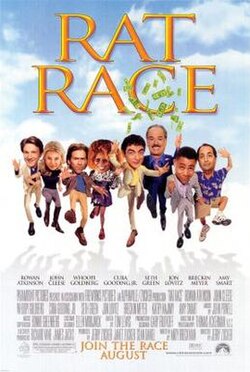
Rat Race
2001
Directed by Jerry Zucker
Same disclaimer as always: this list is entirely a matter of personal taste, shaped by what I happen to respond to and not respond to on screen. If Rat Race is a movie you genuinely love, I’m not trying to argue you out of that. I’m just explaining why it sits at number 13 on mine.
Last week I wrote about Babe: Pig in the City and the way it suffers from not knowing what kind of movie it wants to be, swinging from slapstick to genuine peril without ever settling into one tone long enough to earn either. I closed that post by teasing this one as the opposite problem: a movie that knows exactly what kind of movie it wants to be and still doesn’t quite pull it off. Having sat with Rat Race again for this post, I’ll stand by that. This is a film with total clarity of purpose. It just doesn’t trust that purpose enough to let it work on its own terms.
A Premise Borrowed With Interest
Rat Race is, by its own admission, a remake in spirit if not in name. Stanley Kramer’s 1963 comedy It’s a Mad, Mad, Mad, Mad World set the template: a sprawling cast of strangers learns about a hidden stash of money and races across the country to claim it, with chaos multiplying at every stop. Andy Breckman’s script swaps the dying gangster’s buried fortune for a Las Vegas casino owner’s elaborate betting game, but the bones are the same. Six teams, one prize, one finish line, and a tangle of subplots designed to let the ensemble collide with as much scenery as possible along the way.
I don’t hold the borrowing against the film by itself. Plenty of great comedies are built on a chassis somebody else welded first. The problem is that Rat Race never seems interested in doing much with the premise beyond restaging it. Mad World had a kind of gleeful meanness to its escalation, every character getting steadily uglier as the money got closer. Rat Race wants that same anything-goes energy, but it reaches for it through gross-out shock value rather than character, and that’s where it loses me.
The Shock Humor Problem
Here’s my honest issue with this movie, and it’s less about plot mechanics than about the kind of laugh it’s chasing. A good chunk of Rat Race‘s comedy isn’t built on character or situation so much as on how far it can push something uncomfortable and dare you to laugh anyway.
Take the Pear family detour. Jon Lovitz’s Randy Pear forces his young daughter to relieve herself out a moving minivan window rather than stop the car, which sets up a revenge plot where she tricks the family into visiting a museum dedicated to Nazi officer Klaus Barbie, believing it’s about the doll. From there the family ends up driving Adolf Hitler’s actual staff car, Randy burns his tongue on an ejecting cigarette lighter, and his resulting slurred speech and facial injury get mistaken for a deliberate Hitler impression by a crowd of World War II veterans, one of whom tries to attack him. That’s a lot of distance to cover in a single subplot, and at no point does any of it feel like it’s building toward a joke so much as escalating toward a more extreme one.
Or consider Rowan Atkinson’s Enrico, the narcoleptic tourist, who ends up hitching a ride with an ambulance driver transporting a donor heart. Enrico accidentally drops the heart out the window, where a stray dog grabs it and is then electrocuted on a fence, and the ambulance driver, now panicking about a lawsuit and a missing organ, decides his best option is to kill the friendless Enrico and harvest his heart as a replacement. It’s a wild swing for a mainstream comedy, and not in a way that ever made me laugh so much as wince. Later in the same subplot, Enrico is mistaken for a pedophile by a baby’s parents on a train, which is its own kind of joke that hasn’t aged any better with distance.
None of these moments are badly staged, exactly. Jerry Zucker knows his way around a sight gag, and the Zucker brothers’ pedigree with Airplane! and the Naked Gun films is visible in the technical competence here. But there’s a difference between absurdist escalation that stays light on its feet and shock comedy that just keeps raising the stakes of what it’s willing to put on screen. Rat Race leans hard into the second approach, and the laughs it’s chasing depend less on wit than on whether you find the premise itself funny: a dog getting electrocuted, a man mistaken for a predator, a family literally driving a dictator’s car into a war memorial crowd. I don’t.
Too Many Names, Not Enough Characters
My other issue with Rat Race is one I have with a particular kind of ensemble comedy in general, and this movie is close to a textbook case of it. When a film tries to stuff in as many recognizable faces as it can fit, something usually has to give, and what gives here is any sense that these are people rather than placeholders for famous names.
The cast list is genuinely staggering for a film like this. Rowan Atkinson, John Cleese, Whoopi Goldberg, Cuba Gooding Jr., Seth Green, Jon Lovitz, Breckin Meyer, Kathy Najimy, and Amy Smart all share top billing, with Wayne Knight, Dave Thomas, and a cameo from Smash Mouth rounding things out. That’s an enormous amount of star power for a movie with a 112-minute runtime split across six separate storylines. Do the math and nobody gets enough room to be more than a sketch of a personality. Seth Green and Vince Vieluf’s ne’er-do-well brothers exist mostly to wreck vehicles. Whoopi Goldberg and Lanai Chapman’s mother-daughter reunion gets a handful of scenes to carry real emotional weight that the film hasn’t built toward. Cuba Gooding Jr.’s disgraced referee gets chased by an army of Lucille Ball impersonators in a subplot that’s more premise than payoff.
I don’t think this is a case of bad actors doing bad work. Everyone here is a capable performer, several of them very gifted ones. It’s that the film’s structure treats them as interchangeable parts in a machine built to deliver gags, rather than as people whose choices matter. When It’s a Mad, Mad, Mad, Mad World did this same multi-thread structure, it had nearly three hours to let its enormous ensemble breathe and develop. Rat Race tries to do the same thing in well under two, and the compression shows. You walk away remembering set pieces, not characters.
Where It Actually Works
I’ll give credit where it’s due, because there’s a reason this thing made money and found an audience. John Cleese, as the eccentric casino mastermind Donald Sinclair, is the one performer who gets to do something with real comic shape rather than just react to chaos. There’s an irony in that, given Cleese has talked about how rarely he finds a script worth saying yes to, and how this was one of only two in his career he read and immediately committed to. Whatever drew him to it, his scenes have a control and dryness the rest of the film is reaching for and mostly missing.
The framing device itself, a wealthy eccentric orchestrating misery for the entertainment of his rich friends, is also a clever enough hook, and the film’s ending, where the racers abandon the prize money to a charity benefit concert and Cleese’s Sinclair is forced to match a donation total spiraling past nineteen million dollars, lands as a genuinely satisfying reversal. It’s the rare moment where the film’s chaos finally pays off rather than just escalating for its own sake. I also have a soft spot for the early hot air balloon detour with the locksmith, which has the kind of patient, escalating absurdity that the rest of the movie is usually too impatient to build toward.
The Critical and Commercial Picture
The reviews at the time landed about where you’d expect for a movie this scattershot. On Rotten Tomatoes, it sits at 44 percent approval across more than a hundred reviews, with the site’s consensus noting that the film moves from gag to gag without enough of them actually landing. Metacritic places it at 52, squarely in mixed territory. Jo Berry’s review for Empire was more forgiving than most, calling it incredibly silly but also genuinely funny in places, and giving it three stars out of five.
Audiences were notably warmer than critics. CinemaScore polling gave the film a B+, a solid grade that suggests people walked out of theaters having had a decent time even if the reviews were lukewarm. That gap between critical and audience reaction tracks with my own experience of it. This isn’t a movie that’s trying to be smart or subtle, and on the level of pure spectacle, plenty of people get exactly what they came for.
Commercially, the film did fine for itself. It opened at $11.7 million domestically, finishing third behind American Pie 2 and Rush Hour 2 that same weekend, and went on to gross $56.6 million domestically and roughly $85.5 million worldwide against a $48 million budget. Not a blockbuster, but a clear profit, and enough of a hit that nobody walked away calling it a failure.
Where That Leaves It
What keeps Rat Race at thirteen for me rather than somewhere higher isn’t a lack of competence. Zucker knows how to stage a gag, the cast is full of people I genuinely like watching, and the film has a clear sense of what kind of movie it’s trying to be from its opening scene to its last. That clarity is exactly what makes the choices it makes so frustrating to me. It knows it wants to be a maximalist, anything-for-a-laugh chase comedy in the Mad World tradition, and it commits to that fully. I just don’t think shock value and a packed marquee of recognizable faces are a substitute for the kind of character work that made its inspiration endure. Cleese is funny. The ending genuinely works. But too much of what sits between the opening bet and the closing concert is daring you to wince rather than earning a laugh, and an oversized cast spread too thin to let any single one of them matter.
Next Time on Movie Monday
Next week we’re stepping off the least favorites list entirely for our monthly palate cleanser, and there’s no better antidote to gross-out chaos than a kind-hearted kitten finding his way through 1988 New York City. Disney’s Oliver & Company sends an orphaned kitten into the company of a streetwise gang of dogs, a debt-ridden Fagin, and one genuinely great Billy Joel song about not having a single worry in the world. After this week, I could use a little of that myself. See you Monday.

