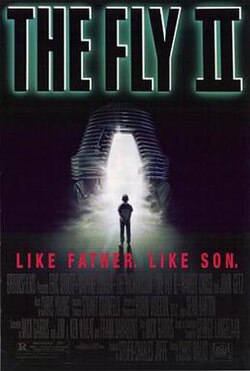
The Fly II
1989
Directed by Chris Walas
Before we get into it, the standard disclaimer applies: everything below is my own opinion, shaped by my own viewing experience, and none of it is meant as a knock on anyone who genuinely enjoys this movie. If you grew up with The Fly II on cable the way a lot of us grew up with a lot of things on cable, and it holds a soft spot for you, that’s completely fair. I’m not here to take that away from you. I’m just here to explain why it lands at number 15 on my list.
What makes The Fly II an interesting kind of disappointment is that it isn’t really a story about a bad movie existing in a vacuum. It’s a story about what happens when a thoughtful sequel gets quietly replaced with a different, much less interesting movie partway through development, and the seams of that swap are visible almost the entire time you’re watching it. To understand why this one frustrates me as much as it does, you have to start with the film it’s a sequel to.
The Shadow of Cronenberg
David Cronenberg’s The Fly came out in 1986, and it remains one of the great horror films of its decade. Jeff Goldblum played Seth Brundle, a scientist whose teleportation experiment splices his DNA with that of a housefly, and the film tracked his slow, horrifying transformation with a kind of tragic intimacy that’s rare for the genre. It was as much a breakup movie as a monster movie. Geena Davis played Veronica Quaife, the journalist who watches the man she loves disappear by degrees, and the film made you feel that loss as much as the body horror. It made nearly $61 million on a budget that, depending on the source, sat somewhere between $9 and $15 million, becoming the biggest commercial hit of Cronenberg’s career. Chris Walas and Stephan Dupuis won the Academy Award for Best Makeup for their work on Brundle’s transformation, the only Oscar a Cronenberg film has ever won.
That is the bar. That is the film The Fly II has to follow, and it knows it, because it spends its opening minutes practically begging you to remember it. Veronica Quaife dies giving birth to a larval sac in the film’s first scene, and the resulting child, Martin Brundle, is raised by Anton Bartok, the corporate executive who funded Seth Brundle’s research in the first place. Martin ages at an accelerated rate, reaching the physical maturity of a 25-year-old by his fifth birthday, and is told his rapid aging is a disease rather than a genetic inheritance from the father he never knew. Eric Stoltz plays Martin as an adult, and Daphne Zuniga plays Beth Logan, a Bartok Industries employee who becomes his love interest.
On paper, there’s something there. A son unknowingly inheriting his father’s curse, raised by the very company that caused it, slowly realizing what he’s becoming just as he starts to fall for someone, is not a bad premise for a sequel. It’s arguably a better premise than a lot of sequels get. The problem is what the film does with it once it gets going.
The Movie That Almost Was
Here’s where The Fly II gets genuinely interesting, and where most of my frustration with it actually comes from.
Mick Garris was brought on to write and direct the sequel, and by his own account, he and producer Stuart Cornfeld wanted to make something in the spirit of Cronenberg’s film: smart, adult, character-driven. Garris has said that plan had real support, until a change in studio leadership at Fox brought in an executive who wanted something else entirely. In a 2020 interview, Garris recalled being told the studio now wanted a teenage monster movie instead, and that he did what he could under the new direction before leaving to direct his first feature, Critters 2 (which landed at number 61 on this very list).
After Garris departed, Ken and Jim Wheat were brought in to rewrite the script, reportedly after Fox passed on a different project the brothers had pitched. By their own description, the draft they inherited was broad, and they tried to refocus it while working under a rushed schedule and notes from eight different people that often contradicted each other. Frank Darabont, later the writer and director of The Shawshank Redemption, did a further pass at the request of director Chris Walas, who had stepped in after Garris left. According to Walas, Darabont brought real dramatic power to the script, and the sequence where Martin euthanizes a deformed dog that Bartok’s scientists had experimented on was Darabont’s contribution.
I want to sit with that dog scene for a second, because it’s the clearest evidence of what this movie could have been. Martin befriends a dog kept in Bartok’s animal testing wing, and after a failed teleportation experiment leaves the animal horribly mutated and in pain, Martin is the one who has to put it down. It’s quiet, it’s sad, and it understands something about empathy and complicity that the rest of the film mostly doesn’t bother with. For about five minutes, The Fly II feels like the movie Garris and Cornfeld originally wanted to make. Then it moves on, and mostly doesn’t come back to that register again.
What’s Actually On Screen
The back half of the film is where it fully commits to being the monster movie Fox apparently wanted all along. Martin’s transformation accelerates once he learns the truth about his father and Bartok’s plans to exploit his condition, he goes on the run with Beth, and the climax involves a cocoon, a password (it’s “Dad,” which is about as subtle as the film ever gets), and a genetic swap that leaves Martin human again and turns Bartok into the monster instead. The final shot, with the newly mutated Bartok creature eyeing a housefly from inside a dog’s old enclosure, is clearly meant as a grim little joke, a hint that the cycle could start over.
It’s not that any of this is incompetently made. Walas knows his way around a creature effect, for obvious reasons, and the makeup and transformation work has its moments. But the film never figures out how to be both things at once. It wants the emotional weight of a young man losing himself and the people closest to him, and it also wants extended sequences of a half-formed insect creature crawling through ventilation shafts. Cronenberg’s film managed both because the horror was the metaphor. Here, the horror mostly just postpones the metaphor until it’s too late to matter.
There’s also a strange thinness to Martin and Beth’s relationship that the film needs to work and never quite earns. We’re told they fall in love, and Stoltz and Zuniga are both likable performers doing their best with it, but the film is in such a hurry to get to its monster movie business that the romance ends up feeling like a checkbox rather than a foundation. When Beth eventually hands Martin over to Bartok under pressure, it’s supposed to land as a betrayal with real emotional stakes. Mostly it just lands as the plot needing her to do that at that moment.
What Actually Works
In the interest of fairness, there’s more here worth crediting than the film’s reputation might suggest.
Lee Richardson, as Anton Bartok, is doing genuinely strong work as a man who has spent five years patiently waiting for a child to grow up so he can harvest the family curse for profit, and he plays that calculation with an icy, unhurried confidence that the film badly needs. Eric Stoltz brings a real sincerity to Martin that goes a long way toward making the character’s situation feel like it matters, even when the script around him doesn’t always support that effort. And that dog scene, again, is the kind of moment that sticks with you long after the rest of the movie has faded, which says something about both how good it is and how little company it has.
The effects work in the film’s final stretch is also legitimately impressive on a technical level, even if I think the film leans on it too heavily and too early. Walas’s team had built a career on this kind of transformation sequence, and you can feel that expertise in the texture and physicality of it, even when the storytelling around it has checked out.
The Critical Verdict
The Fly II opened on February 10, 1989, and the reviews were not kind. Janet Maslin of The New York Times wrote that the film’s only real connection to Cronenberg’s version was in its repulsiveness, calling the final stretch a parade of gory effects. Richard Harrington of The Washington Post described the script as flat and the effects as clumsy. Leonard Maltin gave it his lowest possible rating, summing it up in three words: dull and messy.
Not every notice was quite that harsh. Empire’s David Hughes gave the film three out of five stars, acknowledging it wasn’t as sharply written or directed as its predecessor but praising its pace and gross-out craftsmanship. More recently, Den of Geek’s Ryan Lambie made a similar case, arguing the film deserves more credit as pure entertainment than it usually gets. On Rotten Tomatoes, the film sits at 30 percent, and on Metacritic it carries a weighted average in the mid-30s, both landing in “generally unfavorable” territory. Audiences polled at the time were notably kinder, with CinemaScore recording a B+, which tracks with my own sense that this is a film a lot of people had a perfectly fine time with in the moment, even if it doesn’t hold up especially well on reflection.
There’s an addendum to all of this that I find quietly sad. Geena Davis declined to return for the sequel, reportedly because Veronica’s death in the opening minutes gave her nothing to play, and a planned third film meant to bring her character back, with Veronica having survived and the story shifting toward the children she conceived with Brundle in the first film, never came together. Whatever that version might have been, it would have had to be more interesting than a story that starts by killing off the character everyone cared about and then mostly doesn’t look back.
The Real Disappointment
What sticks with me about The Fly II isn’t that it’s incompetent, because it isn’t. It’s that you can see, in scattered moments, the outline of a sequel that understood what made the original work. The dog scene proves the people involved knew how to do it. Lee Richardson’s performance proves the cast was capable of it. The premise itself, a son discovering his father’s fate by living it, proves the bones were there.
Instead, the film spends most of its runtime being the movie a studio executive wanted instead of the movie its writers and director wanted, and that compromise is visible in almost every scene. Cronenberg’s Fly understood that the most frightening thing in the world is watching someone you love become unrecognizable. The Fly II understands that too, for about five minutes, and then decides what audiences really want is a creature crawling through an air duct. It might even have been right about that, given how much more money it made than what its budget was. It just isn’t the movie it could have been.
Next Time on Movie Monday
Next week we’re trading body horror for barnyard horror, which I promise is a real thing. Number 14 takes us to 1998’s Babe: Pig in the City, the sequel that took one of the gentlest, most beloved family films of the 1990s and somehow decided what it needed was a fever dream involving a chimpanzee, a clown, and enough genuine peril to traumatize an entire generation of children who thought they were settling in for more talking-animal warmth. If The Fly II is a smart sequel that got smothered by studio notes, Babe: Pig in the City is the opposite problem entirely. Come back next Monday and we’ll get into why.

