Everyone knows the rules by now, even people who haven’t watched the trilogy in years. You need a flux capacitor. You need 1.21 gigawatts of power. And you need to hit exactly 88 miles per hour at the moment it all comes together. Say those numbers out loud to almost anyone and they’ll nod, maybe even do a passable Doc Brown impression.
But here’s the question that doesn’t get asked nearly enough: is there anything real hiding underneath all of that? Or is it just a very charming string of made-up numbers that happen to sound scientific?
The answer is more interesting than either “yes” or “no.” So let’s dig in.
The Bad News First
I’ll get this out of the way immediately, because I don’t want to bury the obvious: no, hitting 88 miles per hour in your car will not send you to 1955. There is no flux capacitor. Nobody is going to invent one, because the concept doesn’t correspond to anything in physics as we currently understand it. It’s a beautifully designed piece of movie technology that exists to make a DeLorean look cool while doing absolutely nothing that could work in the real world.
The 1.21 gigawatts isn’t scientifically meaningful either, at least not in the way the film treats it. It’s a big, dramatic number, chosen because it sounds impressive and because Christopher Lloyd’s delivery of the line is one of the great comedic reactions in movie history. It is not a genuine energy requirement for temporal displacement, because temporal displacement, as the films depict it, isn’t a real phenomenon with energy requirements we can calculate.
So if you came into this post hoping I’d tell you Robert Zemeckis and Bob Gale secretly nailed the physics, I’m sorry to disappoint. They didn’t. The trilogy isn’t a physics textbook, and it was never trying to be one.
Now the Surprising Part
Here’s where things get genuinely interesting, though: time travel itself isn’t nearly as ridiculous as the DeLorean makes it look.
Albert Einstein’s theory of relativity tells us, with real mathematical rigor, that time is not the fixed, universal river we intuitively feel it to be. It bends. It stretches. It runs at different rates for different observers, depending on how fast they’re moving and how close they are to a massive gravitational source. This isn’t speculative. It’s been tested and confirmed experimentally, again and again, for over a century.
Which means traveling into the future, in a real and measurable sense, is something we can already do. Astronauts aboard the International Space Station experience time passing very slightly more slowly than the rest of us do down here on the ground, because they’re moving fast enough for relativity’s effects to become noticeable. When they return home after months in orbit, they’ve aged a tiny fraction of a second less than they would have if they’d stayed put. That’s forward time travel. It’s small, and it’s not dramatic enough to build a movie franchise around, but it’s real.
Backward time travel is a much harder problem, and this is where the conversation shifts from “confirmed physics” to “deeply contested theoretical territory.”
The Really Strange Stuff
Physicists have spent decades chasing the idea of traveling into the past, and what they’ve found is a landscape full of fascinating, unresolved possibilities.
There’s the concept of a wormhole, a theoretical shortcut connecting two distant points in spacetime. If one end of a wormhole could somehow be accelerated to relativistic speeds while the other stayed put, the resulting time difference between the two mouths might, in theory, allow someone to travel backward by entering one end and exiting the other. The catch is that keeping a wormhole open long enough for anything to pass through would require something physicists call exotic matter, a form of matter with properties we’ve never actually observed in usable quantities.
There’s also the idea of a closed timelike curve, a path through spacetime that loops back on itself so completely that an object traveling along it could, in principle, arrive back at its own starting point in time. Mathematician Kurt Gödel found a solution to Einstein’s equations that permitted this kind of loop back in 1949, which proved the concept wasn’t automatically forbidden by the laws of physics, even if it required conditions far removed from anything in our actual universe.
And then there’s the grandfather paradox looming over all of it: the unsettling logical knot that appears the moment you try to change your own past. Stephen Hawking took this problem seriously enough to propose that the universe actively protects itself against these kinds of causal violations. Other physicists have proposed quantum mechanical workarounds that might allow paradoxes to resolve themselves in stranger, more self-consistent ways. Nobody has settled the argument. That’s part of what makes it so much fun to think about.
Back to Hill Valley
Here’s what I find genuinely brilliant about the Back to the Future trilogy, now that I’ve spent a good deal of time thinking about all of this: the films never actually needed to solve any of it.
What Zemeckis and Gale did instead was something arguably more impressive. They built a set of fictional rules specific enough to feel real, consistent enough to generate genuine stakes, and just vague enough to sidestep the questions that would have brought the story to a halt. And in doing that, almost by accident, they built a doorway straight into the questions that real physicists and philosophers actually argue about. What happens to a timeline when you change the past? Is the altered future a repaired version of the original, or a new branch existing alongside it? What would it even feel like to move backward against the arrow of time?
The DeLorean can’t answer any of those questions. But it’s very good at getting you to ask them.
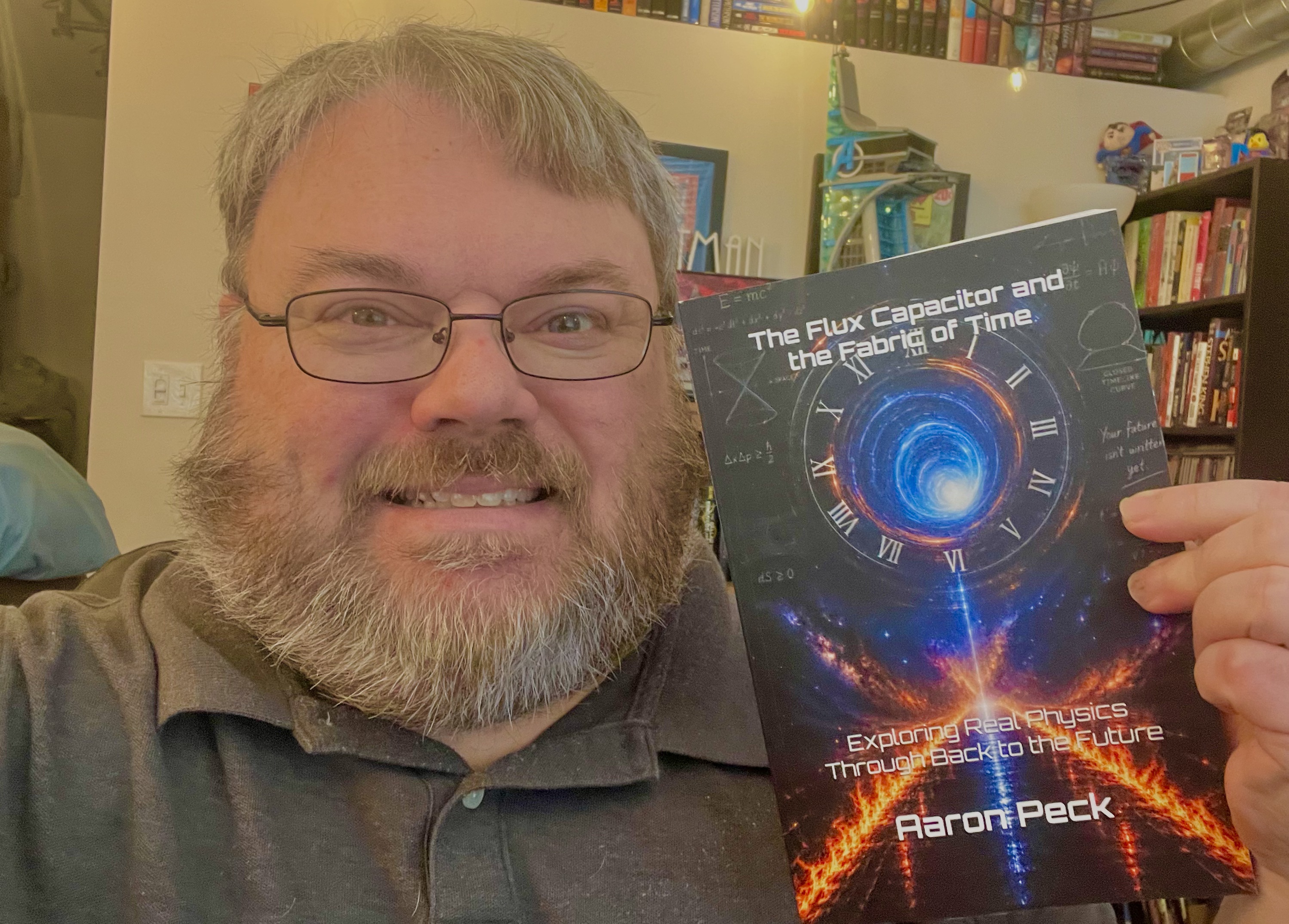
Questions like these are exactly what sent me down the rabbit hole that eventually became The Flux Capacitor and the Fabric of Time: Exploring Real Physics Through Back to the Future. The book uses the trilogy as a jumping-off point to explore relativity, wormholes, paradoxes, alternate timelines, the arrow of time, and even the philosophical questions raised by changing the past. If you’ve ever watched Marty McFly’s family fade out of a photograph and wondered whether any of that could actually happen, this one’s for you.
What do you think? Does the science behind time travel make the movies more fun for you, or does it take some of the magic away? Let me know in the comments.

