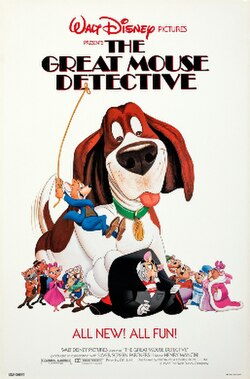
The Great Mouse Detective
1986
Directed by John Musker, Ron Clements, Dave Michener, and Burny Mattinson
Welcome back to Movie Monday. It’s the first Monday of the month, which means we’re taking our usual break from the cinematic bargain bin to spend some time with something I actually enjoy. And this month, we’re staying in the Disney neighborhood.
Last month I wrote about The Black Cauldron, a film that genuinely tried to be something bold and paid a serious price for it — critically, commercially, and institutionally. I made brief mention of the film that followed it. This month, I want to give that film its proper due, because The Great Mouse Detective is more than just the movie that came after the disaster. It’s the movie that kept the lights on.
Let me explain what I mean by that, but first — let me go back to being a kid for a minute.
Where I Come From on This One
I have genuine childhood nostalgia for The Great Mouse Detective. Not the complicated, retrospective kind that forms when you discover a movie in college and work backward to appreciate it — the real kind, rooted in actual memory. I saw this one as a kid, and I loved it as a kid, and watching it now I can still feel something of that original experience underneath everything I’ve learned since.
Part of what grabbed me then was the atmosphere. Even as a child, before I had any framework for what Victorian London was or why Sherlock Holmes mattered, the world of this film felt genuinely cool to me. Cobblestone streets, flickering gaslights, a mouse living in a tiny flat carved out beneath 221B Baker Street. The visual world of The Great Mouse Detective has a texture and a specificity that I responded to long before I was intellectually equipped to articulate why. I just knew it felt different. It felt real.
And then there was Ratigan.
I will come back to him at length, because he deserves it. But even as a kid, before I had any idea who Vincent Price was or what he meant to the history of horror and entertainment, I knew that the villain in this movie was something special. Something in that voice told me so.
The Film That Saved Disney
Here is the thing about The Great Mouse Detective that gets easy to overlook if you watch it in isolation: it arrived at a moment of genuine institutional crisis.
Disney’s 1985 animated feature The Black Cauldron had been a catastrophe by virtually every financial measure. It was the most expensive animated film the studio had ever produced, and it earned back roughly half of what it cost. The animation department was shuffled out of the main Burbank studio and relocated to a facility in Glendale. Leadership was rattled. The question of whether Disney’s animation department had a future — at least in the form it had always taken — was not an abstract one. People were asking it out loud.
The Great Mouse Detective had actually been in development during those same turbulent years, running on a parallel track. Based on the children’s book series Basil of Baker Street by Eve Titus, the project had been kicking around since the early 1980s. Ron Clements, who would later co-direct The Little Mermaid and Aladdin, had championed an adaptation of the books back in 1982 and pitched it to then-Disney president Ron Miller, who approved the project. The animators working on it were, by several accounts, using it as something of a refuge from the chaos surrounding The Black Cauldron — a place to work on something where the creative direction felt cleaner and more coherent.
The new Disney leadership that arrived in 1984 — CEO Michael Eisner and studio chairman Jeffrey Katzenberg — screened a story reel of the film and found it too slow. Eisner slashed the projected production budget in half, from $24 million down to $10 million, and moved the release date up to July 1986, giving the production team roughly one year to complete the film.
The title almost didn’t survive the transition either. After the 1985 Paramount film Young Sherlock Holmes underperformed at the box office, Eisner decided that the title Basil of Baker Street was, in his words, “too English,” and renamed it The Great Mouse Detective. This decision was so unpopular with the filmmakers that animator Ed Gombert wrote a satirical memo — allegedly from studio executive Peter Schneider — that retitled classic Disney films in the same flattened, generic spirit: Seven Little Men Help a Girl, The Wonderful Elephant Who Could Really Fly, Two Dogs Fall in Love. The memo reportedly made the rounds throughout the studio. Those fake titles later turned up as a category on Jeopardy!, which is perhaps the most specifically delightful footnote in this film’s production history.
What the team managed to accomplish with reduced resources and a compressed schedule is genuinely remarkable. The Great Mouse Detective opened on July 2, 1986, earned around $25 million domestically during its initial theatrical run, and — crucially — did so at a fraction of the budget that had sunk its predecessor. It wasn’t the highest-grossing film of the summer; it was outperformed by Don Bluth’s An American Tail, which arrived later in the year. But it was a profitable film made by a department that everyone had written off, and the new management at Disney looked at those numbers and gained something they badly needed: confidence that the animation department was worth keeping.
The film is widely credited as a pivotal reason the Disney Renaissance happened at all. Without The Great Mouse Detective demonstrating that the department could produce something commercially viable and creatively coherent on a modest budget, there may not have been the institutional will to greenlight The Little Mermaid three years later. And without The Little Mermaid, the entire trajectory of the studio through the 1990s looks very different. When people talk about The Great Mouse Detective as the film that saved Disney animation, they are not exaggerating for dramatic effect. The line from this movie to Beauty and the Beast and The Lion King runs through a series of choices that only got made because this film proved the department deserved another shot.
The World of Basil
What makes the film work as a film — separate from its historical significance — is that it commits fully to its world.
The premise is essentially Sherlock Holmes with mice, and the film leans into that without apology. Basil of Baker Street, voiced by Barrie Ingham, is clearly and deliberately modeled on Holmes: brilliant, arrogant, easily bored when not challenged, prone to dramatic deductions, and genuinely difficult to warm to until the moment you need him. His companion Dawson, voiced by Val Bettin, fills the Watson role with warmth and a kind of cheerful credulity that makes him easy to root for. The dynamic between them works because the film trusts it to work without over-explaining it.
The mystery itself — involving the kidnapping of a toymaker named Flaversham, his young daughter Olivia’s quest to find help, and a plot to overthrow the Mouse Queen by replacing her with a mechanical replica — is genuinely well-constructed. It moves. The film’s 74-minute runtime is not a limitation; it’s a precision instrument. Every scene is doing something, moving something forward, and the film never outstays its welcome.
The Big Ben climax is the production’s crowning achievement and has, rightfully, become the thing the film is most remembered for technically. Animators Phil Nibbelink and Tad Gielow designed the interior of the clock tower in extraordinary detail, with the massive gears rendered as wire-frame graphics generated by computer, printed out, and traced onto animation cels. It was among the first uses of computer-generated imagery in a Disney animated feature — the clock tower scene made extensive use of it — and the results still hold up today. The grinding gears create a kinetic menace that gives the final confrontation between Basil and Ratigan a genuinely dangerous feel. You believe something terrible could happen, and that belief is the engine that makes an action climax actually work.
The Voice That Makes the Movie
I said I would come back to Ratigan, and here we are.
Vincent Price was 75 years old when he voiced Professor Ratigan. He had already had one of the most distinctive careers in American entertainment — decades of horror films, a singular voice that was simultaneously theatrical and sinister, an unmistakable quality of intelligence and controlled menace. The animators arrived at him by watching a 1950 film called Champagne for Caesar, in which Price played a pompous, scheming villain with enormous style. They apparently knew within minutes of watching it that they had found their Ratigan.
Price himself, by multiple accounts, adored the role. He reportedly called Ratigan his favorite film performance, and you can hear why. The character is allowed to be funny, theatrically self-important, genuinely terrifying, and ultimately unhinged — and Price navigates all of those modes without losing the thread. The moment when Ratigan’s composure finally breaks, late in the film, and he becomes something feral and stripped of his civilized pretensions, is a quietly extraordinary piece of voice acting. You feel the mask come off.
Ratigan gets two original songs — “The World’s Greatest Criminal Mind” and “Goodbye So Soon” — both written by Henry Mancini, Larry Grossman, and Ellen Fitzhugh, and both performed by Price with the kind of commitment that suggests he understood exactly what kind of movie he was making and refused to give it anything less than everything. “The World’s Greatest Criminal Mind” in particular is a villain song that belongs in any serious conversation about the best of its genre. It is, among other things, genuinely fun.
There is a version of the discourse about Disney villains that overlooks Ratigan almost entirely because The Great Mouse Detective sits in an awkward place in the cultural memory — too recent to be a classic, too old to be a rediscovery, never quite landing in the mainstream conversation the way the Renaissance-era villains did. That’s a real oversight. Ratigan deserves to sit alongside Ursula and Gaston and Scar in any honest ranking. Price gives the character a weight and a theatrical intelligence that the film frankly could not have achieved with anyone else.
A Note on What It Gets from Its Source
Eve Titus’s Basil of Baker Street book series is, like the Lloyd Alexander novels behind The Black Cauldron, considerably deeper and richer than the film adaptation. Titus wrote six novels about Basil, and they develop the character and his world with more patience and complexity than a 74-minute film can accommodate.
But unlike the situation with The Black Cauldron — where the author famously found no resemblance between his books and the film — The Great Mouse Detective at least captures the spirit of Titus’s creation. The Sherlock Holmes homage, the Baker Street setting, the dynamic between Basil and Dawson, the essential good-heartedness underneath Basil’s difficult exterior: these feel true to what Titus was doing. The film is not the books, but it is recognizably related to them. If you love the movie, the books are genuinely worth finding.
What It Means, Looked Back On
Watching The Great Mouse Detective now, as an adult who has seen a lot of these movies and thought a lot about this period in the studio’s history, I find myself appreciating things that went right over my head as a kid. The visual sophistication. The genuine wit in the screenplay. The way the film uses Sherlock Holmes as a structural and tonal skeleton without ever feeling like a parody or a gimmick.
But I also still respond to the things that worked on me when I was young. The atmosphere. The mystery. That voice.
Some movies earn the nostalgia they inspire. The Great Mouse Detective is one of them.
Final Verdict
The Great Mouse Detective is a tightly constructed, atmospherically rich animated mystery that arrived precisely when Disney needed it most and delivered precisely what the studio needed. Vincent Price is extraordinary. The Big Ben climax is thrilling. Ratigan is one of the great underappreciated Disney villains. And the whole thing moves with an efficiency and confidence that makes you wish the films on either side of it in the Disney timeline had half its focus.
It saved the studio. Forty years later, it’s still worth watching.
Next Monday we return to the countdown, and the next entry is one I find almost uniquely baffling: the 2004 political comedy Welcome to Mooseport, starring Gene Hackman as a retired U.S. president who moves to a small Maine town and runs for mayor against a local hardware store owner played by Ray Romano. On paper, that sounds like it might just work. In practice, it is a film that takes two reasonably appealing performers, surrounds them with a capable supporting cast, and somehow produces something that feels like it was written by a committee that had never watched a comedy before. We’ll dig into it next week.
 The Confusing Middle