I was five years old the first time I saw Back to the Future, sitting in the back of my family’s car at a drive-in theater. I didn’t understand half of what was happening on screen. I definitely didn’t understand the science, or the lack of it, behind a souped-up DeLorean hitting 88 miles per hour. What I understood was that something extraordinary was happening, and that Marty McFly’s whole world had just tilted sideways.
I’ve watched that movie more times than I can count since then. I watched it as a kid who just wanted to see Doc Brown do something wild with electricity. I watched it as a teenager who started noticing how tightly the plot was constructed. And somewhere along the way, I started watching it as an adult who couldn’t stop asking a very different kind of question: is any of this real? Could time travel, in some form, actually work?
That question is where this book began. It didn’t start as a book. It started as curiosity, the same kind of curiosity that’s driven nearly every post I’ve ever written on this blog. But this time, the curiosity didn’t fade after a few Google searches. It kept growing. And eventually, it grew into something I couldn’t just think about anymore. I had to write it down.
The Question That Started It
Here’s the thing about Back to the Future: it’s not really a movie about time travel. Not deep down. It’s a movie about family, about legacy, about a kid trying to make sure his parents fall in love so he still gets to exist. The time travel is the engine, but it’s never really the point.
Except I couldn’t stop thinking about the engine.
Could time travel ever actually work, even in theory? Why does a trilogy from the 1980s still spark serious conversations about physics decades later? What did Robert Zemeckis and his team get right, whether they meant to or not, and what did they invent purely for the sake of a good story? And maybe the question that hooked me hardest: did Doc Brown, in his manic, chalkboard-scribbling way, occasionally end up brushing against real scientific ideas without fully realizing it?
The more I dug into the actual physics, the more fascinating those questions became. I started reading about relativity, about the strange behavior of time near the speed of light, about theoretical constructs like wormholes and closed timelike curves. None of it made time travel simple. If anything, it made the whole idea more complicated and more interesting than the movies ever let on. But every rabbit hole I fell into somehow led back to Hill Valley, back to that flux capacitor, back to the same question: what if a goofy inventor and his teenage friend had accidentally stumbled onto something real?
What surprised me most was how often the research and the movie ended up in conversation with each other, even when they clearly weren’t trying to be. I’d read something about how physicists think about time as a dimension rather than a river we move through, and I’d immediately think of Doc Brown’s chalkboard diagrams, all those loops and branches meant to explain why 1985A wasn’t the same as the 1985 Marty left behind. I’d read about the theoretical requirements for something like a wormhole, the sheer scale of exotic energy it would take, and I’d think about how casually the trilogy treats time travel once the DeLorean is built, like the hardest part is already behind us. That gap between “here’s what it would actually take” and “here’s how the movie handles it” turned out to be one of the most interesting parts of the whole project.
I also started noticing how much of my own thinking about the films had changed simply because I’d started asking better questions. I’d always loved Back to the Future as a story about family and second chances. I still do. But once I started treating the time travel itself as worth taking seriously, the movie opened up in a way I hadn’t expected. It stopped being just a nostalgic favorite and started being a genuine entry point into ideas I never would have gone looking for on my own.
That tension between “this is fiction” and “this actually connects to real science” is what kept pulling me forward. It’s also exactly what I wanted to write about.
What This Book Is (and Isn’t)
Before I say anything else, I want to be clear about what this book is not, because I think it matters just as much as what it is.
This isn’t a scene-by-scene recap of the trilogy. If you want a plot summary, you can rewatch the movies. This isn’t an encyclopedia either. I didn’t set out to catalog every gadget, every callback, every Easter egg hidden in three films. And it isn’t a trivia collection. There are already plenty of lists out there ranking the best one-liners and counting how many times someone says “Great Scott.”
What this book is, instead, is a conversation. It’s accessible. It’s written the way I’d actually talk to you about this stuff if we were sitting across from each other with coffee, not the way a physics textbook talks to you. It’s built for fans first, people who already love these movies and want to go a layer deeper, not for people trying to cram for an exam. And it’s grounded in real science, but never at the expense of readability. I wasn’t interested in writing something that only makes sense to people with a physics degree.
You don’t need a degree in physics to enjoy this book. If you’ve ever wondered whether Doc Brown was accidentally asking real scientific questions, this book is for you. That’s really the whole pitch.
I tried to write the kind of book I would have wanted to find myself, years ago, when I first started asking these questions and had no idea where to look. Most of what’s out there tends to fall into one of two extremes: either it’s dense, academic physics writing that assumes you already know the math, or it’s fan content that stays entirely on the surface and never engages with the science at all. I wanted something in between. Something that respects your intelligence without requiring a background in theoretical physics, and something that respects the movies without treating them as sacred texts that can’t be questioned or teased apart.
What Readers Will Find
I’m not going to walk through every chapter here. Half the fun of a book like this is discovering where it takes you, and I’d rather protect that than spoil it. But I can tell you the kinds of ideas you’ll run into along the way.
You’ll find relativity, and what it actually says about time not being as fixed as we tend to assume. You’ll find wormholes, and the strange, speculative physics around whether shortcuts through spacetime could ever exist outside of theory. You’ll find a serious look at alternate timelines, and how the trilogy’s own internal logic around parallel versions of Hill Valley lines up with real scientific thought experiments. You’ll run into the grandfather paradox, which is probably the single most famous time travel puzzle there is, and which the movies handle in a way that’s more clever than most people give it credit for.
You’ll also find something that isn’t strictly physics at all: the ethics of changing history. Even if time travel were possible, should anyone actually do it? What does Marty’s meddling with his parents’ love story say about the responsibility that comes with that kind of power? And underneath all of it, you’ll find an attempt to answer why a movie from 1985 still resonates the way it does, why people who weren’t even alive when it came out still quote it, still debate it, still watch it on loop.
I also tried to leave room for the smaller, stranger questions that don’t always make it into more academic treatments of the subject. Why does Marty fading from that photograph work the way it does, and what would it actually mean for cause and effect if it did? Why does the trilogy insist on treating some changes to the timeline as catastrophic and others as barely worth mentioning? Those are the kinds of questions that don’t have neat answers, but chasing them is exactly what made writing this book so much fun.
I wanted the book to feel like following a thread. You start with a simple question about a flying, time-traveling car, and you end up somewhere much bigger than you expected. Along the way, I tried to keep the tone light even when the ideas got heavy, because that’s the balance the movies themselves always struck so well.
Why I Wrote It
If you’ve read this blog for any length of time, you already know I have a weakness for stories that make people think, and that I’ve never been able to look at pop culture as just surface-level entertainment. That’s basically been the whole mission of The Confusing Middle since I started it. Whether I’m rewatching Smallville episode by episode or picking apart a fictional character’s psychology, the goal has always been the same: take something people love and ask why it works, why it matters, why it sticks.
This book simply gave me room to go deeper than a blog post ever could. A blog post can ask “could time travel work?” and give you a satisfying answer in a few paragraphs. A book can actually sit with that question. It can wander into relativity and wormholes and paradoxes and ethics without needing to wrap everything up in a tidy bow by the end. Writing it felt less like starting something new and more like finally having enough space to finish a conversation I’ve been having with myself since I was five years old in the back seat of that car at the drive-in.
There’s also something I’ve come to believe pretty firmly after years of writing about movies, shows, and characters on this blog: fandom is a legitimate way to think seriously about the world. Loving something doesn’t disqualify you from examining it closely. If anything, love is usually what gets people to look closer in the first place. Nobody spends years thinking about the grandfather paradox because they’re indifferent to Back to the Future. They do it because they care enough to keep asking questions long after the credits roll.
That belief is really the backbone of everything I write here, whether it’s a Movie Monday post about a film I didn’t enjoy or a Character Couch breakdown of someone else’s favorite fictional villain. This book is the biggest expression of that belief I’ve ever put together, and it’s the first time I’ve had an entire book’s worth of space to follow one piece of pop culture as far as the questions would take me.
The Announcement
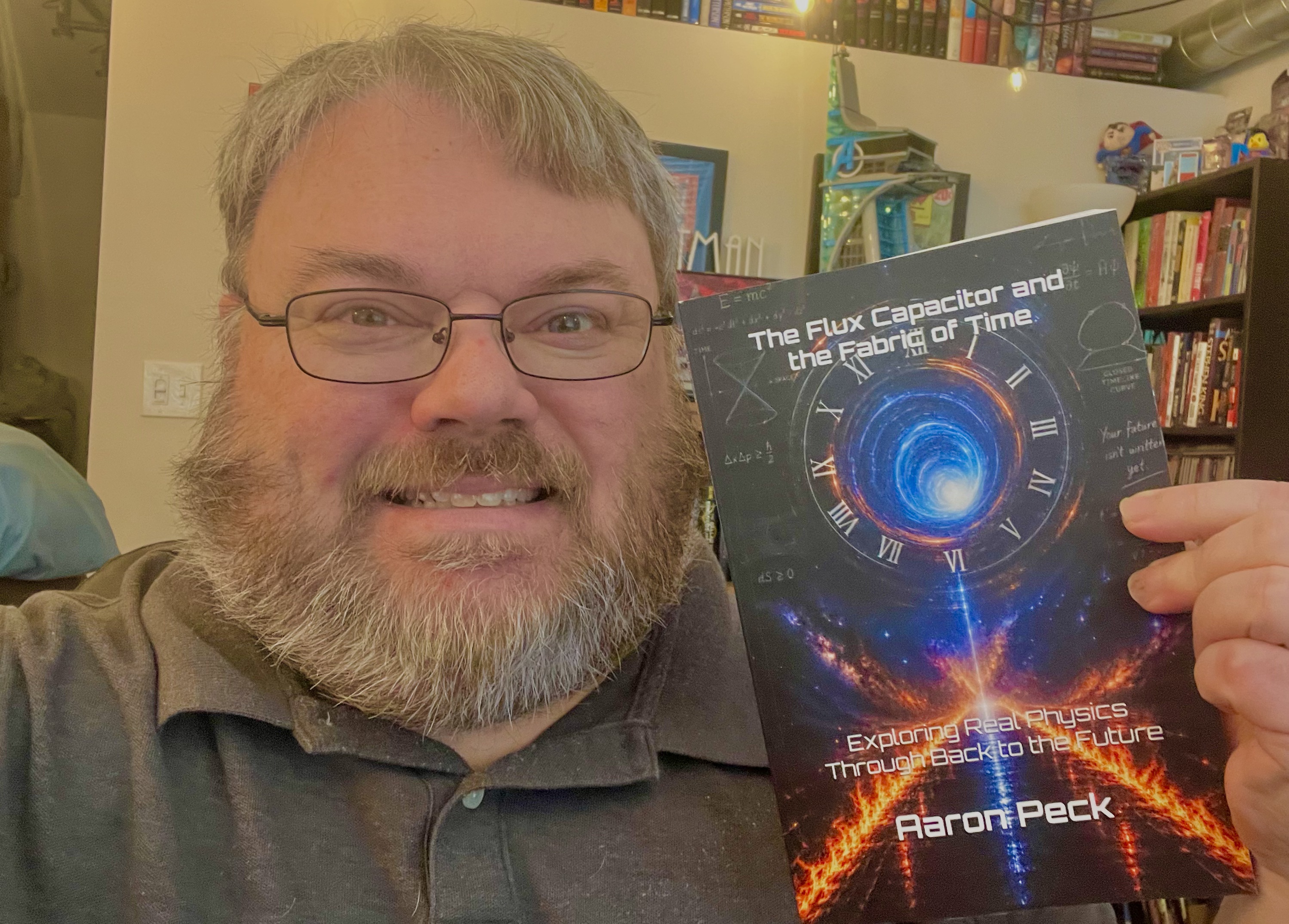
I’m excited to say that The Flux Capacitor and the Fabric of Time: Exploring Real Physics Through Back to the Future is now available on Amazon.
It’s out now in both paperback and Kindle editions. You can find it here:
The Flux Capacitor and the Fabric of Time
If you’ve ever debated the finer points of the grandfather paradox with a friend, or wondered whether Doc Brown was onto something, I hope you’ll give it a read.
Closing
Whether you’ve been reading The Confusing Middle for years or you’ve just discovered it recently, thank you for taking this journey with me. I hope this book makes you laugh, think, and maybe even look at one of cinema’s greatest adventures in a completely new way.
I’d love to hear from you: what’s the question about Back to the Future that’s stuck with you the longest? Drop it in the comments. I have a feeling I’m not the only one who’s been thinking about this since childhood.
 The Confusing Middle
Congratulations on publishing!
LikeLiked by 1 person
Thank you!
LikeLike