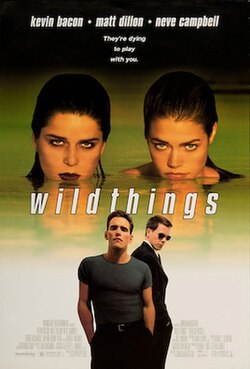
Wild Things
1998
Directed by John McNaughton
Welcome back to Movie Monday. The standard disclaimer applies before we go any further: everything below is my own opinion, shaped by my own particular experience with this film, and none of it is meant as a criticism of anyone who genuinely loves Wild Things. Maybe it holds a cherished place in your late-90s memories. Maybe you appreciated it on a level I simply couldn’t reach. That is entirely valid, and I am not here to take it from you.
What I am here to do is talk about a film that mistakes relentlessness for cleverness, treats its audience like puzzle-solvers rather than viewers, and somehow convinced an impressive collection of talented people to spend a summer in the Florida Everglades making something that feels less like a movie and more like a dare.
I did not see Wild Things in theaters. I caught it on cable somewhere in the early 2000s, the way you inevitably caught everything in that era… flipping channels late at night, landing in the middle of something you couldn’t quite identify for the first few minutes, and then staying because you didn’t know what else to do. By the time I had assembled the full picture across a couple of viewings, I had an opinion. That opinion has not improved with time.
What You Are Getting Into
Wild Things is a 1998 erotic thriller directed by John McNaughton, the Chicago-based filmmaker best known for the disturbing independent horror film Henry: Portrait of a Serial Killer, which he completed in 1986. McNaughton has spoken candidly about his motivation for making Wild Things. He needed a commercial hit, he liked the script, and he reasoned that sex and violence sell. That self-awareness is at least refreshingly honest.
The film was written by Stephen Peters and produced by Mandalay Entertainment for Columbia Pictures. It was released on March 20, 1998, on a budget of $20 million and ultimately grossed $67.2 million worldwide, which makes it a genuine box office success and one of the more commercially prosperous films on this list. Money does not equal quality. We have established this before.
The story is set in the fictional upscale Miami suburb of Blue Bay, Florida. Sam Lombardo, played by Matt Dillon, is a popular high school guidance counselor who becomes the target of rape accusations from two students: Kelly Van Ryan, a wealthy cheerleader played by Denise Richards, and Suzie Toller, a troubled outcast from the Everglades played by Neve Campbell. Kevin Bacon plays Ray Duquette, a detective who suspects something is wrong with the whole situation and keeps investigating despite being repeatedly told to drop it. Bill Murray appears as Kenneth Bowden, Lombardo’s attorney, and functions primarily as comic relief, though he does more with his limited screen time than most of the principals manage with considerably more.
The cast also includes Theresa Russell as Kelly’s vindictive, wealthy mother Sandra, and Robert Wagner as Sandra’s attorney. There are layers here. There are always more layers.
On Rotten Tomatoes, the film holds a 64% approval rating. At CinemaScore, audiences gave it a “C+,” which is the kind of grade that suggests people walked out confused about whether they had a good time. Roger Ebert gave it three stars and called it “lurid trash” with a plot “so twisted they’re still explaining it during the closing titles…” and he meant that as a recommendation, which tells you something about how this film positions itself. The Metacritic score sits at 51, indicating mixed or average reviews across the critical board.
The Twist Economy
Here is the central problem with Wild Things, and there is no delicate way to say it: the film has so many plot twists that they cancel each other out.
The first twist is that Kelly and Suzie fabricated their accusations as part of a scheme with Lombardo to extort money from Kelly’s wealthy mother. That is a legitimately interesting revelation. In a better film, that twist lands, the story breathes for a moment, and then moves into its third act with the audience recalibrated.
Wild Things does not do that. Instead, it keeps going. And going. And going. Somebody kills somebody else and it turns out they were working with a third party who was actually working against a fourth party who has been running the whole operation all along. The closing credits include additional scene vignettes continuing to explain how various elements fit together, as if the movie looked up at the end and realized it still had unfinished business.
There is a version of this structure that works. Chinatown works. The Usual Suspects works. What those films understand is that a great twist recontextualizes everything you have already seen. It makes the story richer in retrospect. Wild Things‘s twists do not recontextualize the story… they replace it. By the time the film arrives at its actual ending, the character you’ve been following has been killed, the character you assumed was the villain has also been killed, and someone you barely noticed has sailed away on a yacht with all the money. The movie doesn’t earn that ending. It just announces it.
The credits-sequence reveals compound the problem rather than resolve it. When a film has to keep explaining itself after it’s over, that is not intrigue. That is the screenplay asking for extra credit because it ran out of time.
The Tonal Whiplash Problem
Wild Things cannot make up its mind what it wants to be, and it never resolves the confusion.
There are stretches that play as genuine thriller, well-paced and atmospheric. McNaughton knows how to frame the Florida landscape… the swamps, the humidity, the particular kind of privilege dripping off every surface of Blue Bay… and he uses it. The film looks good. It is genuinely well-shot.
And then Bill Murray shows up in a neck brace and starts doing physical comedy.
That is not a complaint about Murray, who is, as noted, the best thing in the movie. It is a complaint about a film that wants to be a serious erotic thriller and a campy B-movie simultaneously, without ever committing to either. When you are playing two tones at once, neither one lands with full force. The suspense is undercut by the absurdity. The comedy cannot breathe because it keeps bumping into scenes of genuine menace. Everything exists in an uncomfortable middle register where you’re never quite sure if you’re supposed to laugh, be disturbed, or just sit there waiting for the next revelation.
Erotic thrillers are a specific genre with specific genre rules. Basic Instinct commits to its excess. Body Heat commits to its atmosphere. Wild Things wants the excess and the atmosphere and the laughs and the tragedy and the social commentary, and in trying to have everything, it ends up not quite having any of it.
The Cast, Fairly Assessed
The cast is worth addressing honestly, because it is frequently cited as one of the film’s selling points and the reality is more complicated than that.
Neve Campbell is the best straight actor in the movie, which is both a genuine compliment and a faint one given the competition. She was coming off back-to-back years of Scream and Party of Five, one of the more grueling simultaneous career demands you can imagine, and she takes the role of Suzie seriously in a way the screenplay barely earns. Her character is ultimately revealed to be the architect of the entire scheme, which makes her performance in retrospect more interesting than it seems on first viewing. She is doing real work beneath the surface of a character the film treats as an afterthought for most of its runtime.
Denise Richards is not well-served by the material. The character of Kelly Van Ryan is written as a vehicle for spectacle rather than a person, and Richards is not given much to work with beyond the surface. She is not bad so much as stranded.
Matt Dillon plays Sam Lombardo as smug and evasive throughout, which is the correct reading of the character in retrospect but makes him largely unpleasant company for most of the film’s running time. He is technically doing the right thing and it still doesn’t make the experience more enjoyable.
Kevin Bacon works harder than anyone here and deserves acknowledgment for it. His detective has the most complicated arc in the film once the full picture emerges, and Bacon commits to it without winking at the audience. He also famously appears in a brief moment of full-frontal nudity, something he has said he didn’t give much thought to at the time and was subsequently surprised to be asked about so frequently at American press screenings. European press, he noted, did not ask at all. The cultural footnote writes itself.
And then there’s Bill Murray. Murray’s attorney Kenneth Bowden is in the film for perhaps fifteen total minutes, and in those fifteen minutes he steals every scene, lands every joke, and makes you wish the whole movie had been about him instead. The best scene in Wild Things involves Bowden negotiating a settlement while clearly enjoying himself far more than anyone else involved. That this performance also helped him win the Los Angeles Film Critics Association Award for Best Supporting Actor feels appropriate. He found something worthwhile and made the most of it.
What Actually Works (A Short List)
In the spirit of fairness that this series has always tried to maintain:
McNaughton’s direction is stylistically confident. Whatever problems exist at the screenplay level, the film does not look like a cheap production and does not direct like one. He understands how to build and release tension within individual scenes even when the larger architecture is falling apart around him.
The Florida setting is used well. Blue Bay feels like a specific place with a specific class structure and a specific humidity, and that specificity gives the film a texture it might otherwise lack.
Murray. Always Murray.
And the core premise, that a case which seems straightforward is actually a deliberate construction involving parties you didn’t expect, is not without merit. The failure is in the execution, not the concept. A tighter script, with two twists instead of seven, could have made something of this material. The bones are there. They are just buried under too many other bones.
Number 17 on the List
Wild Things is not without its admirers, and I understand what they see in it. There is a camp appeal to a film that commits this thoroughly to its own excess. Roger Ebert was not wrong that there is something to appreciate in a movie that swings this hard at lurid entertainment and largely connects, at least on the surface level.
But I am not a camp-appeal person, and I cannot get past the fundamental problem at the movie’s center: a film that keeps twisting until it has twisted itself into incoherence, wrapped in a tonal uncertainty that prevents any single element from landing with full impact. It is a movie that mistakes complexity for depth and volume for weight.
Suzie sailed off into the sunset with all the money. The movie told us so, at the end of a closing-credits explainer that kept going long after I needed it to stop.
Somewhere out in the Caribbean, she is probably fine.
The film is not.
Next Time on Movie Monday
We’re taking our regular first-of-the-month break from the worst list, and honestly, this particular break could not come at a better time. Next week we’re trading Florida swamps and double-crosses for Victorian London and a much smaller class of protagonists… specifically, mice.
The monthly Disney Animated Classics series continues with The Great Mouse Detective, the 1986 film that gave us Basil of Baker Street, Professor Ratigan voiced by the legendary Vincent Price, and a climax set inside the clock tower of Big Ben that is genuinely thrilling even by non-animated-rodent standards. It is also a film with a fascinating backstory about how close it came to never happening, and what its success ultimately meant for the future of Disney animation as a whole. Come for the deerstalker cap. Stay for Vincent Price being magnificently, operatically evil.
Elementary, my dear reader.

