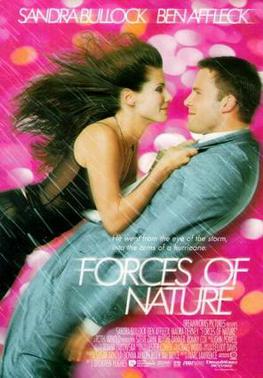
Forces of Nature
1999
Directed by Bronwen Hughes
Welcome back to Movie Monday. Before we get into it, the standard disclaimer applies: everything below is purely my own opinion, filtered through my own particular experience with this film, and none of it is meant as a criticism of anyone who genuinely loves Forces of Nature. Maybe you saw it on a first date. Maybe it holds a warm place in your memory for reasons that have nothing to do with its Rotten Tomatoes score. Your connection to this movie is valid and I am not here to take it from you.
What I am here to do is talk about a film that had one genuinely interesting idea — possibly the most subversive ending a mainstream romantic comedy had attempted in years — and then fumbled it so completely that the whole enterprise collapses under the weight of its own missed opportunity.
I did not see Forces of Nature in theaters. I caught it later on TBS, somewhere in the stretch of the early 2000s when that channel appeared to own the rights to this film outright and was legally required to air it approximately four times a week for six months. You know how that goes. You flip past it, catch twenty minutes in the middle, flip away. Then you catch the last half hour the next time. Eventually you’ve assembled the whole movie in random order and feel strangely qualified to have opinions about it. That is my relationship with Forces of Nature. Consider yourself warned.
What You Are Getting Into
Forces of Nature is a 1999 romantic comedy produced by DreamWorks Pictures and directed by Bronwen Hughes, whose previous film was the 1996 family adaptation Harriet the Spy. The screenplay was written by Marc Lawrence. The film stars Ben Affleck as Ben Holmes, a writer whose actual job title is, and I promise I am not making this up, “book-jacket blurbologist” — a professional writer of the short summaries on the back of hardcover books — who is trying to get from New York City to Savannah, Georgia in time for his own wedding.
At the airport, he meets Sarah Lewis, played by Sandra Bullock, a free-spirited drifter with a complicated past, two previous marriages, and an estranged son she is trying to reconnect with. When a bird flies into the plane’s engine on the runway and grounds all subsequent flights due to an approaching hurricane, the two are thrown together for a road trip full of escalating misadventures… an arrest involving a fellow passenger and marijuana, a train that splits and sends them toward Chicago instead of Georgia, a fire at a bank, and a detour into a gay bar where Ben has to do a strip dance to fund a car purchase. The obstacles keep coming.
Ben’s fiancée is Bridget Cahill, played by Maura Tierney. Steve Zahn plays Alan, Ben’s best man. Blythe Danner and Ronny Cox appear as Bridget’s parents. The film opened in US theaters on March 19, 1999 on a budget of $75 million and grossed approximately $93.9 million worldwide… which sounds like a success until you remember that most studios consider a film to need roughly two and a half times its production budget to actually turn a profit. Forces of Nature finished its theatrical run in the red.
On Rotten Tomatoes, it holds a 46% approval rating based on 67 reviews, with a critics consensus noting a lack of chemistry between the leads and a screwball sensibility that overreaches its own ambitions. The audience score at CinemaScore landed at a “B−,” which is the kind of grade that tells you the people who paid to see it walked out mildly disappointed but not quite angry enough to demand a refund.
The Ending Is the Whole Problem (And the Whole Point)
Here’s the thing about Forces of Nature that I want to get to immediately, because it’s the thing that makes this movie simultaneously more interesting and more frustrating than it has any right to be.
Ben Holmes does not end up with Sarah.
At the end of this film, after nearly two hours of disaster and growing attraction and near-kisses and all the machinery the romantic comedy genre exists to deploy, Ben runs through a hurricane to find Bridget, realizes he loves her and wants to spend his life with her, and marries her in Hawaii. Sarah quietly watches their reunion from a distance and leaves. The closing voiceover has Ben expressing a hope that she has found happiness somewhere out there in the world.
That is an extraordinary choice. In 1999, in a mainstream DreamWorks release with two of the most likeable stars in Hollywood, the movie ends with the protagonist choosing his original fiancée. The free-spirited woman he has clearly been falling for the entire runtime watches from a doorway and then disappears. She does not get him. She does not get a consolation ending either, really… just a hope from a man who barely knows her that life works out.
In a genuinely bold film, that ending could have been something. It could have been a sincere argument that infatuation is not love, that adventure is not a reason to blow up your life, that the person waiting at the altar might actually be the right person. It could have allowed both characters, Ben and Sarah, to be complicated and sympathetic and real. It could have done something the genre almost never does, which is treat commitment as a worthy conclusion rather than a consolation prize for the boring choice.
Instead, Forces of Nature uses that ending as a surprise and then does not know what to do with it. The film spends its entire runtime building the case for Ben and Sarah. It gives them the banter. It gives them the shared disasters. It gives them the almost-kiss in the hotel room. It manufactures every mechanism the genre uses to tell you these two belong together. And then it pulls the rug out, not as a meaningful statement about love or choice or human nature, but because the script apparently decided that a twist was more interesting than a theme.
The result is a film that feels like it has spent two hours arguing one thing and then concludes the opposite, without doing the work required to earn the reversal. You walk away not moved, not challenged, not surprised in any way that sticks. You walk away confused about what the movie thought it was saying. More importantly, confused about why you should have cared about any of it.
The Chemistry Problem
It’s worth being fair here: the film’s critical consensus focused heavily on the lack of chemistry between Affleck and Bullock, and I think that assessment is only partially correct.
Sandra Bullock is doing real work in this movie. The role of Sarah Lewis is not a small one… she is required to be charming and sad and self-destructive and warm and guarded all at once, and Bullock handles all of those registers more capably than the script deserves. The scene where Sarah explains that the money from the bagel shop sale is going to her son, to try to rebuild a relationship she damaged, is the closest the film gets to genuine feeling. It works because Bullock plays it quietly, without reaching for the emotion. She earns it.
Affleck, in contrast, is less comfortable. The character of Ben Holmes is written as anxious and reactive, a man to whom things keep happening, and Affleck spends much of the runtime looking appropriately alarmed without generating the warmth the story needs him to have. In 1999, Affleck was still sorting out what kind of leading man he was. He had won the Academy Award for Best Original Screenplay alongside Matt Damon for Good Will Hunting in 1997, and had just come off the massive commercial success of Armageddon in 1998. Forces of Nature came at a moment when he was being positioned as a romantic lead, and it is fair to say the evidence here suggests the positioning was premature. He is not bad in the movie. He is simply not present enough to anchor it.
The chemistry issue is real, but it might be less about Bullock and Affleck specifically and more about the fact that the film cannot commit to what kind of relationship these two people are supposed to have. If the movie secretly knew all along that Ben was going to choose Bridget, it should have written Ben and Sarah’s dynamic accordingly… two people who bring out something genuine in each other without it quite becoming love. Instead, it wrote them as a romantic pair and then changed its mind at the end, which leaves every scene between them feeling slightly off-register in retrospect.
The Chaos Problem
The other significant issue with Forces of Nature is that it mistakes accumulation for escalation.
The misadventures in this film pile on top of each other with such relentless efficiency that they start to lose any individual weight somewhere around the third or fourth obstacle. The arrest. The wrong train. The bank fire. The retiree bus. The gay bar. Each one is introduced, resolved, and replaced by the next without the story breathing between them or allowing the characters any room to actually respond to what is happening to them. It is the screwball comedy approach, and it can work… but screwball comedy depends on character reactions being funnier than the situations themselves. When the reactions are just variations on Ben looking stressed and Sarah looking unruffled, the formula gets thin quickly.
There’s also a structural problem in that most of the chaos happens to Ben specifically and Sarah merely observes it. She is the source of several disasters but does not seem particularly affected by any of them. The film treats her equanimity as a character trait… she is free-spirited, she rolls with things… but it has the side effect of making her feel like a plot device in her own story. Sarah spends much of the film facilitating Ben’s adventure rather than having her own, which is a strange choice given that she is the more interesting character on paper.
What Actually Works
I want to be honest here, because fairness is what this list has always called for.
Bullock is genuinely good. Whatever the film’s structural problems, she gives it a center it would not otherwise have. The moments that land… and there are a few… land almost entirely because of her. The bagel shop scene. The hotel room scene where the near-kiss stops and both characters stand there in the aftermath knowing what almost happened. These work.
Steve Zahn is reliably entertaining in a supporting role as Alan, Ben’s best man, which is basically what Steve Zahn was in 1999… reliable, funny, worth more than his screen time suggested.
And the premise itself, as I said, is not uninteresting. A road trip film built around escalating disasters is a reasonable scaffolding for a romantic comedy. The question is always what you put on the scaffolding. Forces of Nature had the bones of something moderately better than itself.
The ending, even as it fails, shows ambition. That matters. A film that reaches for something and misses is at least reaching. Forces of Nature is not content to be entirely ordinary. It just isn’t skillful enough to be the extraordinary thing it was apparently trying to become.
Number 18 on the List
Forces of Nature is not the worst movie I have ever sat through. It’s not even close. It’s a film that is largely competent, watchable, and populated by people who are trying their best with the material they were given. What earns it a spot on this list is not badness in the traditional sense. It is something more specifically frustrating: the feeling of watching a movie talk itself out of its own best idea.
That ending could have been meaningful. Instead, it’s just an ending. And somewhere in the gap between those two things is exactly why this film sits at number 18 and not, say, on your comfort watch rotation.
Somewhere out there, Sarah has found happiness. The movie told us so.
I hope it also found a second draft.
Next Time on Movie Monday
We are leaving the world of chaotic road trips and heading somewhere considerably murkier for number 17 on the list: Wild Things, the 1998 erotic thriller directed by John McNaughton, starring Matt Dillon, Kevin Bacon, Neve Campbell, and Denise Richards. If Forces of Nature had trouble committing to its ending, Wild Things went in the opposite direction entirely… it has so many endings it practically laps itself. Come for the Florida swamps and the plot twists. Stay because, honestly, you will not see the next one coming. Or the one after that. Or the one after that.
Blue Bay, Florida is waiting. Bring your waders.

