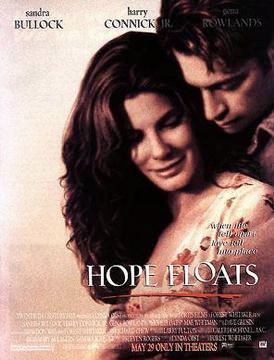
Hope Floats
1998
Directed by Forest Whitaker
Welcome back to Movie Monday. Before we dive in, the usual disclaimer applies: everything that follows is my own opinion, shaped entirely by my own experience with this film, and none of it is meant as a criticism of anyone who watched Hope Floats and genuinely loved it. I know people who do. I know people who will defend it, who have it on their comfort watch rotation, who tear up every time Bernice chases that car down the driveway. Your card in the fan club is valid and I respect it. We’re good? Good.
Because I have some things to say about Sandra Bullock and a sympathy card.
What You Are Getting Into
In case it has been a while: Hope Floats is a 1998 romantic drama directed by Forest Whitaker — yes, that Forest Whitaker, the Oscar-winning actor who has also quietly built a modest directorial career alongside his acting work, including Waiting to Exhale in 1995 and First Daughter in 2004. The screenplay was written by Steven Rogers, and the film was released by 20th Century Fox in May of 1998.
Sandra Bullock plays Birdee Pruitt, a former beauty queen and high school sweetheart who is publicly humiliated at the top of the film when she appears on a daytime talk show expecting a makeover and instead discovers that her husband Bill has been having an affair with her best friend. In front of a live audience and the national viewing public. It is a brutal opening scene, and the film earns it — the specific cruelty of being ambushed on television by two people you trusted is genuinely awful, and Bullock sells the stunned, dismantling shame of it with real skill.
Birdee packs up her young daughter Bernice, played by Mae Whitman — then nine years old, already a veteran of Independence Day and One Fine Day, and doing some of the best work in this entire movie — and retreats to Smithville, Texas, where her mother Ramona (Gena Rowlands) still lives in the house Birdee grew up in. There she encounters the particular cruelty of a small town that watched her fall from grace on national television and has decided, collectively, to enjoy it. And there she also re-encounters Justin Matisse, played by Harry Connick Jr., an old friend who is clearly in love with her and has been waiting approximately her entire adult life to say so out loud.
The film, from that point forward, is about whether Birdee will let herself be loved again.
That is the movie. That is the whole movie.
The Problem Is Not the Premise
Let me say clearly: there is nothing wrong with that premise, in theory. The story of a woman rebuilding herself after public betrayal and humiliation — rediscovering her identity, her community, her capacity for love — is a story worth telling. The pieces are all present. Bullock is capable. Whitman is remarkable. Gena Rowlands is playing the kind of warm, eccentric mother that Gena Rowlands could play in her sleep and still make you feel something genuine. Harry Connick Jr. is charming in the way that Harry Connick Jr. has always been charming, which is to say effortlessly and with good teeth.
None of that is the problem.
The problem is that Hope Floats takes that premise and does almost nothing interesting with it. It treats the story as if simply putting the pieces in the right order is the same as actually telling the story. We watch Birdee come back to Smithville. We watch her struggle to find work. We watch Bernice act out. We watch Justin wait patiently. We watch Ramona be eccentric and loving and eventually, in the film’s sharpest gut-punch, die of a sudden heart attack. And then we watch it all resolve.
What we do not watch is Birdee actually grapple with any of it at a level the film seems willing to commit to. There is real pain threaded through the first act — the humiliation, the daughter’s barely concealed fury, the weight of returning home having failed by everyone’s measure including her own — and the film keeps gesturing at that pain without ever sitting in it long enough to let it mean something. Roger Ebert described it as “a turgid melodrama with the emotional range of a sympathy card,” and while that might feel harsh, it is not wrong. Hope Floats knows how grief is supposed to look. It is considerably less certain about how grief actually feels.
The Bernice Problem (Which Is Also the Film’s Best Argument)
Here is the frustrating thing: the subplot that works best in Hope Floats is the one about the child.
Mae Whitman’s Bernice is the most emotionally honest presence in the entire film. She is furious and desperate and heartbreaking in the way that children of divorce can be, and the scene in which she chases her father’s car down the street, suitcase in hand, refusing to accept that he is leaving without her — and then being left anyway — is the kind of scene that would land in a considerably better movie and be remembered for decades. It lands here too. It is the film’s one moment of genuine, unguarded pain, and it works because Whitman does not soften it or signal to the audience that it will be okay.
The problem is that this subplot — the daughter who desperately wants her father, who sabotages her mother’s new relationship because she cannot accept the permanence of the loss, who has to grieve her father while he is still alive — is more interesting than the main plot. Birdee’s journey from wounded to whole is the A-story, and it gets all the screen time, but it is the B-story of a nine-year-old processing abandonment that carries actual weight.
A sharper film would have recognized this and adjusted accordingly. Hope Floats keeps Bernice in the supporting role the genre requires and sends her toward a tidy resolution alongside everything else.
The Justin Problem
Harry Connick Jr. is fine in this movie. I want to say that plainly, because what I am about to say next might sound like criticism of him and it is not. He is warm. He is charming. He is patient in the way that romantic leads in films like this are required to be patient, which is to say almost supernaturally so. Justin Matisse has been waiting for Birdee his entire adult life and he will wait as long as it takes because that is what the script has decided he does.
That patience is, unfortunately, the character’s entire personality.
Justin has no interior life that the film has any interest in exploring. He exists in relation to Birdee — to wait for her, to pursue her gently, to be there when she is finally ready. What does he want when Birdee is not in the frame? What does he fear? What history has he accumulated in the years since high school? The film does not know, and more importantly, the film does not care. He is the answer to the question the story is asking — Will Birdee love again? — and once you understand that function, you have understood everything the script intends for him.
Connick brings more warmth to the role than the material deserves, which is a skill. But there is only so much a performer can do when the screenplay has decided that supporting characters exist purely to illuminate the lead.
Gena Rowlands Deserved a Different Movie
Gena Rowlands is wonderful in this film, and she knows she is in a lesser one.
Rowlands had been delivering extraordinary performances for decades by the time Hope Floats came along — John Cassavetes cast her in A Woman Under the Influence in 1974, and her career includes a filmography that makes a movie like this feel like an unusual detour. But she commits entirely to Ramona, who is warm and eccentric and full of the kind of folksy wisdom that supporting mothers in Southern-set films are required to dispense at regular intervals.
When Ramona dies — suddenly, and without the film quite earning the weight it needs that scene to carry — the movie loses its most interesting energy. The loss is real within the film, and Bullock responds to it with genuine feeling. But there is a nagging sense that the film brought Gena Rowlands in to do something specific and then could not quite decide what that something was.
The Smithville Question
One thing Hope Floats does that genuinely puzzles me is the way it handles the town’s hostility toward Birdee.
The premise requires that Smithville’s residents take some pleasure in Birdee’s fall from grace — she was the queen bee, the beauty queen, the girl who got out, and now she is back and humiliated and the town’s delight in this has to motivate some of her struggle. That’s fair. That’s how small towns can work. The critics noticed it too — reviewers at the time pointed out that the townspeople’s cruelty strains credulity when you’re watching Sandra Bullock play the character, because it is genuinely difficult to imagine people disliking this particular version of Birdee so intensely that they cannot find any sympathy for what she has been through.
The film wants to have it both ways: Birdee must be the outsider in her own hometown, but she also must be fundamentally lovable and warm and the kind of person you root for immediately. Those two things do not quite fit together, and the movie never resolves the tension. The result is a community that feels less like a real place and more like a plot device that the story has dressed up in cowboy boots and set in Texas.
What Lingers
I do not want to be entirely unfair to Hope Floats, because fairness is what I have committed to on this journey through my least-favorites list.
The film’s opening scene is genuinely effective. Bullock’s performance in it — the moment her face changes when she realizes what is happening — is the kind of acting that makes you feel something before you have time to decide whether or not you are going to. The Bernice storyline, as I have said, is stronger than the film deserves. Gena Rowlands is a pleasure to watch under any circumstances. The Texas setting has a warmth and a texture that the film uses reasonably well without leaning into cliché too heavily.
And the soundtrack, assembled around a Garth Brooks cover of Bob Dylan’s “To Make You Feel My Love,” is genuinely good. Brooks’ version hit number one on the Billboard country charts in the summer of 1998, and it fits the emotional register the film is reaching for even in moments when the film cannot quite meet it.
The bones are fine. The bones are sometimes more than fine. This is a movie that keeps almost doing something and then declining to do it, which is a particular kind of frustration that I find harder to dismiss than outright failure. Outright failure has a clarity to it. Hope Floats is too warm and too well-performed to be dismissed, and not quite good enough to be remembered.
Number 19 on the list. Which feels correct.
The Verdict
One last thing before we close the books on this one: did anyone else walk away from this movie disappointed that Sandra Bullock didn’t play a woman named Hope? Just me? Moving on.
Hope Floats arrives with good intentions, a capable cast, a genuinely affecting premise, and a screenplay content to coast on all three without pushing any of them to their natural conclusion. Sandra Bullock does real work here. Mae Whitman does better work than the film has any right to expect from a nine-year-old. Gena Rowlands shows up, because Gena Rowlands shows up. And still, somehow, the whole never quite matches the sum of the parts.
Roger Ebert called it a sympathy card, and he was not wrong. A sympathy card means well. A sympathy card has the right sentiments in the right order. A sympathy card will not ruin your afternoon.
But no one keeps a sympathy card.
Next Time on Movie Monday
We are staying in the Sandra Bullock cinematic universe — not by design, but apparently by fate — because number 18 on the list is Forces of Nature (1999), in which Bullock plays a free-spirited drifter who disrupts Ben Affleck’s carefully planned road trip to his own wedding. Two Sandra Bullock movies in a row on the least-favorites list. I want to be clear that this is not a referendum on her. She has made genuinely wonderful films. I have seen While You Were Sleeping enough times to quote it. This stretch of the list is simply what it is.
Forces of Nature arrives next Monday — bigger budget, bigger chaos, and a script that apparently decided the ending was optional. Come for the misadventures. Stay for Ben Affleck trying to get to Savannah.
It’s a long way from New York.

