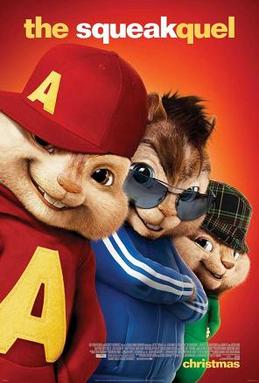
Alvin and the Chipmunks: The Squeakuel
2009
Directed by Betty Thomas
Welcome back to Movie Monday. Before we go any further, the standard disclaimer applies: everything that follows is my own opinion, shaped entirely by my own experience with this film, and none of it is meant as a criticism of anyone who watched The Squeakquel and genuinely enjoyed it. You are allowed to enjoy things. Cinema is subjective. Children’s entertainment especially so. If this movie brought your family joy, that joy is real and yours to keep. We good? Good.
Because I have some things to say about chipmunks.
A Little Context First
I want to be transparent about something before I start in on this one, because it’s relevant to how I’m framing it: I actually loved Alvin and the Chipmunks as a kid. Not in a casual, background-noise sort of way. I mean the animated series, the specials, the whole universe of it. And particularly The Chipmunk Adventure — the 1987 animated film that sent Alvin, Simon, Theodore, and yes, the Chipettes, around the world in a hot air balloon race against each other while someone used them as international diamond smuggling couriers, because apparently the 1980s had a different threshold for what constituted appropriate stakes in children’s entertainment.
The Chipmunk Adventure is legitimately good. It has a propulsive plot, actual character moments, songs that hold up, and a genuine sense of fun that doesn’t condescend to its audience. I watched it on repeat as a kid. I still have warm feelings for it.
I say all of that to establish that my issues with the live-action Chipmunks franchise are not rooted in indifference to the source material. If anything, they’re rooted in affection for it. When the 2007 live-action reboot arrived, I found it tolerable — not exactly good, but serviceable enough, carrying a certain amount of goodwill from the franchise’s legacy. It got by on recognizable characters and nostalgia more than on its own merits, but I wasn’t going to call it a crime against cinema.
The Squeakquel, on the other hand.
How I Came to See This Film
I saw The Squeakquel in what is, now that I think about it, probably the ideal environment for watching a film of this particular caliber: one of those second-run movie theaters that also serves dinner while the movie plays. You know the ones. Dim lighting. Slightly sticky menus. The ambient sound of people ordering mozzarella sticks in the middle of a film. I was there with a family I was friends with at the time, a couple with young children who were absolutely the target demographic for what we were about to experience, which is to say they were thrilled, and I was along for the ride.
In fairness, the children enjoyed themselves tremendously. They laughed at all the right moments. They were invested in the romantic subplot between Simon and Jeanette in the way only small children can be invested in cartoon rodents falling in love. They left happy. So in the narrow, utilitarian sense of “did this film accomplish its stated mission for its intended audience,” I suppose the answer is yes.
For the rest of us, though? I sat in that dim theater eating whatever I ordered — I genuinely cannot tell you what it was — and watched this movie unfold with the slowly dawning realization that this was going to be a long eighty-eight minutes.
The Setup: Now With More Chipmunks
The Squeakquel picks up two years after the first film, and it opens by doing the one thing that the franchise absolutely needed to do: it sidelines Jason Lee almost immediately. Dave Seville is injured at a charity concert in Paris when a cardboard cutout of Alvin sends him flying across the stage, which is the kind of thing that happens in this universe, apparently. He spends most of the film recovering in a French hospital, which means the task of shepherding our three CGI chipmunks through the next eighty-odd minutes falls to Toby, Dave’s cousin and Jackie’s grandson, played by Zachary Levi.
This is, to be clear, not a criticism of Zachary Levi. Zachary Levi is a genuinely likable performer who has done good work in things that gave him good work to do. Toby is not good work. Toby is a twenty-something man-child who is bad at responsibility and vaguely befuddled by the existence of chipmunks, and his arc consists of becoming slightly less bad at responsibility by the end of the film. He is a placeholder. He is an empty chair wearing a flannel shirt.
Meanwhile, the Chipmunks are enrolled in high school. Alvin, Simon, and Theodore attend West Eastman High School, which is the kind of fictional institution that exists in movies solely to provide a setting where adults can ignore children for extended periods without anyone questioning it. The school has a music program that needs saving, because there is apparently a law that requires every family film set in a school to include a music program that needs saving, and the Chipmunks are recruited to help raise money through a competition.
And then the Chipettes arrive, mailing themselves in a FedEx package, which is the introduction they deserved.
The Chipettes: More Is Less
Here’s the thing about the Chipettes: they’re not the problem, exactly. As concepts go, they’re fine. In The Chipmunk Adventure, they worked because the film gave them genuine agency and something to do beyond being counterparts to the Chipmunks. Brittany, Jeanette, and Eleanor were characters in that film.
In The Squeakquel, they are plot devices.
They arrive, they are manipulated by the film’s villain into opposing the Chipmunks, they eventually figure out they’ve been manipulated, and they join forces with the Chipmunks for a triumphant finale. There is the skeleton of a real story there — three girls who’ve been lied to about the people they’ve been set against, who have to decide whether to trust their own judgment over what they’ve been told. Christina Applegate, Amy Poehler, and Anna Faris voice them, which is a genuinely impressive collection of comic talent, and there are brief moments where you can see what a better script might have done with these characters and these performers.
But the film doesn’t really want to develop the Chipettes as characters. It wants to deploy them as a gimmick — more chipmunks, more chaos, more opportunities for the kind of squeaky-voiced pop song covers that the first film proved audiences would pay to hear. Doubling the cast of animated rodents does not double the heart of the film. If anything, it dilutes it, spreading whatever modest character work the story is doing across six subjects instead of three and doing none of them particularly well as a result.
Brittany gets the lion’s share of attention, to the detriment of Jeanette and Eleanor, who are present but barely. Jeanette has a subplot involving Simon that the movie keeps interrupting itself to return to without ever actually developing, and Eleanor exists almost entirely to be round and sweet and occasionally visible in the background. Amy Poehler is one of the funniest people alive. She voices a chipmunk who has approximately four lines of substance. This is a waste on a scale that deserves its own category.
David Cross and the Villain Problem
The returning villain, Ian Hawke, is played by David Cross, and I will grant you that David Cross is working harder than this film deserves. Ian is a disgraced music executive living in the basement of the company that fired him, subsisting on whatever he can scavenge and plotting his comeback with the particular desperation of a man whose entire identity was tied to a professional success he no longer has. That’s actually a moderately interesting character. That could go somewhere.
Where it goes is: he finds the Chipettes and lies to them about the Chipmunks and tries to use them to resurrect his career, then locks them in a cage when they won’t cooperate, and is eventually humiliated. The end.
David Cross commits to the humiliation aspects with an admirable lack of self-consciousness. He is put in situations that are undignified and he is undignified in them, and that professionalism counts for something. But Ian Hawke is not a villain who creates genuine stakes. He is an obstacle with a motive, which is a different and lesser thing, and the film’s climax — in which he chases the Chipmunks in a remote-control toy helicopter — is the kind of conclusion that makes you realize the script was never headed anywhere more interesting than this.
The High School Problem
Setting this film in high school was a choice, and I have questions about it.
The Chipmunks are, canonically, small children. Or they are the emotional and behavioral equivalents of small children. The film doesn’t take a firm position on exactly how old they are, which is sensible, because committing to any specific answer would create problems. What is not sensible is putting them in a high school environment where the primary social dynamics involve popularity, athletics, romantic attraction, and the kind of adolescent status anxieties that are the vocabulary of teen movies rather than children’s films.
The Squeakquel wants to be both things simultaneously. It wants to appeal to small children with its slapstick and its talking animals and its bright colors, and it wants to traffic in high school movie tropes with its jock bullies and romantic subplots and cafeteria social hierarchies. These are not incompatible goals, necessarily, but accomplishing both requires more craft and commitment than this film is prepared to bring. What you get instead is a film that feels tonally unmoored — too adolescent for its youngest viewers to fully engage with and too childish for its older ones to take seriously.
The jock bullies who antagonize the Chipmunks early in the film are introduced, defeated, and essentially forgotten. Alvin joins the football team and becomes popular and then learns a lesson about priorities that the film renders with the depth of a fortune cookie. Theodore befriends a meerkat family at the Los Angeles Zoo, which happens, which is a real subplot that exists in this film. Simon falls for Jeanette. The music competition is won. Dave comes home.
It is ninety percent plot mechanics and ten percent movie.
The Comparison That Can’t Be Avoided
I keep coming back to The Chipmunk Adventure, and I realize that’s not entirely fair — a 2009 Hollywood production shouldn’t necessarily be held to the standard of an animated film from 1987. Different eras, different budgets, different intentions.
But here’s the thing: the intentions are actually pretty similar. Both films are trying to entertain children with beloved animated chipmunk characters on an adventure. Both films involve the Chipettes. Both films have musical performances. The raw materials are comparable.
The Chipmunk Adventure worked because someone cared about the story being told and the characters telling it. The Squeakquel works, to the extent it works, because there is a built-in audience for chipmunks covering pop songs, and that audience was still showing up in 2009 — $443 million at the worldwide box office confirms that much. But box office success and quality are different measurements. The fact that audiences came does not mean the film earned them. It means the brand recognition was strong enough to survive the film.
The live-action franchise, taken as a whole, represents a kind of institutional failure of imagination: here are beloved characters, here is a loyal audience, here is a production budget. Now what? The first film muddled through on charm. The Squeakquel coasted further on that established goodwill and discovered, or should have discovered, that goodwill has limits.
What Doesn’t Work, and What Almost Does
I want to be fair here, because fairness is part of the deal.
The Chipettes’ refusal to perform individually — Brittany’s insistence that they perform together or not at all — is a small, genuine moment of character. The animation on the chipmunks themselves is technically impressive in a way that is easy to take for granted. And there is, buried somewhere under the accumulated obligations of sequel-making, the outline of a real story about trust, responsibility, and what it means to be a family you chose rather than one you were assigned. Those themes are there. They just never get developed with the care they’d need to actually land.
The cast is, on paper, remarkable. Jason Lee, David Cross, Zachary Levi, Christina Applegate, Amy Poehler, Anna Faris. These are talented people. In a film that had something to say and a real interest in saying it, this cast could have been something. Instead, they are furniture — pleasantly arranged, occasionally functional, ultimately incidental to a film that was always going to be about chipmunks singing pop songs rather than about anything.
The Verdict
The Squeakquel lands at number 21 on this list for the same reason Mr. Nanny landed at number 22: it is a film that had everything it needed to be at least genuinely entertaining and chose, at virtually every decision point, to be merely sufficient. It is not a catastrophe. It is not incompetent. It is not even particularly memorable, which is perhaps the harshest thing I can say about it.
The chipmunks squeak. The songs are recognizable. The children in the audience will find it acceptable. The adults with them will check their watches.
My younger self, who watched The Chipmunk Adventure with genuine delight and quoted it for years afterward, deserved better than what this franchise became. So did the Chipettes, honestly. So did Amy Poehler.
Number 21. Mildly inoffensive. Thoroughly forgettable. Ninety minutes of my life spent in a dinner theater with a side of whatever I ordered, which I still cannot remember, which tells you something about the staying power of both.
Next Time on Movie Monday
We are heading into number 20 next week, and after surviving small children laying traps for a professional wrestler and CGI rodents covering Billboard hits, we are apparently headed somewhere with a completely different kind of chaos. We’re going to Beverly Hills, where a troop of socialite Girl Scouts is attempting to earn merit badges and save their chapter, and where the fashion is considerably better than the filmmaking. Troop Beverly Hills arrives next Monday — bring your sash, leave your expectations at the door, and for the love of all that is good, do not let Shelley Long near the camping equipment.

