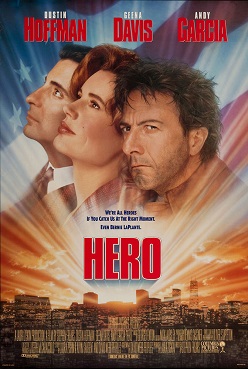
Hero
1992
Directed by Stephen Frears
Welcome back to Movie Monday, where we continue the slow, occasionally painful march down my personal ranking of cinematic disappointments. We’re at number 29 now, which means we’re creeping up the list toward films that are, theoretically, slightly less bad than the ones below them. That’s the deal with this series: it’s not about hatred. It’s not about mockery. It’s about reckoning — honestly and maybe a little sadly — with movies that didn’t quite work, for whatever reason, and ended up sorted toward the bottom of my Flickchart rankings through years of head-to-head comparisons.
Number 29 is Hero.
And if your reaction to that is “what’s Hero?” — well. That reaction is, itself, part of the story.
How It Ended Up Here
I caught Hero the way a lot of early-nineties films entered my life: on cable, sometime after the fact, without much ceremony or fanfare. There was no theatrical experience, no anticipation, no specific memory of choosing to watch it. It was just on. I watched it. It ended. And then, sometime later, when Flickchart asked me to rank it against other films I’d seen, I found myself repeatedly — and without much anguish — clicking the other option.
That’s actually the most honest summary of why Hero lands at number 29: not because it’s memorably terrible, not because it committed any particular sin against cinema, but because it consistently lost when matched up against other movies. It’s the kind of film that, when it appeared in a comparison, made me think, “Oh. Right. That one.” And then choose something else.
The Flickchart methodology is worth explaining briefly for new readers. The rankings aren’t assigned arbitrarily — they emerge from thousands of head-to-head comparisons, movie against movie, building a picture of what I actually think about films through accumulated instinct rather than deliberate scoring. The system is brutally honest in ways that conscious criticism sometimes isn’t. You can talk yourself into thinking you liked something. You cannot talk yourself into choosing it over The Shawshank Redemption when Flickchart makes you pick one.
Hero lost a lot. And honestly? I understand why.
The Setup: An Excellent Premise
Here’s the thing about Hero that makes it genuinely interesting to write about: the premise is terrific. Actually terrific. Not “fine for a studio comedy” terrific — legitimately, classically, should-have-been-a-hit terrific.
Dustin Hoffman plays Bernie LaPlante, a small-time thief and petty criminal who stumbles onto the scene of a plane crash in the middle of the night and, despite himself, starts pulling survivors out of the wreckage. It’s not heroism, exactly — or at least Bernie doesn’t experience it that way. He’s grumbling the whole time, losing a shoe in the mud, and before he leaves, he steals the purse of Gale Gayley (Geena Davis), a television reporter who was on the plane and whom he just saved. Then he flags down a stranger — John Bubber (Andy García), a homeless Vietnam veteran — and mentions what he did, leaving John with his other shoe as a sort of accidental calling card.
When Gale’s news station offers a million dollars to find the “Angel of Flight 104,” John steps forward, presents the shoe as evidence, and tells Bernie’s story as his own. Bernie, conveniently, is in jail at the time and can’t claim the reward. And so the wrong man becomes the hero — a genuinely decent man, as it turns out, who uses his fame and his million dollars to help sick children and the homeless — while the real hero rots in a holding cell and tries, with increasing desperation, to convince anyone who will listen that something has gone wrong.
There are echoes here of Frank Capra’s Meet John Doe and the Preston Sturges tradition of screwball comedies about public perception and manufactured heroism. Critics noticed the connections in 1992, and they were right to. This is a story with real satirical DNA — about celebrity culture, about the gap between image and reality, about how desperate we are to have heroes even when the person filling that role is, essentially, a construction. The premise asks genuinely interesting questions. What makes someone a hero? Does intent matter if the outcome is good? Can a fake hero do real good?
Those are good questions. Hero doesn’t entirely ignore them. It just also doesn’t entirely answer them, or push on them with much urgency, or do very much with the satirical premise that made the whole thing worth setting up in the first place.
What Goes Wrong
The kindest way to describe Hero is that it is a film in which nothing quite clicks. Not catastrophically — there’s no single scene that collapses into disaster, no moment where the film goes irreparably off the rails. It’s more that every element that should land with precision lands a little soft instead, and the cumulative effect of all those slightly-off landings is a movie that feels oddly inert for something with this much going on.
Dustin Hoffman is genuinely committed to Bernie LaPlante, which is both the best and most frustrating thing about the film. Bernie is meant to be a lovable reprobate — a man whose worst impulses are constantly at war with some buried decency he’d rather not acknowledge — and Hoffman attacks the role with the full-tilt energy he brought to Tootsie and Rain Man. The performance is, technically, a lot. Bernie fidgets, wheedles, mumbles, negotiates, slips, and scrambles through every scene with the frantic energy of a man who has been caught doing something wrong and has decided the best defense is forward motion.
The problem is that Bernie, as written, isn’t quite as interesting as the performance. Hoffman is doing the work of two actors — playing the character and generating the charisma the character needs but doesn’t entirely have on the page. There are moments where you can see the movie he was trying to make: a sharper, meaner, funnier film about a genuinely unpleasant man forced to confront the better version of himself that accidentally existed for one night. But the screenplay keeps pulling Bernie back toward likability before he’s earned it, which makes the film’s eventual emotional beats feel a little unearned.
Andy García has the more interesting role and, paradoxically, less to do with it. John Bubber starts as a cipher — a man with no story of his own who borrows someone else’s — and slowly becomes something more complicated: a person who takes on a false identity and then, astonishingly, grows into it. García plays this with a quiet dignity that the film mostly doesn’t know what to do with. His John Bubber is genuinely moving in isolated moments, and then the movie cuts away to Hoffman fidgeting through another scene, and the thread gets lost.
Geena Davis is largely stuck in reactive mode as Gale Gayley, which is a shame because Davis in this era — coming off Thelma & Louise, which had come out the year before — was one of the most compelling screen presences in Hollywood. Gale has real potential as a character: a smart, driven journalist who fell in love with a story and then with its protagonist, and who has to reckon with having been wrong about both. That’s interesting! But the film treats her mostly as an audience surrogate rather than a full character, and her arc resolves too neatly to feel like it cost her anything.
And then there’s Chevy Chase, appearing uncredited as Deke, Gale’s wisecracking news director. Roger Ebert, in his review, specifically singled out Chase’s performance as the film finding “the right note” — and Ebert wasn’t wrong. Chase, ironically, is the most comfortable figure in the film. His Deke belongs to the Preston Sturges tradition the movie is nodding at: fast-talking, cynical, broadly comic in a way that fits the material. Every scene he’s in has a slightly different, slightly more alive energy. Which is its own mild indictment of the surrounding film.
The Weird Footnote You Didn’t Know You Needed
Before we move on, a brief detour that I cannot in good conscience skip.
You know the Mariah Carey song “Hero”? The one that was inescapable in 1993 and has remained a fixture of school talent shows, Olympic montages, and inspirational moments ever since? The one with the soaring bridge and the big note and the message about looking inside yourself?
That song was originally written for this movie.
Epic Records approached Carey about contributing a song to the Hero soundtrack, but her then-fiancé Tommy Mottola — CEO of Sony Music Entertainment — reportedly didn’t want her associated with film projects, worried it would harm her career. Her label had similar reservations. So instead, Carey agreed to write a song to be recorded by someone else — specifically Gloria Estefan. She and producer Walter Afanasieff wrote and demoed the song, and then, somewhere in the process, someone made the very correct decision that this was too good to give away. The lyrics were reworked slightly, Carey kept it, and it became one of the defining songs of her career and the lead single from Music Box.
Meanwhile, the film got “Heart of a Hero” by Luther Vandross, which is a perfectly fine song that approximately no one can name.
I find this footnote genuinely delightful, and a little emblematic. The movie called Hero is probably best remembered — to the extent it’s remembered at all — as the film that almost had “Hero.” The song became a classic. The film became a cable curiosity. There’s something almost too perfectly ironic about that.
The Baffling Middle
Here’s what I keep coming back to when I try to articulate why Hero sits at number 29 and not somewhere higher or lower: the movie is genuinely strange in a way that isn’t quite interesting enough to be fascinating.
Stephen Frears is a genuinely talented director. This was his second American feature, following The Grifters, and he’s proven repeatedly — with Dangerous Liaisons, with High Fidelity, with Philomena — that he can handle tonal complexity and find the human scale inside a big idea. The screenplay was written by David Webb Peoples, who the year before had written Unforgiven and who would go on to write Twelve Monkeys. These are not hacks. These are people who know what they’re doing.
And yet Hero is a film in which the comedy isn’t quite funny enough, the drama isn’t quite moving enough, and the satire isn’t quite sharp enough for any of the three to do the work the others can’t. It’s a movie that seems to be aiming at a very specific tonal register — something like warm cynicism, or hopeful disillusionment — and keeps missing it by just enough to be noticeable.
The film’s treatment of media and celebrity, which should be its sharpest element given that it’s literally about manufactured heroism in the age of television news, is blunter than the premise deserves. The jokes about the press pack and the hero industry have targets that are real and worth hitting, but they’re painted in such broad strokes that they stop being satirical commentary and start being ambient noise. Nothing in the media satire has any bite. No one in the news world suffers any consequences for their credulity or their construction of a false hero. The film seems vaguely interested in the idea that celebrity is hollow and the press is complicit in manufacturing it, but not interested enough to actually do anything with that idea.
What you’re left with is a film that keeps gesturing at depth without quite committing to the dive. Which is, again, more bemusing than infuriating. You watch it and you think: I can see exactly what you were going for. I cannot figure out why you didn’t go for it.
Why Number 29
Hero lands at number 29 not because of a catastrophic failure but because of accumulated smallness. A premise that promised more than was delivered. A cast that deserved sharper material. A satirical premise that kept declining to be satirical. A tonal balancing act that never quite found the balance.
It’s not a bad film in any dramatic sense. It’s a film that is somehow less than the sum of its parts — and with parts that include Dustin Hoffman doing his full Dustin Hoffman thing, Andy García in a quietly fascinating role, Geena Davis at the peak of her career, and a screenplay by the writer of Unforgiven, those parts should have added up to something.
Instead, we got a film that most people vaguely remember as existing, if they remember it at all, and a Mariah Carey song that became immortal.
Hero needed a hero. It just never found one.
Next Time on Movie Monday
I’ll be back next Monday to continue the journey — and next week we’re moving up to number 28 with Baby’s Day Out, the 1994 John Hughes-produced comedy about an infant who crawls his way across Chicago while three hapless criminals fail spectacularly to catch him. It is exactly the movie you think it is. I have thoughts.
In the meantime, if you’ve seen Hero and think I’m completely wrong about it — if this is a deeply misunderstood gem that rewards closer attention — make your case in the comments. I’m genuinely open to being persuaded.
What do you think? Does Hero deserve better, or does it rank right where it belongs? Drop your thoughts in the comments below.
 The Confusing Middle