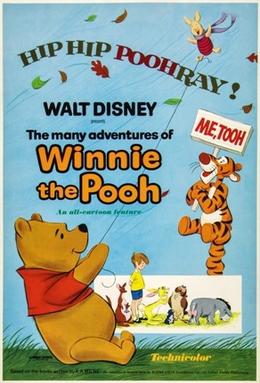
The Many Adventures of Winnie the Pooh
1977
Directed by Wolfgang Reitherman and John Lounsbery
Welcome back to Movie Monday! As we do every first Monday of the month, we’re setting aside the cinematic disasters for a palate cleanser. This month we’re visiting the Hundred Acre Wood with Disney’s 1977 compilation film The Many Adventures of Winnie the Pooh — a movie that probably doesn’t need defending, exactly, but one that deserves more thoughtful appreciation than it usually gets. It’s easy to wave it off as a charming little children’s film and move on. But I think there’s more going on here than that dismissal allows for, and I want to make the case that this modest, unassuming film does something genuinely difficult: it works equally well for children and adults, for entirely different reasons, without ever feeling like it’s trying to serve two masters at once.
That’s a harder trick to pull off than it sounds. Let’s talk about how it does it.
A Film Built from Parts — and Why That Works
The first thing to address is the film’s unusual architecture, because it’s the thing most critics lead with when they want to explain why The Many Adventures of Winnie the Pooh doesn’t quite belong in the conversation with Disney’s best. The movie is, technically speaking, not a single cohesive film at all. It’s three separately produced animated shorts — Winnie the Pooh and the Honey Tree (1966), Winnie the Pooh and the Blustery Day (1968), and Winnie the Pooh and Tigger Too (1974) — stitched together with bridging material and a new closing scene, then released theatrically in 1977. The whole thing clocks in at 74 minutes.
Critics who hold this against the film are, I’d argue, missing the point entirely. The anthology format isn’t a structural weakness. It’s a feature.
Think about how A. A. Milne’s original books actually work. Winnie-the-Pooh (1926) and The House at Pooh Corner (1928) are themselves collections of loosely connected stories, each chapter a self-contained adventure. Milne wasn’t writing a novel with rising action and a climax. He was writing a series of gentle episodes about a small bear and his friends, bound together not by plot but by place and feeling and the texture of everyday life in the Hundred Acre Wood. Pooh doesn’t have an arc in the traditional sense. He just is, and the world he inhabits is, and the stories emerge naturally from that existence.
The film’s episodic structure faithfully reproduces that experience. Each short has its own internal logic and emotional rhythm. The Honey Tree establishes the world and Pooh’s central motivation (hunny, always hunny). The Blustery Day introduces Tigger, brings us Kanga and Roo more fully, and delivers the film’s most genuinely surreal sequence — the Heffalumps and Woozles dream — alongside its most emotionally satisfying resolution, with Owl losing his house and Pooh offering his own. Tigger Too is the most thematically coherent of the three, exploring what it means to belong, to be different, and to be accepted anyway.
What the bridging material adds — and this is clever — is a layer of meta-narrative that ties everything together. The Narrator isn’t just a storytelling device. He’s a character. Pooh talks to him. Pooh reads his own story in the book on screen. Characters walk across the text of the page they’re printed on. The film is explicitly aware that it is a film, that it is an adaptation, that there’s a book and a child reading it somewhere behind all of this. That self-awareness doesn’t undermine the emotion. It deepens it — because it frames everything as an act of imagination and love, the way all great children’s literature is ultimately an act of imagination and love between an author and a child.
The Voice of the Hundred Acre Wood
Any serious discussion of this film has to center on Sterling Holloway, whose voice performance as Winnie the Pooh is one of the most perfectly cast roles in Disney’s history. Holloway had one of the most distinctive voices in American entertainment — that slow, slightly befuddled, honey-warm tenor that sounds perpetually on the verge of either a revelation or a nap. He’d voiced characters for Disney going back to the 1930s, but Pooh was his masterpiece. He found the exact right register for a bear of very little brain: not stupid, not childlike exactly, but operating on a different frequency than the rest of the world. Pooh’s logic is internally consistent and deeply sincere. He’s not confused about the world so much as he’s engaged with it on his own terms.
The supporting cast is equally strong. John Fiedler’s Piglet is anxious and sweet without becoming grating — a difficult balance, since Piglet’s defining characteristic is timidity, and timidity is easy to make annoying. Fiedler plays him as genuinely brave underneath the anxiety, which is exactly right. Piglet keeps showing up and trying even when he’s terrified, and that makes him a more interesting character than his nervous exterior suggests.
Paul Winchell as Tigger is pure kinetic energy in voice form. Tigger arrives in the Hundred Acre Wood like a small explosion and never really stops bouncing, and Winchell captures that perfectly — the enthusiasm that hasn’t yet learned to consider consequences, the bluster that masks a surprisingly deep need to belong. His arc in Tigger Too is legitimately moving, and it works entirely because of Winchell’s ability to modulate the character’s energy without losing what makes Tigger Tigger.
Ralph Wright’s Eeyore deserves his own paragraph. Eeyore is one of literature’s great comic creations — a character whose defining pessimism is played not for pathos but for dry, self-aware humor. The joke is never at Eeyore; the joke is always with him, because Eeyore knows exactly what he is and has made a kind of peace with it. “Thanks for noticin’ me” is a line that manages to be funny and a little heartbreaking at the same time, and Wright delivers it with exactly the right combination of resignation and wry acceptance.
Sebastian Cabot as the Narrator rounds out the ensemble, and his role is bigger than it might initially appear. A warm, slightly theatrical British narrator might have created distance between the audience and the story. Instead, Cabot’s voice feels like a fireplace — you settle into it. And when Pooh interrupts him, or ignores him, or the story diverges from what he’s describing, the Narrator’s exasperated affection for these characters becomes its own kind of running joke.
The Songs That Live in Your Head Forever
The Sherman Brothers — Richard and Robert — wrote the songs for all three shorts, and they did what the best film songwriters do: they made songs that feel inseparable from the characters who sing them, as if those characters couldn’t possibly express themselves any other way.
“Winnie the Pooh,” the main theme, is deceptively simple. It’s a lullaby dressed as an introduction, and it does more atmospheric work in two minutes than most film scores manage in ninety. It tells you exactly how to feel about this world before you’ve seen a single frame of it. Gentle. Warm. A little whimsical. Safe.
“Up, Down, Touch the Ground” and “Rumbly in My Tumbly” are essentially Pooh’s interior monologue set to music, and they nail the character — the physical, uncomplicated, contented relationship with hunger and satisfaction that defines him. Food is not a metaphor for Pooh. Hunny is just hunny, and wanting it is enough.
“The Wonderful Thing About Tiggers” is one of those songs that exists in a category with “Bare Necessities” and “Hakuna Matata” — the kind of song that articulates a philosophy of life so simply and so memorably that you can’t quite shake it. Tiggers are wonderful things, and they know it, and the song announces that with such unguarded delight that it’s impossible not to be charmed by it.
But the crown jewel, emotionally speaking, is “The Rain, Rain, Rain Came Down, Down, Down,” which plays over the flood sequence in The Blustery Day. It’s a seemingly minor song, but it creates something remarkable — a sense of cozy catastrophe, of small creatures enduring big weather with good humor and improvisation. It’s the musical equivalent of putting on a blanket when the power goes out.
What Milne Actually Wrote (And How Much of It Survived)
For a film that takes considerable liberties with its source material, The Many Adventures of Winnie the Pooh is surprisingly faithful to the spirit of what Milne created. Gopher, notably, doesn’t appear in the books at all — he was invented specifically for the films because Disney wanted an American character to appeal to domestic audiences. It’s the most obvious addition, and the one most Pooh purists object to. The complaint is fair, though Gopher’s role is small enough that he doesn’t fundamentally alter the ecosystem of the Hundred Acre Wood.
What the film gets right — and this matters — is Milne’s underlying emotional intelligence. The books are about friendship and acceptance and the particular melancholy of childhood ending. They’re funny and light on the surface, but there’s real weight underneath, and the film finds it. The closing scene, adapted from the final chapter of The House at Pooh Corner, is the most direct evidence of this. Christopher Robin must leave the Hundred Acre Wood to start school. He and Pooh say goodbye. The Narrator assures us that wherever Christopher Robin goes, Pooh will always be waiting.
It’s a scene about the end of childhood. About how the imagination that makes a stuffed bear come alive doesn’t survive intact into adulthood. About the love between a child and the inner world they created, and what it means to leave that world behind. For the children watching, it’s probably just a sweet goodbye. For the adults watching, it hits entirely differently — because they’ve already left. They know what it costs.
That the film earns that moment is a testament to everything that came before it. The anthology structure, far from undercutting the emotional climax, actually makes it more powerful. We’ve had 74 minutes of small adventures, of getting lost and found, of being stuck in rabbit holes and bounced by Tiggers and flooded out of small houses. We’ve had time to love this place and these creatures the way Christopher Robin loves them. So when he has to leave, we feel it too.
The Case for Children’s Films That Respect Their Audience
Here’s the argument I want to make, and it’s the one I think this film most clearly demonstrates: a great children’s film doesn’t simplify its emotional content. It finds the emotional content that children and adults can access simultaneously, from different angles. Children experience The Many Adventures of Winnie the Pooh as a warm, funny, safe adventure with characters they recognize as versions of people they know — the anxious friend, the bouncy friend, the gloomy friend, the reliable friend who always has honey. Adults experience the same film as a meditation on imagination, friendship, and loss.
Neither reading is wrong. Neither reading is the “real” one. The film contains both, and the fact that it does so without condescension in either direction is what elevates it above the merely pleasant.
The Many Adventures of Winnie the Pooh holds a 100% rating on Rotten Tomatoes, which is either a testament to its quality or a reflection of the fact that nobody wants to be the critic who kicked Pooh. I’d like to think it’s the former. The critical consensus calls it “perhaps the most faithful of Disney’s literary adaptations,” and on the question of spirit — if not strict plot — that’s exactly right.
Is it Disney’s greatest film? Not even close. It lacks the visual ambition of Sleeping Beauty, the narrative drive of Cinderella, the darkness of Bambi. It’s a small film. It’s deliberately, proudly small. It’s the size of a child’s imagination on a quiet afternoon, which is exactly the size it needs to be.
And that, it turns out, is more than enough.
What are your memories of the Hundred Acre Wood? Do you revisit this one as an adult, and does it hold up for you? And is there any Disney film from the so-called “Dark Age” of the ’70s that you think deserves more credit than it gets? Let me know in the comments. Next Monday we return to the regularly scheduled disasters — and trust me, we’ve got a good one.
 The Confusing Middle