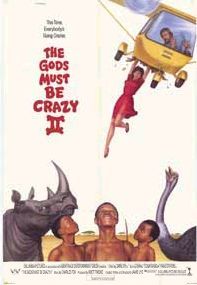
1989
Directed by Jamie Uys
Welcome back to Movie Monday, where we continue the long, winding journey through my personal list of cinematic disappointments. As always, the standard disclaimer applies: this list is entirely subjective, shaped by my own experiences and tastes. If The Gods Must Be Crazy II holds a special place in your heart—if you found the parallel storylines charming, if the slapstick comedy landed perfectly for you, if N!xau’s performance moved you in ways I clearly failed to appreciate—I’m genuinely not here to take that from you. I’m just here to explain why, for me, this 1989 sequel represents the particular heartbreak of watching something good get a lesser version of itself.
This week brings us to number 31 on the list: The Gods Must Be Crazy II, a film that looked at a beloved, quirky, internationally successful original and decided the best thing to do was make it again, but slightly worse.
A Western Civ Education Like No Other
There’s something genuinely strange about sitting in a 10th grade Western Civilization class and watching The Gods Must Be Crazy. Western Civ, as the name implies, is supposed to be the sweeping story of Western cultural development—ancient Greece, Rome, the Renaissance, the Enlightenment, the rise of nation-states, all of that. It is not, traditionally, a course that concludes with a Kalahari bushman chasing a Coke bottle toward the edge of the world.
And yet, there we were.
I honestly don’t know how this movie fit into the curriculum. Looking back, I can construct some rationale—something about cultural relativism, or the collision between industrial civilization and indigenous peoples, or perhaps just an object lesson in how the things we take for granted (a glass bottle, for instance) carry enormous weight when seen through different eyes. These are not unreasonable themes for a Western Civ class to explore.
Or maybe Mr. Salo just liked the movie and wanted an easy couple of days. I was fifteen. I wasn’t exactly analyzing the pedagogical motivations of my teachers.
What I do know is that when we watched the original The Gods Must Be Crazy, something genuinely interesting was happening on screen. There’s a reason that film became an international phenomenon—a reason it broke box office records across multiple countries, became the highest-grossing foreign film ever released in the United States at the time, and still gets referenced and discussed decades later. It had a clever concept, genuine wit, and a sweetness to it that was hard to resist. Even as a tenth-grader who had no particular interest in South African cinema or Kalahari bushmen, I was entertained.
Then we watched the sequel.
When the Magic Doesn’t Transfer
The original Gods Must Be Crazy works because it has a genuinely brilliant central premise. A Coca-Cola bottle, dropped from a plane, lands in the middle of the Kalahari Desert. To the San people—who have no concept of property, no understanding of manufactured goods, no framework for comprehending where such a thing came from—the bottle is clearly a gift from the gods. And it causes nothing but trouble. The simplicity of that setup, and the elegance of using one everyday object as a lens to examine the absurdity of modern civilization, gives the film a thematic spine that holds everything together.
The Gods Must Be Crazy II doesn’t have a central premise with that kind of resonance. Instead, it has four storylines running in parallel: N!xau (now renamed Xixo, for reasons the film doesn’t really explain) searching for his lost children; two elephant poachers whose truck his children have accidentally hitched a ride on; a zoologist and a lawyer stranded in the desert after a plane crash; and two soldiers—one Cuban, one Angolan—who keep stumbling across each other in the middle of nowhere, each trying to take the other prisoner.
These storylines eventually converge, in the way that parallel storylines in movies always eventually converge, but the convergence feels more like a screenwriting obligation than an organic conclusion. The original film’s storylines also braided together, but they did so in service of a point—the collision between Xi’s world and the world of modern civilization was the whole thematic project of the film. In the sequel, the various plots intersect mostly because movies have to end somewhere.
Roger Ebert—who liked the sequel, for the record—noted that the original was the better film while still giving the sequel a positive review. Ebert’s praise was for director Jamie Uys’s patient craftsmanship, his willingness to build elaborate physical comedy over long stretches of screen time. And to be fair, there are moments in The Gods Must Be Crazy II where that patience pays off. The animal sequences in particular have a genuine charm. Uys clearly loved the natural world of the Kalahari and had a gift for capturing animals doing unexpectedly funny things.
But charm in isolated moments isn’t the same thing as a film that works as a whole. And The Gods Must Be Crazy II, for me, never quite coheres into something that earns its place as a sequel to a film that genuinely did something special.
The Soldiers as Symptom
Let me spend a moment on the soldiers subplot, because I think it illustrates something important about why the sequel falls short.
The original film had a band of guerrillas as its antagonists—and yes, the film’s treatment of those characters attracted significant criticism. Writers and scholars noted that the guerrillas in the original were depicted as bumbling, dangerous African men who were ultimately disarmed and neutralized, in ways that some critics argued reinforced rather than challenged the racial myths of apartheid-era South Africa. It’s a legitimate criticism, and it’s worth sitting with even if your interest in the film is primarily as entertainment.
In the sequel, the soldiers subplot is designed to be lighter—more comic than threatening. The Cuban soldier Mateo and his Angolan enemy Timi spend the film circling each other in a kind of hapless Mexican standoff, repeatedly attempting to capture one another before eventually reaching an uneasy peace. The intent, clearly, is to treat the Angolan civil war with a kind of winking acknowledgment—yes, there’s a war nearby, but look how absurd war is when you zoom in on these two particular soldiers who can’t seem to get anything right.
The problem is that the Angolan civil war was not a comedic premise. The conflict that was raging as this film was made had been ongoing for over a decade and would continue for another decade and a half. Hundreds of thousands of people had been displaced or killed. Treating it as the backdrop for slapstick misadventure requires either a very particular kind of satirical intent—the kind that uses absurdity to expose the horror beneath—or a certain blithe unawareness of what’s actually being invoked.
The Gods Must Be Crazy II doesn’t appear to have that satirical intent. It just wants the soldiers to be funny obstacles. Whether that works for you probably depends on how much you’re willing to let the film’s cheerful obliviousness slide.
The Sequel Problem
There’s a broader issue here that goes beyond the specifics of this particular film, and it’s something that second installments in unexpected-hit franchises run into all the time. The original Gods Must Be Crazy succeeded partly because it was a surprise. Nobody had seen anything quite like it. The combination of Kalahari landscape, San cultural perspective, physical comedy, and gentle social observation was genuinely novel.
A sequel, by definition, cannot be novel in the same way. The best sequels find a way to expand on what made the original interesting—to use the established world and characters as a foundation for taking things somewhere new. The worst sequels just reassemble the original’s components and hope the familiarity is enough.
The Gods Must Be Crazy II is closer to the latter category. Xixo is separated from family members (his children this time, rather than his tribe’s treasured object) and must make a long journey to retrieve them. Along the way, he crosses paths with various Western characters who are baffled by the desert environment and its customs. The formula is the same. The novelty is gone.
N!xau himself is still a presence worth watching. There’s a quality to his performance—a kind of patient, unhurried physicality—that the camera responds to naturally. He doesn’t need dialogue to be interesting, and Uys was smart enough to know that and let the performance breathe. But N!xau alone can’t carry the weight of a film that doesn’t give him anything new to do.
The parallel characters—the zoologist Stephen Marshall and the lawyer Ann Taylor, stranded and bickering and gradually falling for each other—occupy the same structural slot as the biologist and schoolteacher in the original. The romantic comedy beats are familiar. The desert mishaps are familiar. Even the comedic use of sped-up footage, which Variety pointed out in their review, starts to feel like a crutch rather than a creative choice.
What made the original surprising was that you didn’t know where it was going. The sequel’s path is visible almost from the beginning.
The Parts That Work (And Why They Aren’t Enough)
In the interest of fairness, let me acknowledge what The Gods Must Be Crazy II does reasonably well.
The animal sequences are genuinely fun. Uys had a gift for filming wildlife in ways that found comedy without cruelty, and the scenes where animals interact with the human storylines have a lightness to them that’s hard to dislike. A scene involving a lion and the two stranded protagonists has the kind of physical comedy timing that Uys was known for—setup, escalation, release—and it works.
The Kalahari itself remains beautiful on screen. Cinematographer Buster Reynolds, who shot both films, captures the landscape in ways that make the desert feel vast and strange and alive. Whatever criticisms you might have of the story, you can’t deny that the film looks like a real place, full of real wonder.
And Xixo, as I mentioned, is worth watching. His reunion with his children at the end of the film has a warmth that’s genuinely affecting if you’ve spent the movie with him. The emotional payoff isn’t nothing.
But here’s the thing about a sequel that does some things reasonably well while falling short of the original: it doesn’t succeed on its own terms, and it doesn’t live up to what you already know is possible. You’re not watching something that surprises you. You’re watching something that reminds you of a better version of itself. And that, more than any specific flaw, is the core of why The Gods Must Be Crazy II earns its spot at number 31.
The Deseret News review I came across put it well—the film is “a pretty good movie in its own right,” but it was “ultimately doomed to fail” to equal the surprise success of the original. I think that’s right, as far as it goes. As a standalone film, it’s inoffensive and occasionally charming. As a sequel to The Gods Must Be Crazy, it’s a reminder of how rarely lightning strikes the same place twice.
Why Number 31
The Gods Must Be Crazy II lands at number 31 on my worst movies list not because it’s a catastrophe—it isn’t—but because of how specifically it disappoints. It takes a film I genuinely enjoyed, one that stuck with me enough that I still remember watching it in a 10th grade classroom, and it offers a slightly thinner, slightly more tired version of the same experience.
There’s a particular kind of disappointment that comes from sequels that don’t need to exist, and this is one of them. The original Gods Must Be Crazy told a complete story with a satisfying ending. Xi threw the bottle off the edge of what he believed was the world and went home. That was enough. That was exactly enough.
The sequel’s existence doesn’t ruin the original—nothing can do that—but it does remind you that the original’s success was at least partly a matter of timing, novelty, and a specific kind of inspired weirdness that can’t really be manufactured twice. Sometimes a film is what it is because of the conditions that made it, and those conditions don’t replicate.
Jamie Uys was a skilled craftsman who built funny things with patience and care. The original Gods Must Be Crazy is proof of that. But even skilled craftsmen sometimes build things that don’t need to be built. The Gods Must Be Crazy II is one of them.
Next Week on Movie Monday
Join me next Monday when we continue down the list with number 30 — a film that I fully expect will put me in hot water with its surprisingly passionate cult following. All I’ll say for now is that the babysitter is not, in fact, available to comment. Until then, may the movies you love never get sequels they don’t deserve, and may you never be stranded in the Kalahari Desert with only a malfunctioning ultralight aircraft and a lawyer for company.
What are your thoughts on The Gods Must Be Crazy II? Did you see the original and find the sequel lived up to it? Was watching it in a classroom a formative experience for you, too, or was that just Mr. Salo’s thing? Leave your thoughts in the comments below.
 The Confusing Middle